VP Mike Pence and President Nechirvan Barzani discuss security, protecting minorities
US Vice President Mike Pence and Nechirvan Barzani, President of the Kurdistan Region, spoke by telephone on Tuesday.
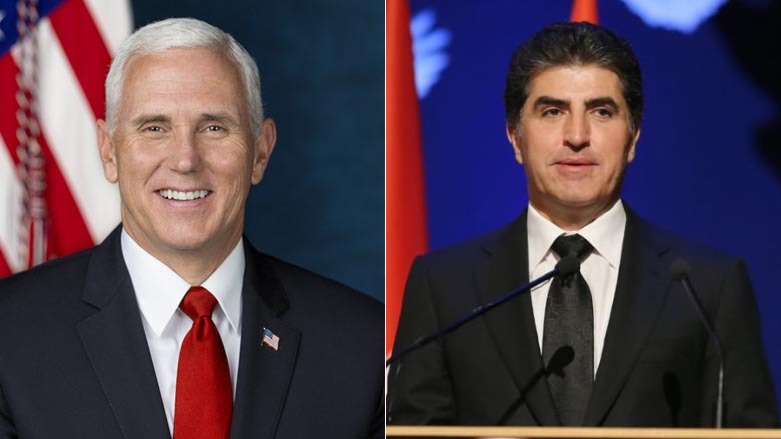
WASHINGTON DC (Kurdistan 24) — US Vice President Mike Pence and Nechirvan Barzani, President of the Kurdistan Region, spoke by telephone on Tuesday.
Leading their discussion was the “security situation in northern Iraq,” including “enhancing efforts to bring stability to the disputed territories” and facilitating the return of Iraqis to their homes, “including religious and ethnic minority communities, displaced by conflict,” a White House readout of the discussion explained.
Barzani’s office, for its part, affirmed that the Kurdish President had assured Pence that the Kurdistan Region would continue to follow its long-established policy “to protect and support the religious and ethnic components of the Kurdistan Region and work to promote a culture of coexistence.”
I had a productive phone call with @VP. We discussed our enduring partnership and joint efforts against terrorism, our concerns for the Christian and Yezidi IDPs who wish to return home, and other matters of mutual interest. He welcomed the improved Erbil-Baghdad relations.
— Nechirvan Barzani (@IKRPresident) August 27, 2019
The White House summary continued as it explained that Pence had praised Barzani and the Kurdistan Regional Government (KRG) “for providing refuge for displaced civilians and for leading Iraq’s efforts to protect those impacted by conflict,” including the Yezidi community, which five years ago this month suffered a “horrific assault” at the hands of the so-called Islamic State.
Indeed, in a recent interview with Kurdistan 24, Amb. Sam Brownback, US Ambassador at Large for International Religious Freedom, similarly praised the Kurdistan Region for its tolerance, hailing it as “an island in a sea of difficulty.”
Even with the territorial defeat of the Islamic State, the return of displaced minorities has been seriously hampered by a lack of security. “The US government,” and many others, “have invested a lot of money in rebuilding the areas destroyed by ISIS,” Brownback said. “But it won’t be sustainable in the long term, or grow, until the security issue is dealt with.”
The Barzani Charity Foundation is deeply engaged in aiding displaced persons in the Kurdistan Region. As its US representative, Delovan Barwari, similarly explained to Kurdistan 24, the fundamental obstacle to their return is a lack of security in their home areas.
In addition to the dangers posed by the resurgence of the Islamic State, elements of the Popular Mobilization Forces (PMF) pose a second security challenge. PMF units drove the Islamic State out, but now, they themselves won’t leave and often resort to abusive mafia-style tactics to extort the population.
In his discussion with Barzani, Pence “emphasized” the US “concern that Iran-backed militias continue to undermine Iraq’s security and sovereignty.” He also explained that the US was considering “additional steps to degrade” their influence.
In July, as Pence noted, the US sanctioned two PMF leaders who are responsible for gross human rights abuses in northern Iraq.
The US and Kurdish leaders also discussed the progress that has been made in talks between the KRG and the Baghdad government. Pence affirmed that the US “supports timely resolution of outstanding issues, including budget allocations and oil sales,” according to the US summary of their conversation.
Barzani noted the “improvement in the Kurdistan Region’s relations with the Iraqi federal government,” as he stressed “the readiness of the Kurdistan Region to resolve all problems with the Iraqi government through dialogue,” according to the Kurdish readout.
Finally, as the US summary concluded, the two leaders “discussed opportunities to deepen the US partnership with the Iraqi Kurdistan Region, including in the economic and security spheres.”
Editing by Nadia Riva