US says it is withdrawing forces from Syria, amid growing chaos
US Secretary of Defense Mark Esper said on Sunday that the US was withdrawing the remainder of its 1,000 troops from northeast Syria...
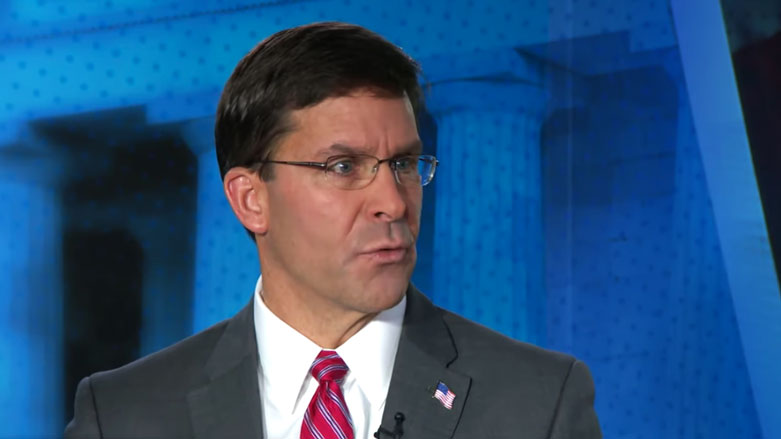
WASHINGTON DC (Kurdistan 24) – US Secretary of Defense Mark Esper said on Sunday that the US was withdrawing the remainder of its 1,000 troops from northeast Syria, four days after the Turkish assault on that territory began.
“The viability of the US mission in Syria rapidly unraveled after Turkish troops and their Syrian rebel proxies advanced deep into Syrian territory and cut US supply lines,” The Washington Post reported.
Speaking on the CBS program, Face the Nation, Esper explained that the US had been trying to broker some sort of cease-fire, but it did not appear as if Turkey would agree to it.
Indeed, as Esper stated, “In the last 24 hours we learned that they likely intend to expand their attack further south than originally planned and to the west.”
Moreover, it appeared that the Kurdish-led Syrian Democratic Forces (SDF), America’s main ally in the fight in Syria against the Islamic State, have reached an understanding with the Syrian regime and Russia to help it counter the Turkish assault.
Read More: Syrian Kurdish leader says deal reached with Damascus and Moscow
Reports of such an understanding began to emerge later on Sunday, with rumors that Syrian forces were preparing to enter the SDF-controlled cities of Manbij and Kobani and that the Syrian army was moving north to confront the Turks.
In addition, hundreds of Islamic State prisoners have reportedly escaped, while accounts of atrocities and human rights violations, committed by the Turkish forces and their Syrian militia proxy, are mounting.
Indeed, former US Defense Secretary, Jim Mattis, speaking publicly on Sunday for the first time since he resigned last December over this very issue, warned on NBC’s Meet the Press that the Turkish incursion, and lack of US response, would likely lead to the re-emergence of the Islamic State.
“We may want a war over; we may even declare it over,” Mattis said. “You can pull your troops out, as President Obama learned the hard way, out of Iraq, but the 'enemy gets the vote,' we say in the military.”
“In this case, if we don't keep the pressure on, then ISIS will resurge. It's absolutely a given that they will come back,” Mattis stated.
Over the past week, since US President Donald Trump and Turkish President Recep Tayyip Erdogan spoke on Sunday and the White House announced that it was withdrawing some troops from the immediate area of the Turkish attack, Trump has acted as if the US had no real interest in northeast Syria.
Read More: Broad opposition to Trump on Syria, including Republicans and evangelical Christians
Trump repeated that position as late as Saturday, in an address to the Values Voters Summit, an annual conference of conservative Christian activists in Washington. He described the Kurds as merely “fighting for their land,” while affirming, “I don’t think our soldiers should be there for the next 50 years guarding a border between Turkey and Syria when we can’t guard our own borders at home.”
Yet on Sunday morning, before leaving for a round of golf, and amid the growing chaos, Trump’s attitude seemed to change. In a tweet, he suggested that the US would impose “powerful sanctions” on Turkey.
Dealing with @LindseyGrahamSC and many members of Congress, including Democrats, about imposing powerful Sanctions on Turkey. Treasury is ready to go, additional legislation may be sought. There is great consensus on this. Turkey has asked that it not be done. Stay tuned!
— Donald J. Trump (@realDonaldTrump) October 13, 2019
But depending on the course of events and the understanding that has been reached among the SDF, Russia, and Syria, Trump’s threat of sanctions may prove largely irrelevant.
If Damascus and Moscow succeed in making themselves the dominant powers in northeast Syria, sanctioning Turkey may have little impact on the situation there.
“Trump has no military experience,” Paul Davis, a former Pentagon analyst and currently an instructor at The Institute for World Politics, told Kurdistan 24, and “he chose to ignore the strong advice of his military commanders.”
“Trump doesn’t understand that economic sanctions, even if they do have the desired effect, are generally slow to achieve it. But armies move a lot faster,” Davis said, and “when deployed skillfully, they achieve results a lot faster.”
Sunday’s developments are sure to generate substantial concern in Israel. It is worried, in the first instance, about an Iranian “land-bridge” to the Mediterranean, from which Tehran can resupply its proxies in Lebanon and Syria.
As long as the SDF, along with the US-led coalition, controlled northeast Syria, they were a barrier to the movement of Iran and its proxies through that territory. Now, the situation is uncertain, as both Syria and Russia are aligned with Iran.
Israelis are also concerned about a general US withdrawal from the region.
“It goes to the role of America as a superpower in the Middle East,” Amos Yadlin, a former head of Israeli military intelligence, told The Washington Post. “If the Americans leave, it’s easier for Iran, it’s easier for Bashar al-Assad, it’s easier for Hezbollah. All of these are our enemies.”