Boosting Economy: Kurdistan PM, deputy chair meeting on economic policy
Kurdistan Region Prime Minister Masrour Barzani and his deputy, Qubad Talabani, chaired a meeting on Monday to discuss policies to boost the region’s economy, a government statement said.
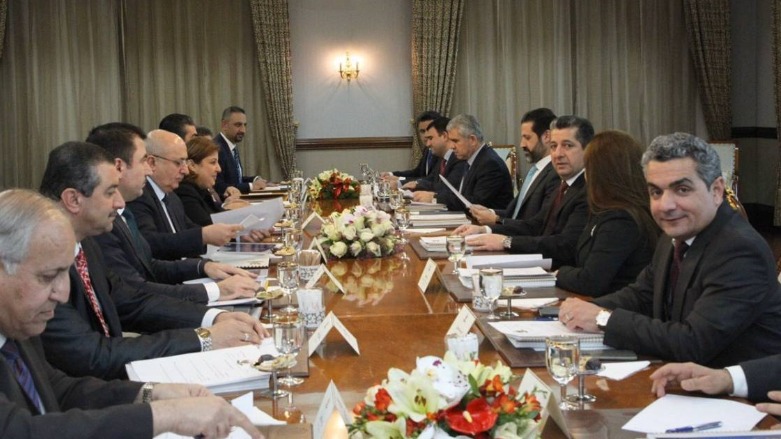
ERBIL (Kurdistan 24) – Kurdistan Region Prime Minister Masrour Barzani and his deputy, Qubad Talabani, chaired a meeting on Monday to discuss policies to boost the region’s economy, a government statement said.
The Kurdistan Region’s “Economic High Council” held its first such meeting to “discuss the financial situation in the Kurdistan Region and to seek ways to boost the economy,” the statement read. The body is made up of cabinet ministers and provincial governors.
“Prime Minister Barzani emphasized the need to establish a roadmap for economic growth with policies that will update the tax system, reduce excessive and unnecessary expenditures, and increase national revenues.”
The prime minister also reaffirmed “his cabinet’s commitment to diversifying and modernizing the economy of the Kurdistan Region to attract local and foreign investors and encourage growth in all sectors.”
Related Article: Kurdistan Region approves first steps in tax reform
In an earlier Council of Ministers gathering last week, members began the process of an overhaul to the tax system in the autonomous region, developing the framework for updating the “current auditing practices and increasing the transparency of the taxation system.”
These steps come just weeks after the regional parliament passed the Reform Bill, a government initiative that has the stated aim of establishing a “fair” pension system for public servants and workers.
Read More: Kurdistan Region parliament votes to pass landmark Reform Bill
Dealing with multiple crises, especially from 2014 onward, the Kurdistan Region’s finances became increasingly strained when the so-called Islamic State overran a large part of northern Iraq. Furthermore, relations with Baghdad deteriorated, reaching a near-breaking point in late 2017 when Iraqi troops and militias took over disputed areas in response to the region’s independence vote.
Issues such as the central government cutting the region’s share of the national budget, the influx of almost two million displaced people and refugees to the region, and the fight against the Islamic State limited funding to various projects throughout the region.
Editing by Karzan Sulaivany