Kurdish artist Zehra Doğan wins prestigious Italian award
Doğan received the award “because of the striking power of her work to translate a strongly situated experience, drawing on multiple longstanding aesthetic heritages.”
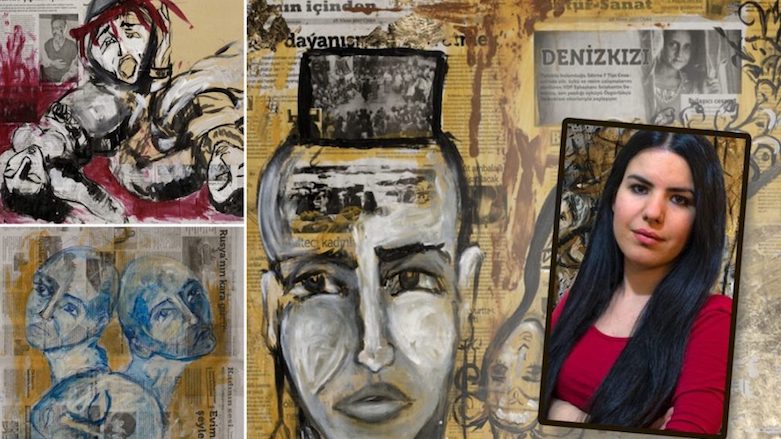
ERBIL (Kurdistan 24) – Award-winning Kurdish journalist and artist Zehra Doğan on Thursday won the newly created Carol Rama Award for her artistic work, which includes a cash prize of 5,000 euros.
In 2020, in collaboration with its sponsors and institutions, Artissima, the first contemporary art fair in Italy founded in 1994, awards five prizes for artists and galleries, assigned by international juries, including the Carol Rama Award by Fondazione Sardi per l’Arte.
The award is named after the self-taught Italian artist Carol Rama, whose paintings dealt with themes of sexuality and bodily forms. The prize is attributed to “the artist who embodies, through research and work, the ideal of unconventional female creativity and artistic freedom Carol enacted and transmitted with her works and personality.”
The jury unanimously awarded the first edition of the Carol Rama Award by Fondazione Sardi per l’Arte to Zehra Doğan “because of the striking power of her work to translate a strongly situated experience, drawing on multiple longstanding aesthetic heritages.”
Furthermore, the jury noted that both artists had a “resonance between the artists’ approaches, notably in their strategic appropriation of found materials from their immediate environment.”
Zehra Doğan was released from a Turkish prison last year after serving almost 20 months in jail for a painting that the Turkish government claimed was “terrorist propaganda.”
The artist began using materials from her prison environment, including food and even her own blood as paint and letters, milk cartons, or newspapers as her canvas.
Doğan told Kurdistan 24 that during her imprisonment, her family was always supportive of her.
“They did everything so I would not feel alone. All of my family [members] were compassionate in a collective feminist manner. I am proud of them. I was a politically active child in my family in Amed, and I have experienced underground life in such tense conditions during conflict. My art developed despite all of those limits, yet they motivated me.”
However, when she was a child, her family would sometimes feel frustrated when she continued drawing. “Where I lived there were not many opportunities for one to study art academically. It was until I grew up and traveled that one could go to university for such interest in art.”
She added that many young Kurdish women are in “similar situations, deprived of normal rights in education, and suffering from poverty and contained to the underground life. Some of these families might not be able to support their children financially in the path to studying art, especially since men and marketing art is ruling.”
“I am lucky to have made my way despite those forceful obstacles against talent and opportunities. But think of many others who are limited by external factors. Because of all of this, I would like to keep my natural essence, and remember where I come from.”
Doğan had also founded the Kurdish JINHA, Turkey’s first women’s news agency, which was shut down in 2016 by the Turkish government.
Since she left prison, Doğan has held several exhibitions abroad and left Turkey.
“I had not applied to any contest for the last award and I was not aware of it. But recently I have been active in my artistic experience in Europe and the US. Carol Rama was a successful woman… She has been against patriarchy and state oppression.”
“For me to win this award [in] her name has been an honor, and it has made me happy,” Doğan said.
Doğan added that winning awards is not a goal for her.
“I would like to continue and progress my journey to further know myself, and art is helping me for that purpose.” She added that she was not “looking to” get “more awards though I have been awarded many after my imprisonment in Turkey.”
“Especially, awards that are sponsored by state marketing do not interest me at all. The awards that I have received have been different; they are from circles that have a clear stance against the system and war.”
Editing by Khrush Najari