Kurdistan PM Barzani: KDP Has the Right to Nominate Iraq’s President, U.S. Forces Still Needed to Defeat ISIS
Kurdistan Region prime minister warns of ISIS resurgence, stresses constitutional rights of Kurds, and balanced regional relations.
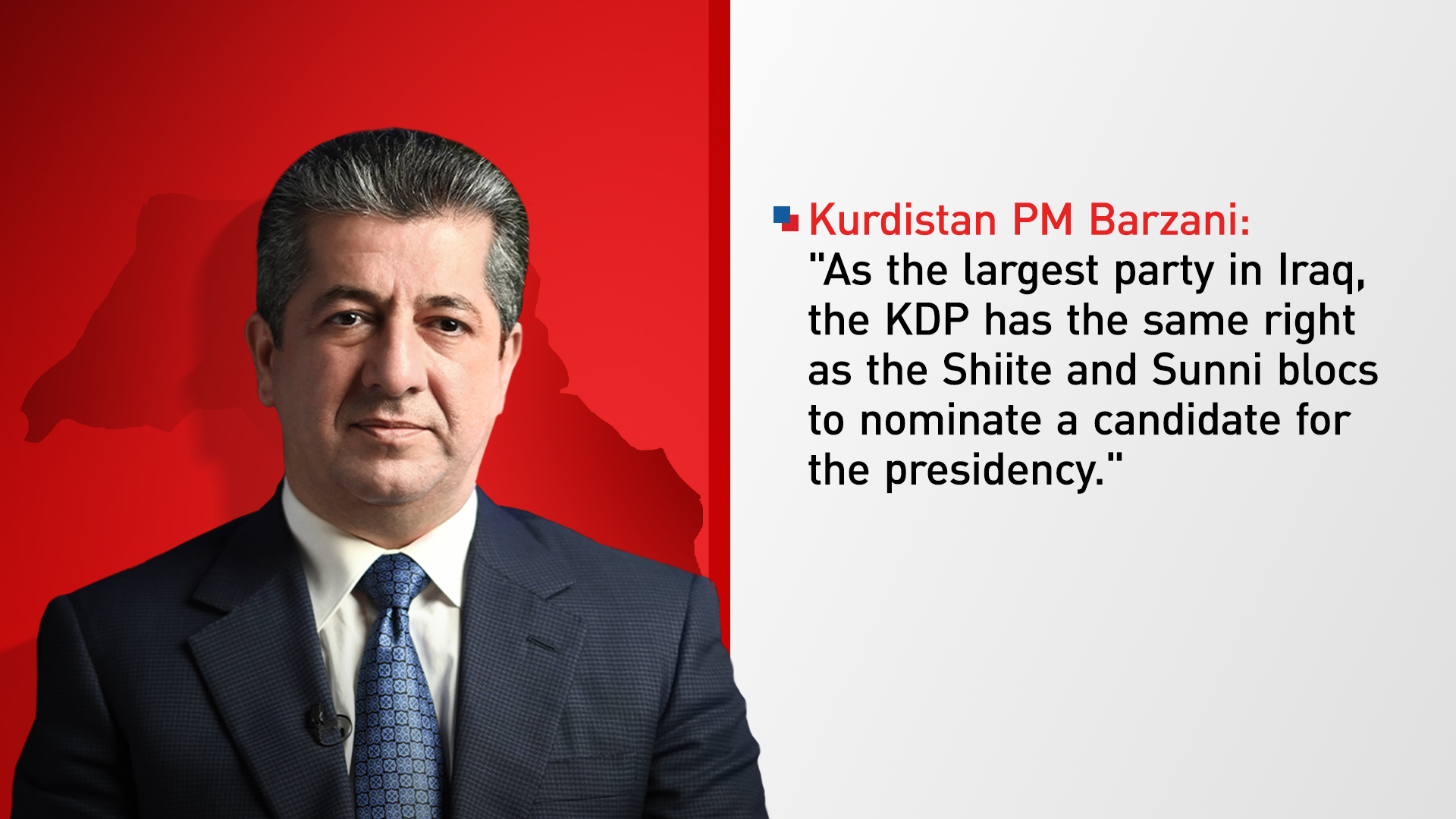
ERBIL (Kurdistan24) — Kurdistan Region Prime Minister Masrour Barzani said Iraq’s next president should be nominated in line with democratic norms and electoral results, stressing that the Kurdistan Democratic Party (KDP), as the largest Kurdish and national political force, has the legitimate right to put forward the presidential candidate. His remarks came during a televised interview with Sky News Arabia on Saturday, in which he also addressed Iraq’s political process, U.S. military presence, the threat posed by ISIS, and the broader Kurdish question across the region.
Barzani emphasized that Iraq’s post-election process must reflect the will of voters, beginning with the selection of parliamentary leadership and culminating in the election of the president and prime minister. He underlined that sovereignty and balanced international relations are both vital for Iraq, noting that relations with the United States and the broader international community must be handled carefully and responsibly.
On government formation, Barzani said the nomination of the prime minister has, by political convention, been the responsibility of the Shiite bloc, while the speakership belongs to the Sunni component. Similarly, he argued, the presidency is the constitutional responsibility of the Kurdish political forces.
“It will not be a president of the Kurds, but a Kurdish president of Iraq,” he said.
Barzani highlighted that the KDP secured more than 1.2 million votes in the most recent elections, making it the largest party in Iraq and earning the support of roughly half of the Kurdish electorate. Based on the same logic applied to Shiite and Sunni nominations, he said, the KDP has the right to nominate the presidential candidate. However, he added that the party remains open to consensus and unity among Kurdish parties in the interest of the Kurdish people.
“If consensus cannot be reached,” Barzani said, “then a fair and democratic process must decide.”
He outlined two possible mechanisms: a vote within the Kurdistan Parliament to select a unified Kurdish candidate, or a vote by Kurdish members of the Iraqi parliament, with the candidate receiving the highest Kurdish support becoming the consensus nominee.
The prime minister confirmed that the KDP has nominated Foreign Minister Fuad Hussein, describing him as a capable and experienced statesman who would serve Iraq well as president. He noted that while the presidency carries a different portfolio from the foreign ministry, it remains a critical national role, and any successor at the foreign ministry would assume responsibility for Iraq’s foreign policy.
On security, Barzani strongly defended the continued presence of U.S. and coalition forces in Iraq, arguing that their deployment was requested by all Iraqis—not only the Kurds—to combat ISIS. He expressed gratitude for the American-led coalition’s role, particularly in supporting Kurdish forces who were at the forefront of the fight against the group.
Barzani warned that ISIS has not been fully defeated, despite losing territorial control. He cited remaining sleeper cells, instability in Syria, and the release of detained militants as ongoing risks. “The threat of ISIS is very real,” he said, cautioning that extremist groups thrive in environments marked by injustice, poverty, inequality, and weak governance—conditions that still persist in parts of the region.
While acknowledging improvements in local security capabilities, Barzani said coalition support remains essential to prevent ISIS from regrouping in new forms. He noted that the timeline for the withdrawal of U.S. forces was negotiated between Washington and Baghdad, but said the Kurdistan Region believes continued assistance is still necessary to fully defeat terrorism.
Addressing regional Kurdish issues, Barzani said Kurdistan’s division across Iraq, Syria, Turkey, and Iran has produced distinct realities in each country. While respecting the sovereignty of neighboring states, he stressed that Kurds everywhere deserve full rights and dignity. He reiterated support for federalism in Iraq, arguing that it can succeed if fully implemented.
Barzani said Kurds, like all nations, have their dreams and should not be prevented from expressing their aspirations. “God created me Kurd, and I am proud of being a Kurd,” he said, adding that pluralism and respect for diversity are essential for stability.
He also criticized what he described as Baghdad’s failure to uphold constitutional obligations toward the Kurdistan Region, particularly delays in transferring financial entitlements and salaries. Barzani said such actions constitute a violation of the Iraqi constitution and amount to injustice against Kurdish citizens, despite the Kurdistan Region’s consistent support for successive federal governments, including Prime Minister Mohammed Shia al-Sudani.
Concluding his remarks, Barzani said the Kurds seek to be part of solutions, not problems—both within Iraq and in the wider region. He called for de-escalation, dialogue, and restraint amid regional tensions, stressing that Iraq should remain neutral and avoid being drawn into external conflicts.
“We want stability, mutual respect, and peaceful coexistence,” he said, “and that is how lasting solutions are built.”