'Crises Must Be Solved Through Dialogue': President Masoud Barzani at MEPS 2025 in Duhok
"We must all work together to make the state a state of institutions. No longer should there be a state within a state that creates obstacles and problems. The law must be sovereign. Every citizen must know their rights and duties," said President Barzani.
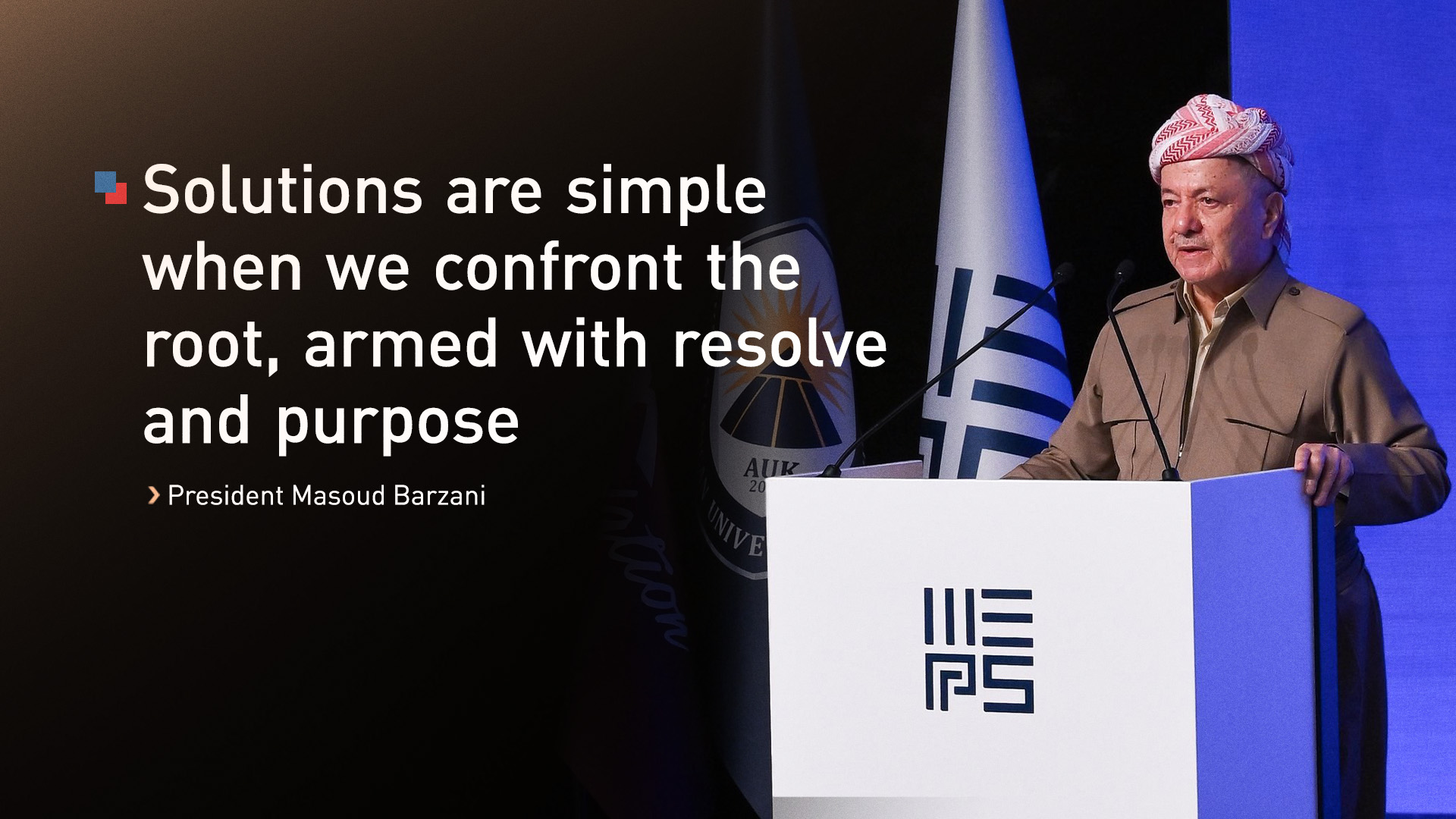
ERBIL (Kurdistan24) — The Sixth Middle East Peace and Security (MEPS) Forum 2025 commenced on Tuesday, in Duhok, hosted by Kurdistan Region Prime Minister Masrour Barzani and attended by President Masoud Barzani, alongside more than 120 leaders from 25 countries.
President Barzani, in his opening remarks, emphasized the importance of dialogue as a tool for lasting peace and stability in the Middle East.
“This forum takes place at a critical moment. We hope that its deliberations yield practical outcomes and that the goals set here can become actionable solutions for the region,” he said.
He warned of persistent crises in the Middle East and expressed hope that forums such as MEPS can help identify pathways to resolution.
“This forum takes place at a critical moment. We hope that its deliberations yield practical outcomes and that the goals set here can become actionable solutions for the region,” he said.
He warned of persistent crises in the Middle East and expressed hope that forums such as MEPS could help identify viable pathways to resolution.
“Some events create great changes, or even create history, just as World War I and the Sykes-Picot Agreement brought major transformations to this region. The system established by the Sykes-Picot Agreement, unfortunately, did not bring peace or stability. It created significant problems and difficulties, and to this day, all the peoples of the Middle East continue to suffer from the repercussions of that agreement,” President Barzani said.
He stressed that the peoples of the region should seriously examine the sources of these shortcomings and address them, emphasizing that it is inappropriate for communities living together to remain in disagreement and conflict.
“If we identify the shortcomings, the solution becomes very easy, provided there is intention and will. It is very easy to make mistakes, but it is a crime to persist in them,” he emphasized.
He added that imposing control over all areas has never been successful, neither in Iraq nor in any other Middle Eastern country. “We have all suffered. We should have lived a happy and prosperous life. The problems and difficulties we have created with one another must not be passed on to future generations,” Barzani said.
“Arabs and Kurds are partners in this homeland.”
President Barzani highlighted that Iraq was founded on the principle of partnership after World War I. Following the July 14, 1958 revolution, a clause was written stating that “Arabs and Kurds are partners in this homeland.” He noted, “This gave strength to all of Iraq and created a very positive atmosphere in both Iraq and Kurdistan.”
“On March 11, 1970, an agreement was reached between the leadership of the revolution and the Iraqi government of that era. It continued for a while and then failed. We witnessed the consequences of that failure: chemical attacks, Anfal, and the destruction of villages,” Barzani said, stressing that “the leadership of the revolution never missed a single opportunity for a peaceful resolution.”
“In 1963, think about who was ruling Baghdad. We welcomed every opportunity for peace. From 1963, 1964, 1966, 1970, and until 1991, we consistently proved that the Kurds are peace-loving. We have not forgotten what happened to us, but we have not retaliated, because we know that the brotherhood between us, Arabs, and other communities is far stronger and more important than the conflicts and crimes committed by governments. Conflict with the government is one matter; brotherhood, friendship, and harmony among peoples is another,” he said.
“The drafting of the constitution was based on partnership, balance, and consensus.”
Barzani recalled that a golden opportunity arose after the fall of the regime in 2003. Steps were taken based on three principles: partnership, balance, and consensus. In 2005, Iraq drafted a new constitution. He acknowledged its shortcomings but said, “Compared to the previous constitution and to constitutions in the region, it is very advanced. Its positive aspects far outweigh the negatives, and it clearly defines how to address any shortcomings. When the constitution was completed, I returned to Erbil and said it does not contain everything we want, but it contains many things to be proud of. It brought Iraq to a new stage, reorganized relations between the Kurdistan Region and the federal government, and includes articles we support both now and in the future.”
“The side that is in power, capable, and strong bears more of the blame for mistakes.”
Barzani emphasized: “We must ask ourselves: are these problems the fault of the Kurds or the government? I do not absolve any party, but certainly, the side that is in power, with capability and strength, bears more of the blame. We have all suffered greatly, and much blood has been shed. The opportunity that arose in 2003 still exists, and we must not lose it.
We have a constitution, and we are committed to it. It guides us on how to resolve any problems that may arise. We hope that the election held a few days ago will pave the way for us to return to the right path and for Iraq’s political process to return to its proper course, so that no further problems arise.”
“We support the peace process in Turkey.”
He added, “I am pleased with the peace process that has started in Turkey. We have given it our warm support and continue to do so, hoping it reaches its goal, benefiting all sides. A golden opportunity has also arisen for Syria. We hope that all components, including Kurds and other groups, will reach agreements peacefully and democratically with the current government, resolving problems and creating conditions for all to live together harmoniously.”
“The November 11 election was technically very successful.”
Barzani noted that the recent Iraqi election was an important and technically smooth process. “I congratulate all the people of Iraq. It was very different from previous elections. In the past, I waited until the last moment to vote due to complicated systems. This time, I was among the first to vote, and the process took just one minute. It was well-organized, and I did not witness any problems that could spoil this positive atmosphere. This is commendable for the federal government, the people, and the regional government alike.”
He highlighted that this should inspire serious post-election measures:
- First: Amending the election law: "In my opinion, the election law under which this election was held was an unjust law with many flaws, and the rights of many deserving people were denied, while undeserving people received rights. We will seriously work with the parties and make every effort to correct this law because, in reality, this law lacks any justice."
- Second: Work towards establishing a Federal Council: "According to Article 65 of the Constitution. This is very important because it provides reassurance for both the region and the provinces."
- Third: Iraq's Federal Court: "A federal court should be established, in accordance with the basic law and Articles 92 and 93. All these things must be consistent with the constitution, but they must be done, not postponed, because many problems may be caused by the absence of these institutions. Article 140 must be implemented and no longer delayed. The oil and gas law must be approved, which is consistent with the basic law. This is one of the main causes of problems between the region and Baghdad, and it should not exist. This law was prepared and written in 2007. I will not go into details, but it should have been implemented at that time, but it was delayed, and it was a big mistake. We hope that this law will also be implemented and completed."
"We must all work together to make the state a state of institutions. No longer should there be a state within a state that creates obstacles and problems. The law must be sovereign. Every citizen must know their rights and duties. And more focus should be placed on services throughout Iraq. I see that our people, everyone in Kurdistan, in the center, in the south, are tired of slogans. They have heard many slogans; people want practical things. They want electricity, they want roads, they want hospitals, and they want correct and proper education. I hope all parties think about improving the living standards of the people. That will be a good outcome," Barzani added.
“I call on all Kurdish parties to come and form the Kurdistan Regional Government.”
He added that the regional election had been delayed for over a year. “After the results were announced, we called on all winning parties to form a broad-based government, but they did not. I hope the federal election will encourage all Kurdish parties to form the Kurdistan Regional Government together, preserving balance and ensuring each party receives its rights according to electoral merit.”
“The threat of ISIS remains.”
Barzani warned: “Terrorism, particularly ISIS, is far from resolved. Whenever they see an opportunity, they can regroup. Full coordination among political parties, the federal government, the regional government, and international partners is essential. Denying the threat does not eliminate it; ISIS persists, and cooperation with friends abroad is necessary.”
“Drug traffickers must be punished.”
He stressed the danger of narcotics: “Many youths from Kurdistan to Basra have fallen victim to this scourge. Security agencies and relevant institutions must act decisively. Traffickers and those who establish drug factories are serious criminals and must be prosecuted. The future government, both federal and regional, must coordinate to eliminate this threat.”
He also condemned national and sectarian extremism: “It has brought no benefits. While some parties make statements during elections, I hope this remains propaganda and does not become policy, as it yields no positive outcomes.”
Barzani noted that while global crises persist, the most dangerous ones are in the Middle East. “We hope crises will be resolved peacefully through dialogue. Iraq must not become a battlefield for external conflicts, and our people should be protected. Our country is still rebuilding; we must avoid further calamities.”
Coexistence as a Core Value
He concluded: “Kurdistan is proud of its deeply rooted culture of coexistence across Iraq. We hope all parties will strengthen this coexistence, recognizing that Iraq is a multinational, multi-religious, and multi-sectarian country. Everyone must know their duties and rights, and work as partners to ensure a prosperous future for all.”
MEPS 2025
MEPS has, in recent years, emerged as one of the Middle East’s most important platforms for addressing political, security, economic, and governance challenges. Organized annually at the American University of Kurdistan in Duhok province, in the Kurdistan Region, the forum attracts heads of state, prime ministers, ministers, diplomats, global experts, policymakers, academics, and business leaders from around the world.
The conference is known for its open, in-depth discussions on regional stability, counterterrorism coordination, economic diversification, climate challenges, energy transitions, and the future of partnerships across the Middle East.
It also serves as a critical venue for examining Iraq’s evolving political dynamics and the Kurdistan Region’s role as a reliable and stabilizing partner.
Beyond its diplomatic impact, MEPS has become a major vehicle for enhancing the Kurdistan Region’s global profile. By consistently convening high-level leaders and experts, the forum showcases Kurdistan as a secure, open, and dynamic environment capable of hosting world-class policy discussions, while simultaneously promoting investment opportunities and cultural visibility.
As MEPS Forum 2025 continues through Nov. 19, participants are expected to explore new avenues for cooperation in security, economic integration, post-conflict stabilization, and regional development — reaffirming the Kurdistan Region’s central role in shaping future dialogues across the Middle East.