KDC Urges International Intervention in Aleppo as Clashes Intensify
The Kurdistani Diaspora Confederation (KDC) urged UN intervention to stop attacks on Aleppo Kurds. Presidents Macron and Erdogan discussed the crisis with Syrian President al-Sharaa as casualties rose to 13.
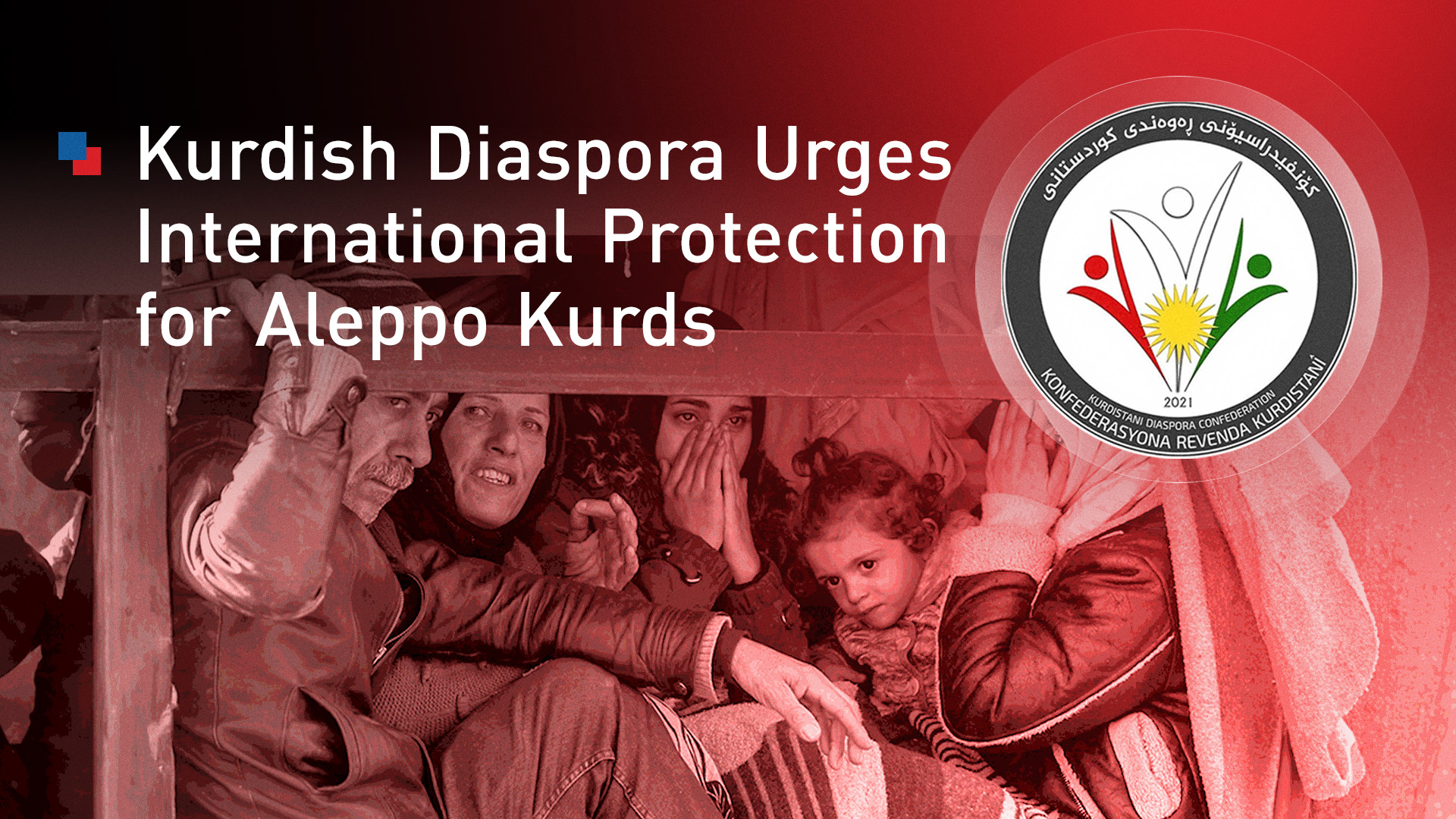
ERBIL (Kurdistan24) — The Kurdistani Diaspora Confederation (KDC) issued an urgent appeal to the international community on Thursday, calling for immediate intervention to halt what it described as a deterioration of the humanitarian situation in the Kurdish-majority neighborhoods of Aleppo.
In an official statement, the organization warned that the ongoing military offensive by the Syrian Arab Army in the Sheikh Maqsud and Ashrafiyeh districts has placed the civilian population under severe threat, necessitating a response from the United Nations and global powers to prevent further killing and forced displacement.
The warning from the Confederation, released on Thursday, comes amid a rapidly shifting security landscape in northern Syria, where Kurdish-inhabited areas have faced intensifying encirclement and bombardment.
The diaspora organization, which positions itself as a national umbrella for Kurds abroad tasked with conveying the grievances of the Kurdish people to decision-making centers in Europe and the United States, condemned the military actions as "racist attacks" targeting Kurdish citizens.
The statement emphasized that the international community must assume its legal and ethical responsibilities to prevent any attempt at extermination, asserting that the protection of innocent lives must supersede all political interests.
A central component of the Confederation’s appeal was its endorsement of the political approach advocated by President Masoud Barzani.
The statement described President Barzani’s historical and national stances as an "urgent necessity" for the protection of Kurds in Western Kurdistan (Rojava). Specifically, the Confederation highlighted President Barzani’s vision to keep the Kurdish population away from inter-component warfare and to prevent the creation of ethnic tension with Arabs.
The organization characterized this approach as a "wise roadmap" essential for protecting the supreme interests of the Kurdish nation and preventing further devastation in the region.
The Confederation called for unity among all Kurdistani forces during what it termed a sensitive moment, urging them to support the resilient population of Sheikh Maqsud and Ashrafiyeh.
Reiterating a message of defiance against the military pressure, the statement asserted that the Kurdish national identity would not be broken by force of arms or siege. The organization pledged to continue its struggle to amplify the voice of the oppressed until legitimate rights are attained and dignity and freedom are secured for Kurdistanis globally.
The diaspora’s alarm regarding the situation in Aleppo was echoed by the Supreme Islamic Alawite Council in Syria and the World, which issued its own forceful condemnation of the violence.
In a statement released shortly after the escalation began, the Council demanded an immediate halt to what it termed a "massacre" in the Sheikh Maqsud and Ashrafiyeh neighborhoods. The Council’s condemnation extended to events on the Syrian coast as well, painting a picture of widespread instability.
The Supreme Islamic Alawite Council specifically pointed to the actions of the "de facto authority led by Abu Muhammad al-Julani," describing him as its temporary leader.
The Council accused this authority of carrying out mass arrest operations, killings, and illegal operations, characterizing these actions as a flagrant violation of human rights that threatens the national fabric of Syria.
The statement warned that the continuation of such a "policy of cleansing" risks completely dismantling Syrian society, placing the ultimate responsibility for the crisis on the current administration of Syria.
In its call to action, the Supreme Islamic Alawite Council urged an immediate cessation of field massacres and the end of the armed presence in the city of Aleppo.
It called for the protection of all components of Syrian society without discrimination and demanded adherence to international resolutions.
Furthermore, the Council appealed to the international community not to remain silent, advocating for a future Syria based on a civil constitution and administered through a decentralized system.
The violent crackdown in Aleppo has been underway since Tuesday, when the Syrian Arab Army launched an offensive using tanks and artillery against the Kurdish neighborhoods. According to reports from the ground, the assault has continued for four days, involving indiscriminate shelling that has resulted in significant civilian casualties.
As of Friday, 13 citizens had lost their lives, and 64 others had been injured, while a large number of residents have been forcibly displaced from their homes.
Amid the intensifying violence on the ground, high-level diplomatic activity was reported early Friday morning.
The official Syrian news agency, SANA, reported that Syrian Interim President Ahmed al-Sharaa received separate telephone calls from French President Emmanuel Macron and Turkish President Recep Tayyip Erdogan to discuss the situation in Aleppo and broader regional developments.
Previously, Türkiye’s defense ministry said it would provide support to Syria if formally requested.
In his conversation with President al-Sharaa, President Macron discussed the horizons of bilateral cooperation.
Al-Sharaa praised France’s role in reducing humanitarian suffering and supporting the reconstruction phase of Syria. For his part, Macron emphasized the importance of continued coordination and consultation between Paris and Damascus regarding the unfolding events.
Separately, President Erdogan spoke with President al-Sharaa to discuss efforts to establish peace and the latest developments in the Syrian arena.
The Turkish President expressed his country's support for efforts aimed at strengthening security and stability. Erdogan emphasized the importance of "joint coordination" to confront the challenges and threats facing both Türkiye and Syria.
SANA reported that the call concluded with both sides agreeing on the continuation of intensive communication and coordination between the relevant institutions of their respective countries.
The international concern over the crisis was further underscored by Gregory Galligan, the Canadian Ambassador to Syria and Lebanon. On Thursday, Ambassador Galligan announced that Canada is "very concerned" about the fighting and tensions in Aleppo, noting the great harm caused to civilians.
The Ambassador called for tensions to be stopped as soon as possible and for civilians to be protected. Crucially, Amb. Galligan advocated for a political resolution, calling for the resumption of dialogue between the Syrian government and the Syrian Democratic Forces (SDF) to resolve the issues plaguing the city.
Deeply concerned by the continued violence in #Aleppo, which is exacting a heavy toll on civilians. Immediate de-escalation, protection of civilians, and renewed dialogue between the transitional authorities and the SDF are required without delay.
— Gregory Galligan 🇨🇦 (@Greg_Galligan) January 8, 2026
The convergence of condemnations from the Kurdistani diaspora, the Alawite religious leadership, and Western diplomats highlights the severity of the four-day offensive.
With the Syrian Arab Army continuing their military attack on Ashrafiyeh and Sheikh Maqsud, the humanitarian toll continues to rise, prompting urgent calls for the international community to move beyond rhetoric and ensure the physical protection of the besieged population.