Sudani Signals Openness to Electoral Reform at MEPS 2025, Backing Calls to Curb Vote Fraud
“We stand with President Barzani on the issue of wasted votes,” Sudani said, pointing to the need to curb vote fragmentation and fraud.
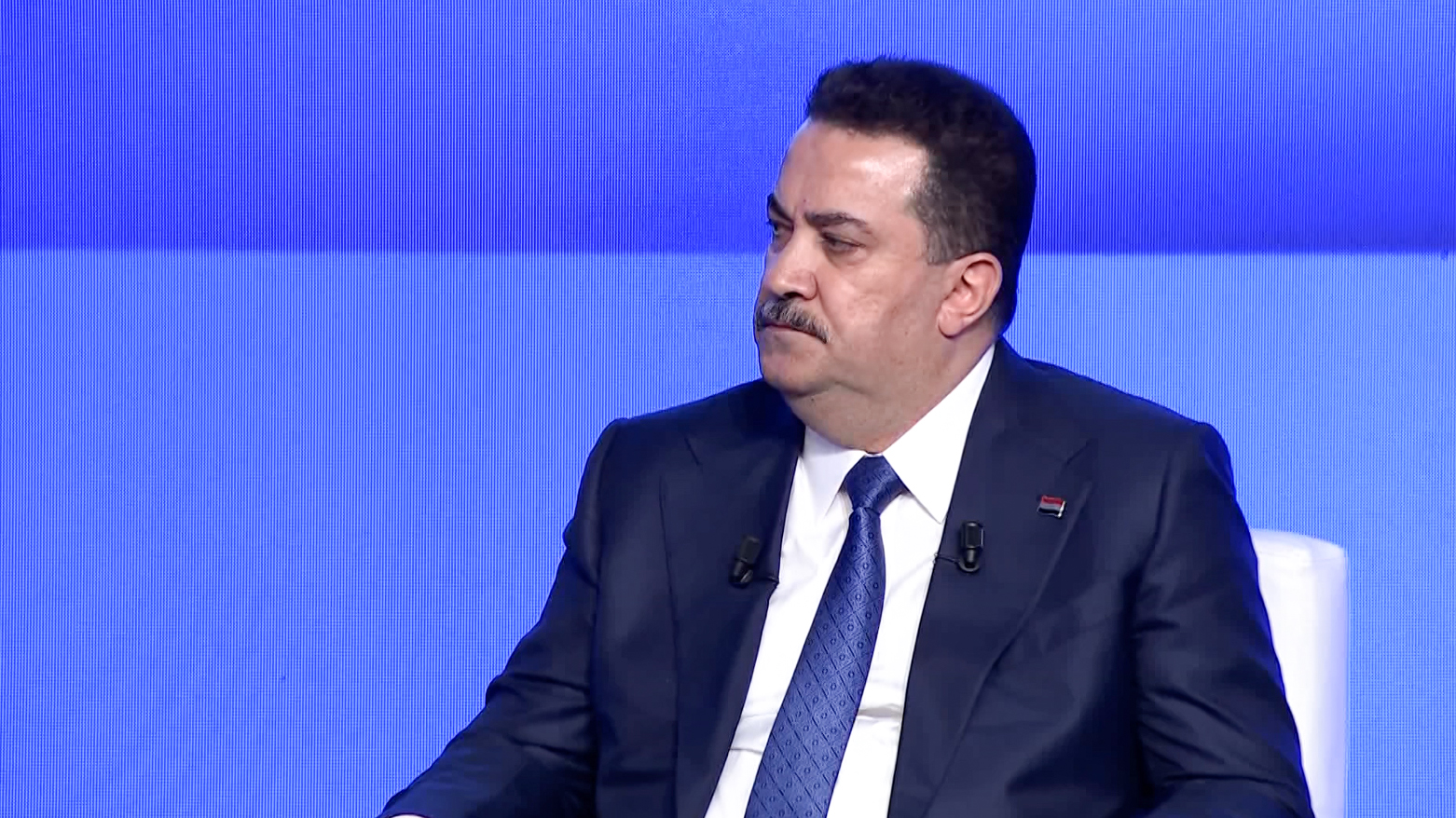
ERBIL (Kurdistan24) — Iraqi Prime Minister Mohammed Shia’ al-Sudani on Tuesday used a private session on the sidelines of the Middle East Peace and Security Forum (MEPS 2025) in Duhok to address Kurdish concerns over Iraq’s current electoral law, emphasizing his government’s readiness to pursue reforms that ensure greater fairness, transparency, and public confidence in the democratic process.
MEPS, now in its sixth edition, has become one of the region’s most influential political and economic gatherings, bringing together leaders, policymakers, and experts to debate governance, security, regional cooperation, and conflict de-escalation across the Middle East. Sudani’s remarks came as part of discussions on Iraq’s political trajectory following the recent parliamentary elections.
Sudani said he supports stabilizing Iraq’s electoral framework, stressing that “it is not right to have a new electoral law for every parliamentary cycle.” Responding directly to President Masoud Barzani’s repeated calls for reform, he noted significant discrepancies in vote allocation, particularly for his Coalition of Reconstruction and Development, which won 1,317,000 votes but saw its seat count fall short of what party leaders consider fair.
“We stand with President Barzani on the issue of wasted votes,” Sudani said, pointing to the need to curb vote fragmentation and fraud.
The Iraqi premier underscored that parliament has the mandate “to prepare a clearer report or proposal to establish a fair law that reflects citizens’ votes and prevents manipulation.”
He also acknowledged that election outcomes often complicate government formation, saying: “In every parliamentary election, results have never produced complete harmony for forming a government or distributing posts.”
Sudani highlighted that his Coalition has now become “a principal component of the Coordination Framework,” adding that the coalition recently decided to form the largest parliamentary bloc.
He confirmed ongoing negotiations between the Shiite Coordination Framework leaders and other political parties to finalize constitutional entitlements, form the next cabinet, and determine the division of sovereign positions.
He stressed that all political forces appear committed to respecting constitutional timelines for forming a government, noting that the elections were conducted “peacefully, clearly, and without any violations,” which he described as “a sign of political maturity and trust in the system.”
Addressing a question on whether he intends to seek another term, Sudani said he has “no personal ambition,” but is ready to continue his responsibilities to complete the governing program endorsed by voters.
He emphasized that the focus must remain on policies, services, and meeting public demands, not on individuals or partisan interests.
Sudani reaffirmed that Iraq will not alter its long-standing arrangement for distributing the three top federal positions—presidency, premiership, and parliament speakership—among the country’s main components. “We see no reason to change this formula,” he insisted.
Commenting on foreign pressure, Sudani said: “I served in two previous governments as minister and now as prime minister. We have never been subjected to external pressure. Iraq should not become a bargaining chip for any country’s disputes.”
He added that Iraq maintains balanced relations with regional states, the European Union, and the United States, and dismissed claims circulated in the media that Iraq faces foreign coercion as “far from the truth.”
Sudani concluded by stressing that any governmental decision “must serve the interests of all Iraqis,” adding: “No decision taken in the public interest will ever be changed under pressure.”
MEPS has, in recent years, emerged as one of the Middle East’s most important platforms for addressing political, security, economic, and governance challenges. Organized annually at the American University of Kurdistan in Duhok province, in the Kurdistan Region, the forum attracts heads of state, prime ministers, ministers, diplomats, global experts, policymakers, academics, and business leaders from around the world.
The conference is known for its open, in-depth discussions on regional stability, counterterrorism coordination, economic diversification, climate challenges, energy transitions, and the future of partnerships across the Middle East.
It also serves as a critical venue for examining Iraq’s evolving political dynamics and the Kurdistan Region’s role as a reliable and stabilizing partner.
Beyond its diplomatic impact, MEPS has become a major vehicle for enhancing the Kurdistan Region’s global profile. By consistently convening high-level leaders and experts, the forum showcases Kurdistan as a secure, open, and dynamic environment capable of hosting world-class policy discussions, while simultaneously promoting investment opportunities and cultural visibility.
As MEPS Forum 2025 continues through Nov. 19, participants are expected to explore new avenues for cooperation in security, economic integration, post-conflict stabilization, and regional development — reaffirming the Kurdistan Region’s central role in shaping future dialogues across the Middle East.