Baghdad Struggles with Gridlock as Kurdistan-Registered Vehicles Surge in Capital’s Car Markets
Baghdad's traffic crisis is worsening with 3-4 million vehicles clogging outdated roads, while car markets see rising demand for Kurdistan-plated cars due to faster registration and lower taxes.
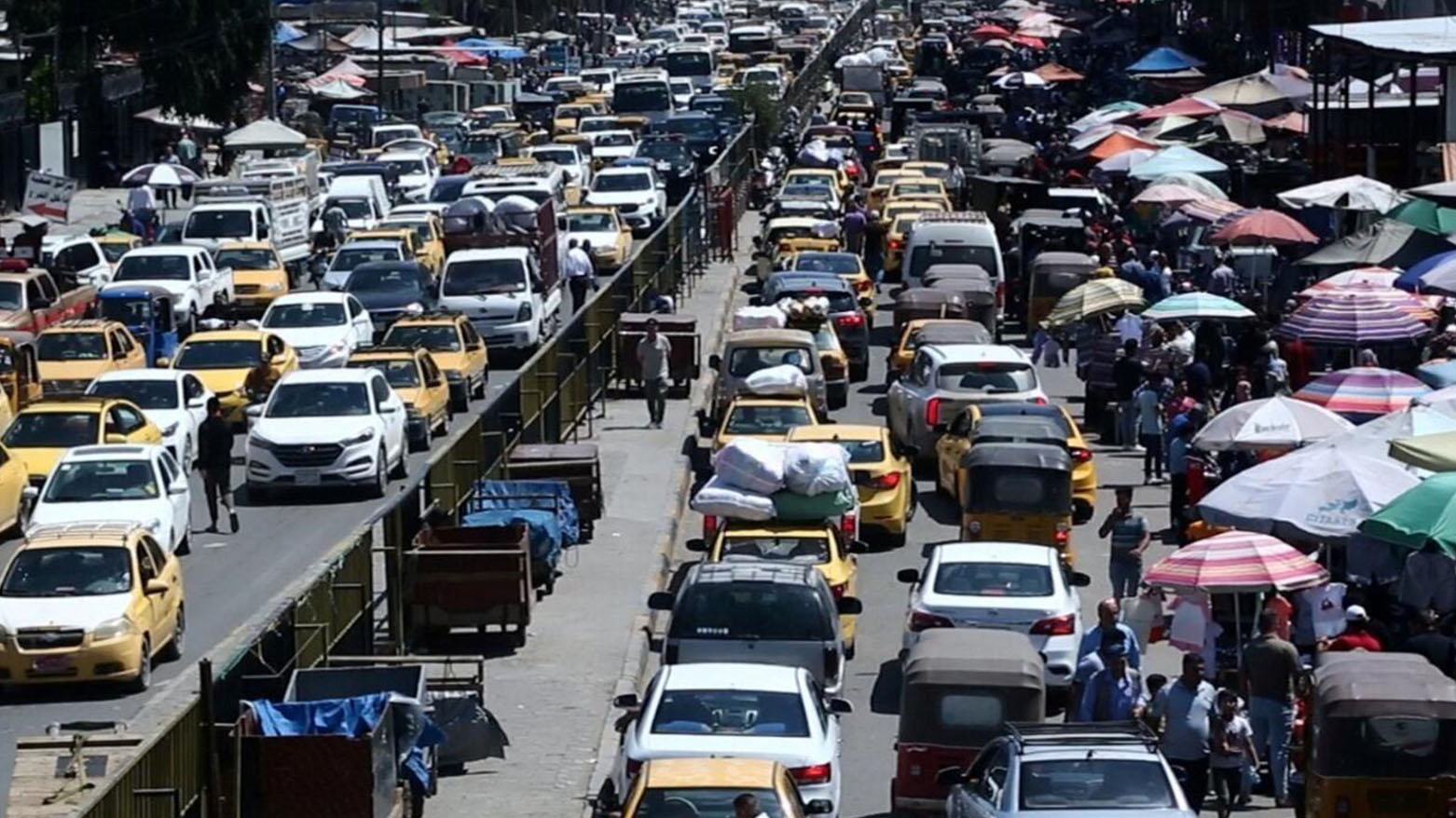
Erbil (Kurdistan24) – The Iraqi capital is suffocating under one of its worst traffic crises in years, with Baghdad’s major arteries reduced to near-standstill conditions and digital navigation maps flashing red across more than 35 key intersections. Amid this paralyzing congestion, an unexpected trend has emerged in the city’s auto dealerships: a sharp rise in demand for vehicles carrying license plates from the Kurdistan Region.
A Kurdistan 24 team toured Baghdad’s streets and car showrooms to uncover the roots of the capital’s severe traffic bottlenecks and understand why residents are increasingly turning to Kurdistan-registered cars.
According to Kurdistan 24’s correspondent in Baghdad, navigation applications display complete immobilization across dozens of areas, turning the city into a maze of stalled engines and lost hours.
Residents and taxi drivers attribute the crisis to uncontrolled vehicle imports and dilapidated infrastructure, stressing that streets built nearly 80 years ago can no longer absorb the massive influx of modern cars—particularly in the absence of proper adherence to traffic regulations.
Speaking to Kurdistan 24, Brig. Gen. Nasir Abdul-Sattar, Director of Relations and Media at the General Traffic Directorate, explained that it is difficult to provide a precise count of vehicles in Baghdad due to the diversity of registration sources—Baghdad, the Kurdistan Region, and other governorates.
“The estimated number ranges between 3 to 4 million vehicles in the capital, and this far exceeds the current road capacity,” he said. He added that new overpasses and decongestion projects may offer temporary relief, but they do not address the core issue unless Baghdad’s roads are expanded in proportion to population growth.
During Kurdistan 24’s tour of Baghdad car markets, a notable share of displayed vehicles carried plates from Erbil, Sulaimani, and Duhok. Dealers pointed to several key factors driving this preference—chief among them the efficiency of procedures and the quality of imported cars.
Kazem Abbas, a Baghdad dealership owner, told Kurdistan 24:
“People prefer buying from Erbil because the entire process is completed within an hour, and the buyer immediately receives the registration card and plates. In Baghdad, it can take a long time. Cars arriving through the Kurdistan Region are generally cleaner, and customs fees are more reasonably priced.”
Car trader “Haji Star” revealed that financial considerations play a decisive role, especially for buyers of pickup trucks and light-duty vehicles.
“Pickup trucks with Baghdad plates are subject to a monthly tax of 150,000 to 200,000 dinars—equivalent to 300,000 to 500,000 dinars annually, paid in advance,” he explained. “Pickup trucks with Kurdistan plates, however, are exempt from these monthly taxes, which is a major incentive for workers and small business owners.”
He added that vehicles entering Baghdad from the Kurdistan Region are typically of higher quality. “American cars imported to Baghdad often come with heavy damage, while inspections in the Kurdistan Region are far more rigorous,” he noted.
Brig. Gen. Abdul-Sattar emphasized that coordination between the General Traffic Directorate in Baghdad and traffic directorates in the Kurdistan Region remains strong and continuous. He confirmed that information exchange and violation tracking operate smoothly, dismissing claims of administrative obstacles affecting vehicle movement between governorates.