Trump Administration Shifts Focus From “Forever Wars” to Economic Power in 2025 Strategy
U.S. unveils a revamped security doctrine, citing a post-Iran strike shift from Middle East wars to economic power, tighter borders, and renewed great-power rivalry with China and Russia.
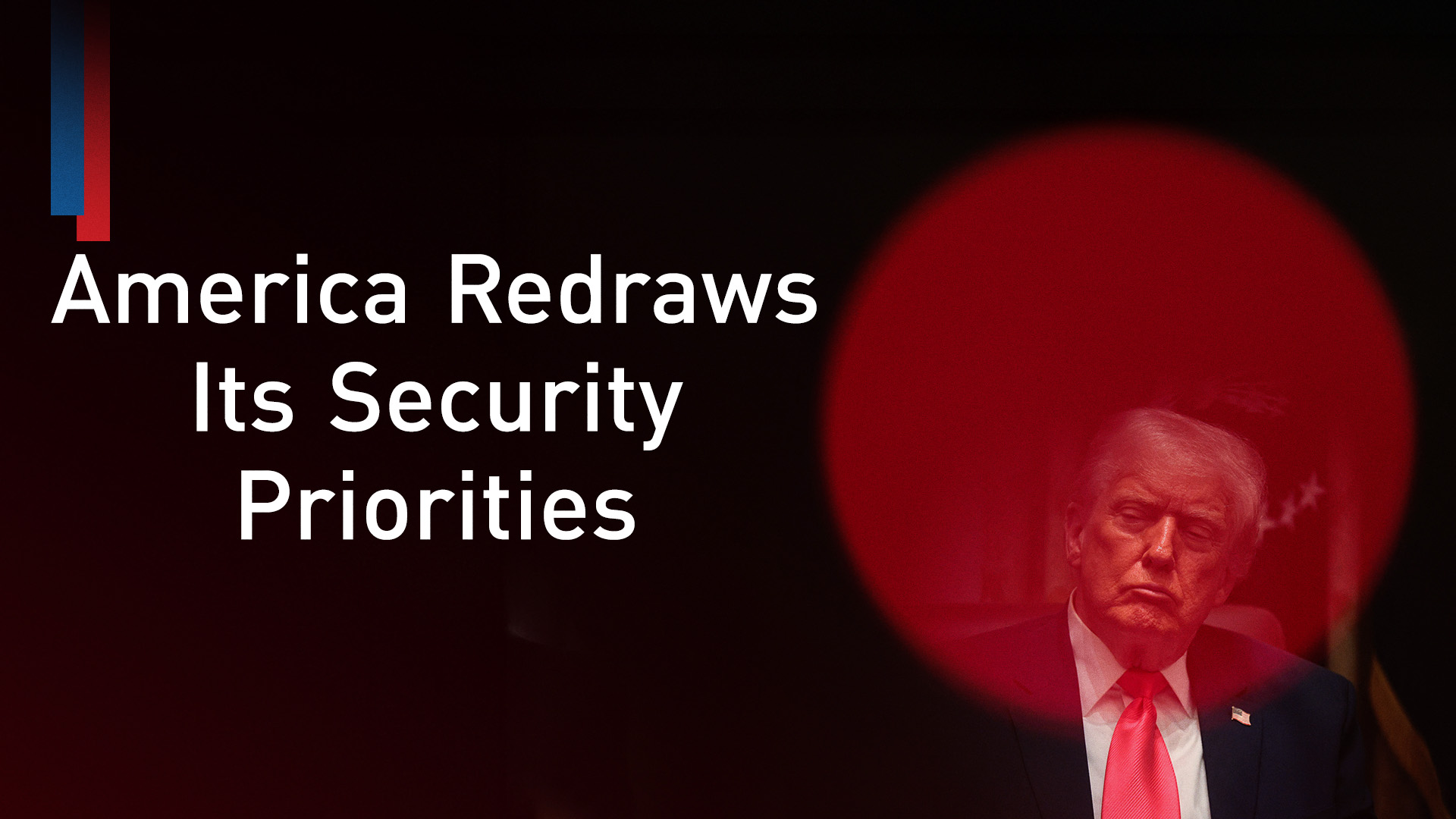
ERBIL (Kurdistan24) — In a sweeping redefinition of American foreign policy priorities, the White House released its 2025 National Security Strategy on Friday, declaring that the era in which the Middle East dominated American long-term planning is officially over.
The document, issued nine months into President Donald J. Trump’s second term, outlines a “Peace Through Strength” doctrine rooted in the concept of “America First,” while revealing previously undisclosed details regarding U.S. military engagements.
Most notably, the administration confirmed the execution of “Operation Midnight Hammer” in June 2025, a military campaign that the White House asserts “obliterated” Iran’s nuclear enrichment capacity and significantly degraded the country’s influence in the region.
The release of the strategy comes at a moment the administration describes as a “new golden age,” characterized by a pivot away from “forever wars” toward a focus on economic preeminence, border security, and burden-sharing with allies.
While the strategy addresses global competition with China and stability in Europe, the section dedicated to the Middle East represents a fundamental departure from the policies of the last half-century.
The strategy argues that the region is no longer a source of imminent catastrophe but is emerging as a center for partnership and investment, a shift facilitated by the United States’ return to the status of a net energy exporter.
According to the document, conflict remains the Middle East’s most troublesome dynamic, yet the administration posits that the threat landscape has been drastically altered by recent U.S. and Israeli actions.
The strategy explicitly references Operation Midnight Hammer as a decisive turning point that has left Iran, the region’s chief destabilizing force, greatly weakened.
This military action, combined with what the document describes as the successful negotiation of a ceasefire in Gaza and the return of all living hostages, serves as the foundation for a new regional architecture.
The administration asserts that Hamas’s chief backers have stepped away, creating a vacuum that allows for a reimagined diplomatic approach.
The strategy outlines a vision for Syria that will be of particular interest to regional observers.
It acknowledges that Syria remains a potential problem but suggests that stability is achievable through a cooperative framework involving American, Arab, Israeli, and Turkish support. The goal, as stated in the text, is for Syria to reassume its place as an integral, positive player in the region, a marked shift from previous policies of isolation.
Central to this new Middle East policy is the concept of "Burden-Sharing and Burden-Shifting."
The administration makes clear that as U.S. energy production ramps up, the historic necessity for a heavy American footprint in the region recedes. Instead, the White House envisions the Middle East becoming a premier destination for international investment in sectors extending well beyond oil and gas, including nuclear energy, artificial intelligence, and defense technologies.
The strategy emphasizes that the United States will work with regional partners to bolster opportunities to develop friendly markets in other parts of the world, specifically Africa.
However, the document draws firm red lines regarding U.S. core interests.
The administration asserts that it will always act to ensure that Gulf energy supplies do not fall into the hands of an outright enemy, that the Strait of Hormuz and the Red Sea remain navigable, and that the region does not become an incubator for terror against the American homeland.
The security of Israel remains non-negotiable. Yet, the method for achieving these security goals has shifted.
The strategy explicitly rejects the “misguided experiment” of hectoring Gulf monarchies into abandoning their traditions and historic forms of government. Instead, the United States will accept the region’s leaders as they are, encouraging organic reform without imposing it from the outside.
This pragmatic approach extends to the expansion of the Abraham Accords.
The strategy highlights President Trump’s ability to unite the Arab world at Sharm el-Sheikh in pursuit of peace and normalization, framing this diplomatic success as the mechanism that allows the United States to finally prioritize its own interests.
The administration intends to address ideological and military threats without engaging in decades of fruitless nation-building wars, preferring instead to leverage economic incentives and military deterrence.
While the Middle East section signals a strategic contraction of ambition regarding political transformation, the broader document outlines an expansive view of American sovereignty and power projection globally.
The strategy is built upon the premise that the post-Cold War consensus—which pursued globalism and international interdependence—was a failure that hollowed out the American middle class.
In response, the administration has introduced a “Trump Corollary” to the Monroe Doctrine regarding the Western Hemisphere.
This policy asserts that the United States will deny non-hemispheric competitors the ability to position forces or control strategically vital assets in the Americas. It further details the designation of drug cartels as Foreign Terrorist Organizations and the use of lethal force to secure the border.
On the topic of Great Power competition, the strategy identifies the Indo-Pacific as the key economic and geopolitical battleground of the 21st century. The administration takes credit for reversing decades of mistaken assumptions that economic engagement would liberalize China.
Instead, the strategy calls for rebalancing trade relations and prioritizing reciprocity to restore American economic independence. It warns that China’s state-led companies have strengthened their hold on supply chains in low- and middle-income countries.
To counter this, the United States aims to win the economic future by maintaining technological preeminence in AI, biotech, and quantum computing. Militarily, the strategy focuses on deterring conflict over Taiwan by preserving "military overmatch" and ensuring that no competitor can control the vital shipping lanes of the South China Sea.
Regarding Europe, the document offers a stark critique of the continent's current trajectory. It warns of “civilizational erasure” due to migration policies, censorship, and cratering birthrates.
The administration states that it is a core interest of the United States to negotiate an expeditious cessation of hostilities in Ukraine to stabilize European economies and reestablish strategic stability with Russia.
The strategy is critical of European officials who rely on the United States for defense while subverting democratic processes at home. It introduces the “Hague Commitment,” a new global standard pledging NATO countries to spend 5 percent of their GDP on defense, signaling that the days of allies offloading defense costs onto the American taxpayer are over.
The strategy concludes by linking domestic renewal to international strength. It calls for the restoration of American spiritual and cultural health, arguing that long-term security is impossible without a citizenry that cherishes its history.
It touts a robust domestic agenda that includes rooting out "radical gender ideology" from the Armed Forces, unleashing energy production, and imposing tariffs to reindustrialize the economy.
By grounding its foreign policy in specific national interests rather than abstract global commitments, the 2025 National Security Strategy seeks to institutionalize the "America First" doctrine.
With the obliteration of Iran’s nuclear capacity cited as a fait accompli and the war in Gaza declared ended, the administration presents a worldview where decisive military action facilitates a pullback from foreign entanglements, allowing the United States to focus on economic dominance and the protection of its own sovereignty.