In Message to Istanbul Summit, President Barzani Commends Architects of New Negotiation Path
President Barzani backs renewed peace efforts in Türkiye, praising Ankara and Kurdish leaders for pursuing dialogue as regional voices urge a political path to stability.
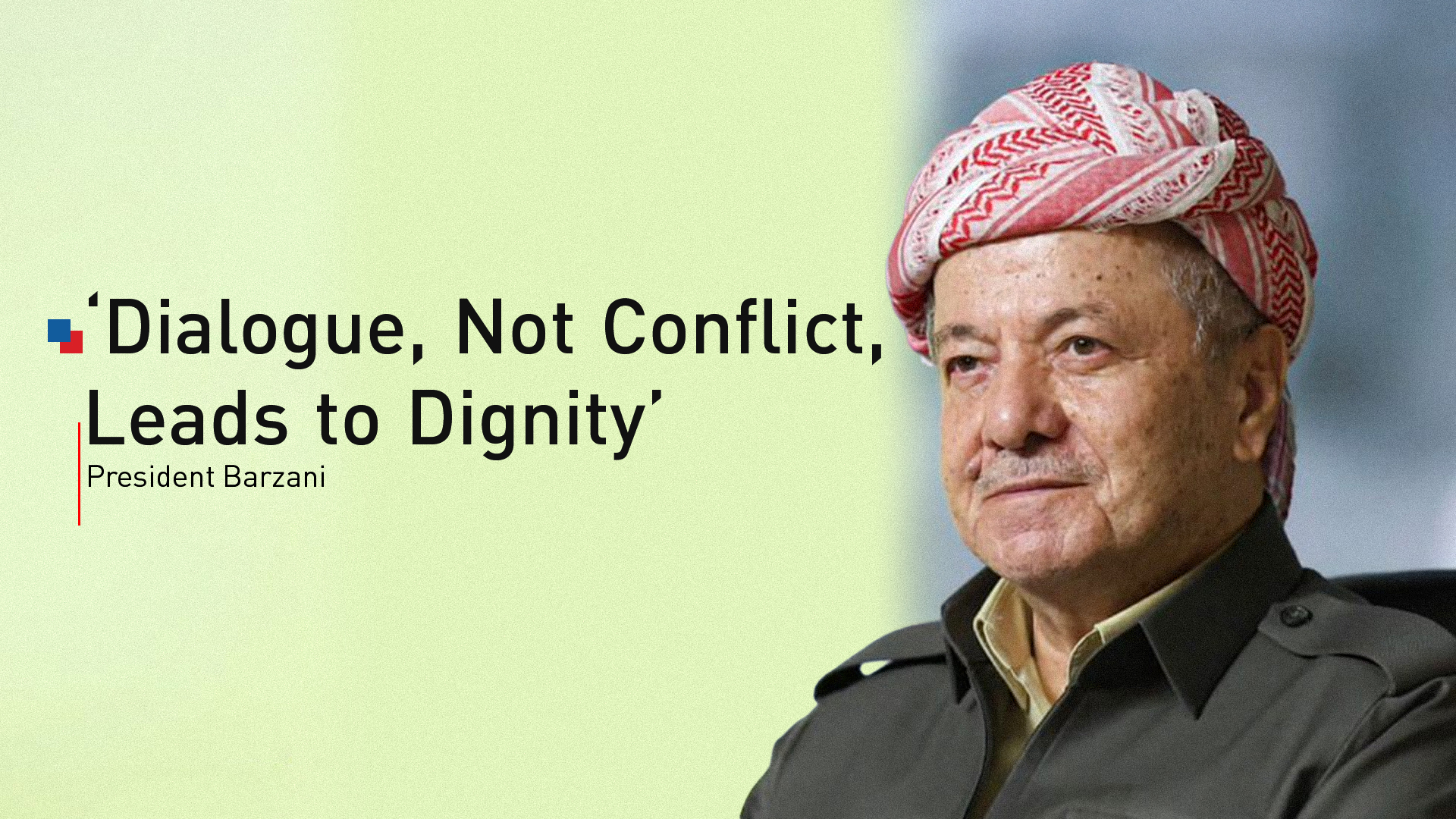
ERBIL (Kurdistan24) – In a significant diplomatic move aimed at bolstering stability across a volatile region, President Masoud Barzani on Saturday threw his full political weight behind the renewed peace efforts in Türkiye, explicitly commending both the Turkish state leadership and Kurdish figures for choosing the path of negotiation over conflict.
In a message delivered to a high-level gathering in Istanbul, the Kurdish leader articulated a vision for the Middle East that rejects the cycles of violence of the past, asserting that humanity acts as the ultimate victor only when dialogue supersedes turmoil.
The address was presented at the "International Conference on Peace and Democratic Society," a two-day summit organized by the DEM Party that began on Saturday. The event, held in Istanbul, has drawn a diverse array of international observers, foreign dignitaries, and Nobel Peace Prize laureates, serving as a major platform for discussing the future of Türkiye and Northern Kurdistan.
While President Barzani was not physically present, his words were delivered with considerable gravity by Amina Zikri, a member of the Political Bureau of the Kurdistan Democratic Party (KDP), who read the text to an audience composed of key political stakeholders.
At the core of President Barzani’s message was a robust endorsement of the fragile but critical steps being taken toward reconciliation in Türkiye. In a passage that drew particular attention for its directness and balance, President Barzani offered specific praise to the architects of this potential de-escalation.
"I wholeheartedly commend the Turkish government, Mr. Erdogan, and Mr. Ocalan, and all those gentlemen who created the opportunity for the process of peace, resolution, and negotiation," the message read. By naming both President Recep Tayyip Erdogan and the imprisoned PKK leader Abdullah Ocalan, President Barzani signaled a strategic support for a comprehensive process that bridges the deep political divide, framing the initiative not as a concession by either side, but as a mutual creation of opportunity.
The President’s message was deeply rooted in a reading of the current geopolitical climate, which he described as a "sensitive stage" for both the region and the world. He suggested that the Middle East stands at a crossroads, facing a "new beginning" that holds dual possibilities.
This new era, President Barzani noted, could be "fraught with obstacles," or it could alternatively be "full of new opportunities for stability, security, and a dignified, honorable, and peaceful life for the peoples of the region." His message underscored the agency of political leaders in determining which of these paths the region takes, placing the onus on decision-makers to navigate the complexities of the moment with foresight rather than reactionary politics.
Central to avoiding the obstacles of this new era, according to President Barzani, is the necessity of historical reflection. He urged all parties involved to "learn lessons from the mistakes of past eras," a clear allusion to the decades of conflict that have exacted a heavy toll on the region's population and development.
He called for a departure from old grievances, advocating instead for approaching new developments with a "new spirit, a clear vision, and full faith and hope." This appeal for a psychological and strategic reset aligns with the KDP’s long-standing position that military solutions are incapable of resolving the deep-seated political and social issues facing the Kurdish people and the nations they inhabit.
Elaborating on the philosophy of non-violence, the message emphasized that "dialogue and understanding are always better than war and turmoil." President Barzani posited that the benefits of peace extend beyond the immediate political gains of any single party, stating that "in dialogue and peace, humanity benefits."
This humanitarian framing of the political process serves to elevate the talks in Türkiye from a local political maneuver to a moral imperative, potentially increasing the pressure on all sides to maintain the momentum toward a settlement.
The conference in Istanbul also featured other significant voices from the Kurdish political sphere.
Ilham Ahmed, the Co-chair of the Department of Foreign Relations of the Autonomous Administration, addressed the participants via an online message, further highlighting the cross-border significance of the discussions taking place.
The convergence of these messages suggests a broadening consensus on the need for a democratic resolution to the Kurdish question, with the conference serving as a nexus for these various political strands.
President Barzani concluded his address by reiterating his personal and political commitment to the success of these efforts.
He pledged support for "any effort that serves the peace process and the strengthening of brotherhood and coexistence among the peoples of our region." This pledge of support is likely to be interpreted as an offer of the Kurdistan Region’s good offices and diplomatic channels to facilitate the dialogue if necessary, reinforcing Erbil’s role as a stabilizing factor in the broader neighborhood.
The International Conference on Peace and Democratic Society is scheduled to continue through Sunday, December 7. The organizers hope that the results and recommendations emerging from the sessions will provide a roadmap for the "resolution of issues" and meet the "requirements of the current era," aspirations that President Barzani explicitly supported in his opening remarks.
As the region watches the developments in Istanbul, the endorsement from President Barzani provides a significant boost to the proponents of peace, validating the dialogue as the only viable path toward a dignified and secure future.