Syria’s Sharaa Warns Israeli Demilitarization Demands Threaten Stability
Sharaa said the United States is engaged in negotiations to address both Israel’s and Syria’s security concerns and supports Syria’s demand that Israeli forces return to their pre-December 8 positions.
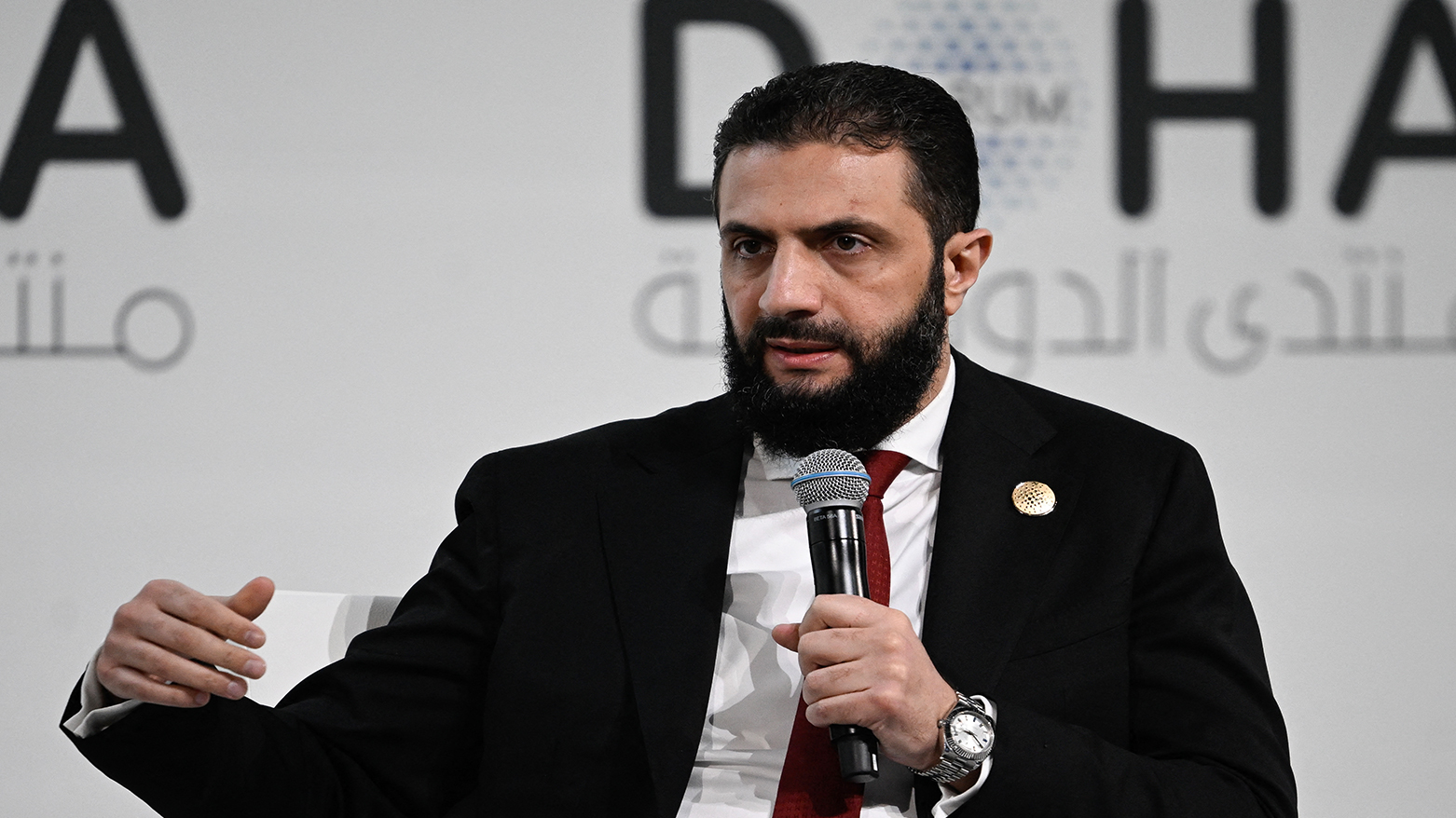
ERBIL (Kurdistan24) — President Ahmed al-Sharaa on Saturday warned that Israel’s push for a demilitarized zone in southern Syria could endanger his country, as Israeli forces continue operations in the area. Israeli troops have entered a UN-patrolled buffer zone on the Golan Heights, which has separated Israeli and Syrian forces since 1974.
Since Sharaa’s Islamist alliance ousted Bashar al-Assad on December 8 last year, Israel has conducted repeated incursions deeper into Syrian territory and carried out airstrikes, while insisting on the establishment of a demilitarized zone in the south.
Speaking at the Doha Forum, Sharaa emphasized Syria’s commitment to the 1974 disengagement agreement with Israel, which he described as “a successful agreement” upheld for over 50 years.
He cautioned that tampering with the deal or seeking new arrangements could “lead us to a dangerous place,” underscoring the agreement’s international consensus and Security Council backing.
Sharaa said the United States is engaged in negotiations to address both Israel’s and Syria’s security concerns and supports Syria’s demand that Israeli forces return to their pre-December 8 positions.
“Syria is the one that is being subjected to Israeli attack… so who should be the first to request a buffer zone and a withdrawal?” he asked.
U.S. President Donald Trump has urged Israel to avoid actions that could destabilize Syria and its new leadership, following an Israeli operation late last month that killed at least 13 people and wounded six Israeli soldiers. Damascus condemned the strike as a “war crime” intended to “ignite the region.”
In November, Israeli Prime Minister Benjamin Netanyahu visited troops in the Golan Heights buffer zone, calling their presence critical to national security, drawing sharp criticism from Damascus and others in the region.
One year after toppling Assad, Sharaa has rebuilt Syria’s international standing and secured relief from economic sanctions. The U.S., European Union, and Britain have lifted major sanctions, and Damascus has announced new investment deals in infrastructure, transport, and energy.
Sharaa has also toured capitals in the Gulf, Europe, and Washington, and visited Russia, home to an exiled Assad.
Critics, however, argue that Sharaa still faces significant challenges at home. Sectarian violence in Alawite and Druze heartlands, alongside ongoing Israeli military operations, has tested his authority.
“International rehabilitation means little if all Syrians don’t feel safe walking their own streets,” said Nanar Hawach, senior Syria analyst at the International Crisis Group.
While many Syrians see Sharaa as the only viable option to prevent a power vacuum, the new leadership’s temporary constitution concentrates power in a presidential office set for a five-year transition and does not fully reflect the country’s ethnic and religious diversity.
Sharaa’s government has disbanded armed factions, including Islamist and jihadist fighters, though many were absorbed into the new army and security forces, including some foreign fighters.
Outbreaks of sectarian violence have persisted: massacres in March in Alawite areas killed over 1,700 people, while clashes in July in Druze-majority Sweida left more than 2,000 dead, including hundreds of civilians.
Investigations and trials have been launched, but experts caution that Sharaa’s ability to enforce national reconciliation remains limited. Nicholas Heras of the New Lines Institute said Sharaa “does not command a unified security apparatus that can enforce the rules made by his government,” noting his prior failures to contain sectarian violence.
Gamal Mansour, a researcher at the University of Toronto, described the integration of factional leaders into official positions as contributing to “a crisis of trust” among minority communities, though he added that most Syrians still view Sharaa as the only leader capable of maintaining stability.
Adding to domestic pressures is Israel, which continues airstrikes and regular incursions despite direct talks and the UN-patrolled Golan buffer. Israel’s insistence on a demilitarized zone in southern Syria remains a central point of conflict between the two neighbors.
The new Syrian parliament, selected in October, has yet to be fully seated, with 70 of 210 representatives still to be appointed by Sharaa. Meanwhile, Kurdish authorities in the northeast of the country, West of Kurdistan, have agreed in principle to integrate into the central government, though progress has stalled.
“Sharaa won abroad, but the real verdict comes at home,” said Hawach, noting that internal security, sectarian reconciliation, and territorial cohesion remain critical tests for the one-year-old government.