Erbil Governor Dismantles 'Untruths' Surrounding Erbil's Lanaz Refinery Incident
Erbil Governor Omed Khoshnaw confirmed two deaths in the Lanaz refinery riots, rejected land seizure claims, and vowed legal action against inciters.
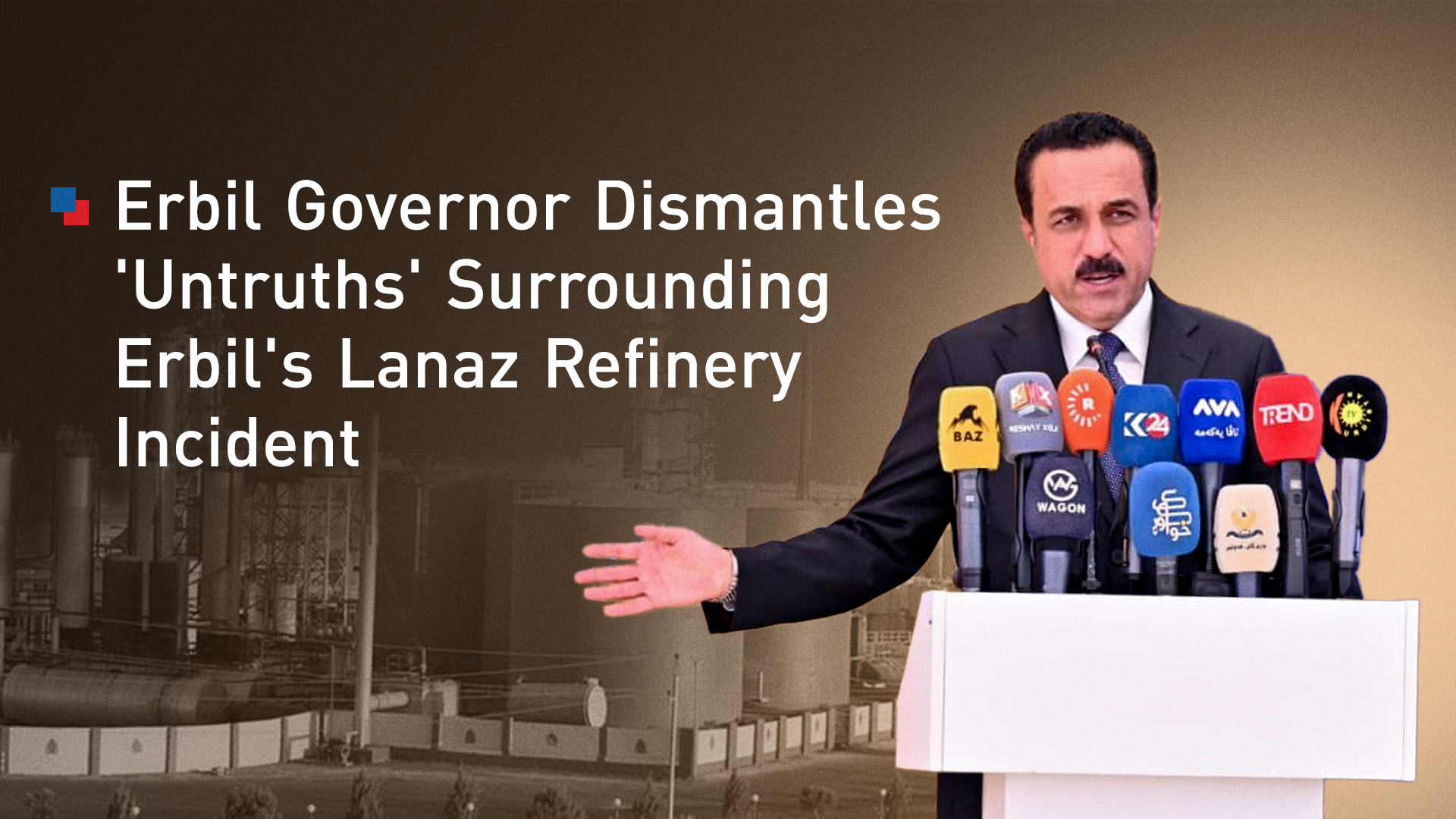
ERBIL (Kurdistan24) – In a comprehensive and forceful address aimed at correcting the public record regarding the violent unrest at the Lanaz refinery, Erbil Governor Omed Khoshnaw on Sunday presented a detailed forensic accounting of the events that led to two deaths and multiple injuries, categorically rejecting allegations of land seizure while accusing external actors and a number of media outlets of orchestrating a campaign of incitement that threatened the social peace of the Kurdistan Region.
Speaking at a press conference characterized by a rigorous presentation of facts intended to dispel what he termed a web of "deception" and "untruth," the Governor outlined the legal, economic, and security dimensions of the conflict, asserting that the government has successfully restored control and will pursue justice through judicial channels against those who transformed a demand for services into an armed riot involving heavy weaponry.
The Governor began his address by tackling the central grievance that had been amplified by various political figures and media channels: the allegation that the land housing the Lanaz refinery had been forcibly occupied or seized from the residents of Lajan village.
Khoshnaw dismissed this narrative as having absolutely no basis in truth, positioning it as a fabrication designed to inflame local tensions. He clarified that when the refinery was originally constructed, the land was acquired through a transparent purchase process where monetary compensation was paid directly to the landowners.
To underscore the government's confidence in the legality of the transaction, Khoshnaw issued a sweeping invitation for scrutiny, calling upon media channels, the Public Prosecution, the Integrity Commission, or any governmental entity to investigate the property records.
He offered an assurance that any such inquiry would confirm that "the land was bought, not granted by the state or confiscated from citizens," thereby dismantling the primary moral justification utilized by the instigators of the unrest.
Moving beyond the property dispute, the Governor provided an exhaustive breakdown of the economic and social engagement between the refinery and the local community, challenging the claims that the villagers had been marginalized or denied benefits.
He presented documentation detailing a robust package of services and employment opportunities that had been extended to the village of Lajan, arguing that the company had gone beyond its obligations.
Khoshnaw revealed that nearly 70 individuals from the immediate location had been employed, fulfilling a significant portion of the community's initial demands.
Furthermore, in the adjacent steel factory, which operates alongside the refinery and employs nearly 300 staff, additional villagers were hired, while another 73 individuals from Lajan were specifically employed at Lanaz.
The economic integration extended to logistics, with the Governor noting that a specific mechanism had been established to employ 67 trailer trucks belonging to the villagers, managed by a local council to ensure daily work opportunities.
Khoshnaw was frank about the limitations of these arrangements, recounting that when demands for even more employment arose, the company had communicated clearly that the allocation for Lajan was already in excess compared to other neighboring villages that also required attention.
He firmly rejected the narrative that "nothing was given," framing the village’s transformation as proof of prosperity; he noted that prior to the refinery's establishment, the village consisted of fewer than 100 families, whereas today it boasts 425 families.
This demographic explosion, characterized by households expanding from single units to owning multiple homes, was cited by Khoshnaw as irrefutable evidence that the refinery’s presence had improved the quality of life and business environment, prompting a return of residents to the area.
However, the Governor’s address took a somber turn as he detailed the human cost of the riots, which he distinguished sharply from peaceful protests.
He confirmed that two individuals had lost their lives during the chaos, referring to them as martyrs. The first victim was identified as an innocent driver from Kirkuk who was working at the site, while the second was a guard who succumbed to wounds after being hospitalized for several days.
The violence also resulted in six injuries, including four villagers, a child of Arab descent who was working as a shepherd in the vicinity, and a driver from Northern Kurdistan. The toll of eight casualties—two dead and six wounded—served as a grim testament to the severity of the incident.
Khoshnaw was particularly emphatic regarding the nature of the disturbance, questioning the legitimacy of describing the events as a demonstration.
He revealed that the violence involved the use of Rocket-Propelled Grenades (RPGs), posing the rhetorical question to the public and the media of whether a protest is conducted with such heavy weaponry. "Is a demonstration conducted with RPGs? If you confront a place with an RPG, is that a demonstration, or is it chaos and the disruption of peace?" he asked.
The use of RPGs and Kalashnikovs, he argued, constituted chaos and a deliberate disruption of peace rather than a civil demand for rights.
In the aftermath of the security response, 16 Kalashnikov rifles and one RPG were surrendered to the police, although the Governor noted with certainty that these surrendered arms were likely not the specific weapons used during the incident, implying that the perpetrators had concealed the actual instruments of the crime while handing over others to feign compliance.
The security crackdown has been swift and targeted.
Khoshnaw announced that the primary instigator responsible for starting the riot had been arrested early on. Following dialogue between government institutions, village representatives, and the families of the accused, five additional suspects were handed over by their own community.
Investigative files have been opened for all detainees, and they are currently being processed through the judicial system.
The Governor also linked the unrest to a separate incident in Khabat, where two individuals were arrested and investigative files opened. He referenced a public confession from one of these detainees to reject any notion that the actions were politically sanctioned by any party, labeling the perpetrators strictly as "rioters."
Nevertheless, the political implications of the unrest were addressed with notable specificity.
Khoshnaw issued a direct request to the leadership of the Patriotic Union of Kurdistan (PUK), pointing out that one of the individuals whose confession was published held the rank of a committee official within that party.
While expressing disbelief that the violence represented official PUK policy, the Governor demanded a clarification of the party’s position.
He suggested that the PUK should be grateful to the Kurdistan Region’s security apparatus—including the Internal Security Forces, the Security Council, and the Ministry of Interior—for apprehending an individual who, allegedly guided from outside the Kurdistan Region, incited violence that led to the burning of public institutions.
Khoshnaw listed the targets of this arson, which included the headquarters of the Youth and Sports Center, the National Card building, and the Commission's representation office, questioning what possible connection these administrative centers could have to the grievances regarding the refinery.
In a move to ensure transparency and counter allegations of mistreatment, the Governor threw open the doors of the detention centers to international scrutiny.
He invited human rights organizations, United Nations agencies, diplomatic missions, and local human rights bodies to visit and observe the legal measures and treatment of the detainees, expressing confidence that the procedures were being conducted strictly within the framework of the law.
This openness was paired with a stern warning that while the innocent would not suffer for the crimes of the guilty—invoking the idiom that "the wet and dry will not burn together"—the law would be applied rigorously to those involved in the rioting and anyone contemplating future unrest.
A significant portion of the press conference was dedicated to exposing the role of certain media outlets in exacerbating the crisis. Khoshnaw accused specific channels of dedicating themselves to creating chaos and fabricating a narrative of instability.
He directly attributed the temporary displacement of women and children from the village to the fear-mongering of these misleading media reports, stating there was no operational reason for families to flee into the open fields.
He recounted how government officials, accompanied by village dignitaries, had gone to the families in the fields that night to reassure them, resulting in their return to their homes once they realized the government’s intent was protection, not persecution.
He called upon the Ministry of Culture to enforce the Press Law against channels that had sacrificed credibility for viewership, accusing them of being unable to bear the sight of Erbil as an example of peace in the Middle East.
To further illustrate the community support provided by the refinery, Khoshnaw read a litany of services that Lanaz had funded, emphasizing that these claims were corroborated by the villagers themselves.
These included the construction and renovation of schools, complete with the recent replacement of all air conditioning units, the building of a health center, the development of road networks, and the construction of a stadium slated for future renovation.
He highlighted a direct financial injection into the village economy through a monthly assistance fund of $14,000, distributed by a council of the villagers every four months. The company also maintained water and electricity networks, dug replacement wells when water sources dried up, and funded the construction of event halls.
On a humanitarian level, the refinery covered the costs for medical treatment abroad for patients sent to India and Türkiye when local treatment was unavailable, as well as providing financial assistance to patients within the region.
The Governor concluded by outlining the ongoing security measures designed to demilitarize the village and prevent a recurrence of such violence. A specialized committee has been formed to inventory all weapons in Lajan, with 24 firearms registered so far.
Khoshnaw acknowledged the complexity of the task, noting that many residents are members of the Peshmerga, Asayish, or Police and therefore possess weapons legitimately. However, he insisted that all weapons, whether licensed or unlicensed, formal or informal, would be registered to clarify the security landscape.
Omed Khoshnaw’s address served as a reassertion of state authority and a defense of the region’s stability against what he portrayed as a nexus of internal lawlessness, external incitement, and media manipulation.
By detailing the economic benefits provided to the village, he sought to delegitimize the grievances that sparked the riot, while his confirmation of the deaths and the use of heavy weapons justified the robust security response.
The Governor’s message was one of finality: the rioters’ plan to expand chaos into Erbil city had failed, the situation was under control, and the institutions of the Kurdistan Regional Government would continue to serve the people while enforcing the law without hesitation.