‘Journalists Don’t Just Die — They’re Killed,’ Press Freedom Group Says
RSF reports 67 journalists killed in 2025, mostly by regular armies and crime syndicates. Gaza and Mexico remain deadliest, with global detentions rising to 503.
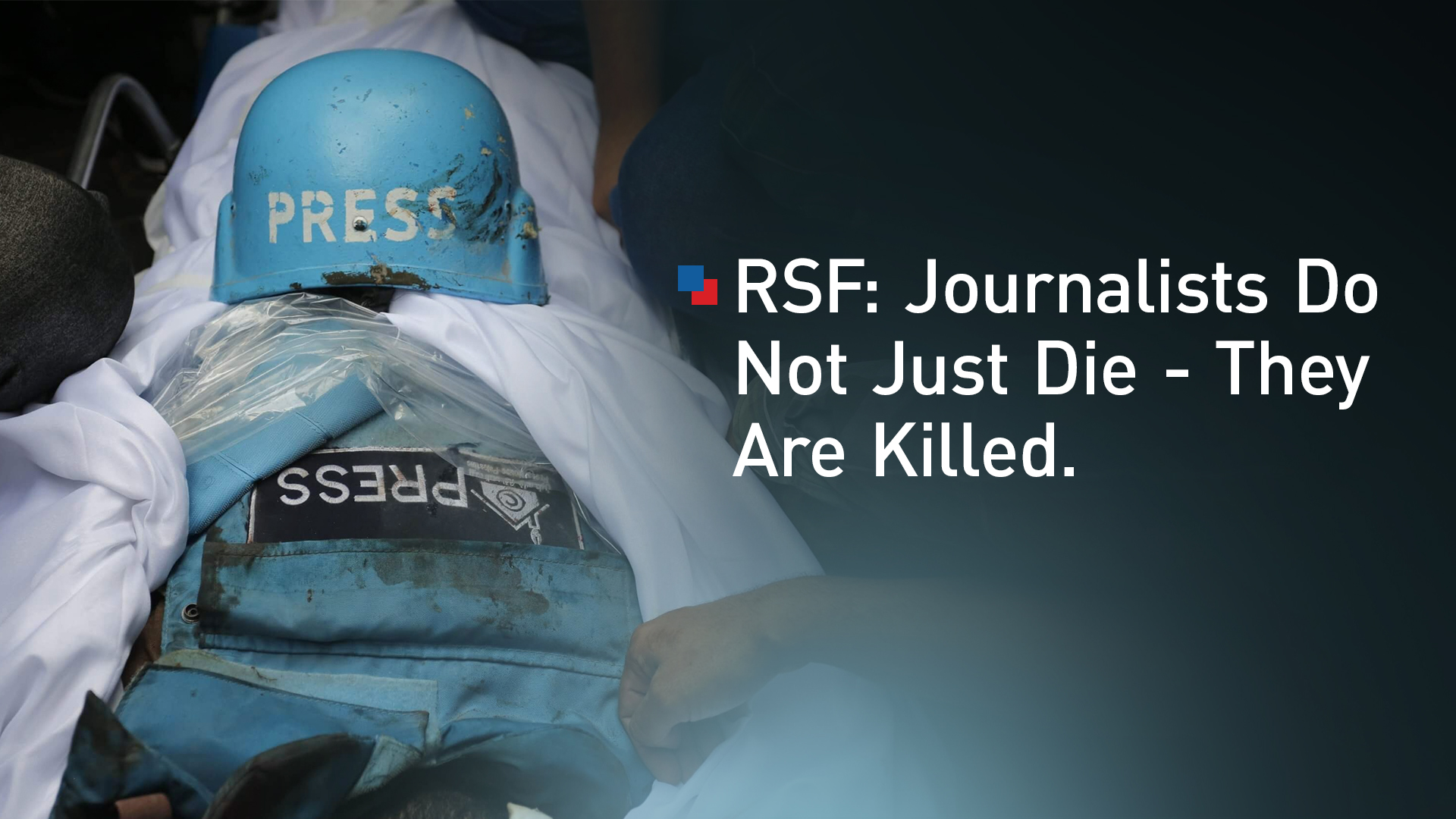
ERBIL (Kurdistan24) — In a year defined by the grim resurgence of conventional warfare and the unchecked proliferation of organized crime, the profession of journalism has faced an existential assault, not merely from the chaotic crossfire of conflict, but through the deliberate, calculated targeting of news professionals. According to the exhaustive 2025 annual round-up released by Reporters Without Borders (Reporters sans frontières - RSF), the past twelve months have cemented a terrifying reality: "Journalists do not just die – they are killed."
The statistics detailed in the report paint a harrowing picture of the global media landscape between December 1, 2024, and December 1, 2025.
In this period, 67 media professionals were killed worldwide, a rise in fatalities driven largely by the criminal practices of military groups—both regular armies and paramilitary forces—as well as sophisticated criminal networks. The data reveals that the killing of journalists has ceased to be an accidental byproduct of war.
Instead, it has become a strategic objective for those who wish to silence inconvenient eyewitnesses to history. As RSF Director General Thibaut Bruttin noted in the report, the world must discard false notions about reporters; these individuals do not simply give their lives for journalism, but rather, their lives are violently taken from them.
The Middle East: The Epicenter of Lethal Violence
The geopolitical fracture lines of the Middle East have once again proven to be the most dangerous terrain for the press, accounting for half of all journalists killed globally in 2025.
Central to this devastation is the ongoing conflict in Gaza. The report identifies the Israeli armed forces as being responsible for nearly half—specifically 43 percent—of all crimes committed against journalists over the past twelve months.
Since October 2023, the scale of loss in the Palestinian territories has been catastrophic.
The RSF dossier indicates that the Israeli army has killed nearly 220 journalists in total since the escalation began, with at least 65 of those targeted specifically due to their work or slain while actively reporting.
This persistent elimination of the press corps in Gaza has turned the enclave into a zone of silence, where the act of documentation is met with lethal force.
However, the Middle East’s peril is not confined to the Palestinian territories. The report highlights Yemen and Syria as continuing black holes for information, characterized by abduction and disappearance.
Furthermore, Sudan has emerged as an exceptionally deadly war zone for news professionals. In 2025, four journalists were killed while working in Sudan, with the conflict characterized by gross abuses against the press.
At least two of these deaths occurred after the journalists were abducted by the Rapid Support Forces, underscoring the lethal threat posed by paramilitary entities operating with total disregard for international humanitarian law.
The "Mexicanization" of Violence in the Americas
Across the Atlantic, a different but equally lethal dynamic has taken hold.
While the Middle East suffers under the weight of military artillery, Latin America is bleeding from the brutality of organized crime.
The RSF report outlines an alarming spike in murders in Mexico, where organized crime groups are responsible for the carnage seen in 2025. Despite the political transition and the commitments made to RSF by President Claudia Sheinbaum one year ago, the violence has not abated.
2025 has been recorded as the deadliest of the past three years for news professionals in Mexico, solidifying its status as the second most dangerous country in the world for journalists, with nine confirmed killings.
The report describes a disturbing regional trend termed "Mexicanization," where the brutal tactics employed by Mexican cartels and criminal gangs are spreading throughout Latin America.
This spread of organized violence accounted for 24 percent of the world’s murdered journalists in the past year, turning the region into a perilous landscape for those attempting to investigate corruption, trafficking, and governance failures.
This violence is overwhelmingly domestic.
One of the most striking findings in the RSF round-up is the local nature of the tragedy. Contrary to the cinematic image of the foreign war correspondent in peril, journalists are overwhelmingly more at risk within their own borders.
Only two foreign journalists were killed worldwide this year: French photojournalist Antoni Lallican, who was killed by a Russian drone strike in Ukraine, and Salvadoran journalist Javier Hércules, who was killed in Honduras, a country where he had resided for over a decade.
All other victims reported the news in their own nations, dying in the communities they served.
The Global Prison State: Detention as a Weapon
Beyond the immediate threat of assassination, the authoritarian toolbox for suppressing dissent heavily relies on mass incarceration.
As of December 1, 2025, the report lists 503 journalists detained in 47 countries across the globe. This industrial-scale imprisonment serves to paralyze newsrooms and intimidate potential whistleblowers.
China remains the world’s largest prison for journalists, holding 121 media professionals. Under Xi Jinping’s regime, 113 are detained on the mainland, with an additional eight imprisoned in Hong Kong, signaling that the People's Republic of China continues to exert a suffocating grip on press freedom.
However, the most significant shifts in the landscape of detention have occurred elsewhere. Russia has ascended to second place on this grim podium, holding 48 journalists.
Under the leadership of Vladimir Putin, Russia has distinguished itself by imprisoning more foreign journalists than any other state, with 26 Ukrainians currently behind bars. This targeting of foreign nationals highlights Moscow's strategy of using detention as a tool of geopolitical leverage and information control.
The situation across the former Soviet bloc reflects a broader collapse of press freedoms. The report cites serious threats in Belarus, Azerbaijan, and Georgia. In Azerbaijan, 25 journalists are currently behind bars.
In Georgia, the government’s relentless authoritarian tactics culminated in the January arrest of journalist Mzia Amaghlobeli, illustrating how quickly democratic backsliding translates into the persecution of the press.
Israel also ranks highly among the world's jailers of the press, following Russia as the second country to imprison the largest number of foreign journalists.
As of December 1, 2025, 20 Palestinian journalists are behind Israeli bars, 16 of whom were arrested over the past two years in Gaza and the West Bank.
Myanmar follows closely in the global rankings, holding 47 journalists, further cementing Asia and the Middle East as the primary centers of mass detention.
The Missing and the Hostages: A Legacy of Unresolved Grief
Perhaps the most haunting aspect of the RSF report is the plight of the missing—those who walked out to cover a story and simply never returned.
Currently, 135 journalists are missing in 37 countries. Some of these cases stretch back more than 30 years, leaving families and colleagues in a perpetual state of agonizing uncertainty.
The geography of disappearance is highly concentrated, with 72 percent of missing journalists disappearing in the Middle East and Latin America.
The trend spikes sharply in Mexico, where 28 journalists are missing, and Syria, which accounts for the highest number of missing news professionals in the world.
In Syria, 37 journalists remain missing, representing over a quarter of the global total.
The political landscape in Syria has shifted dramatically, yet the fate of these individuals remains sealed in silence. One year after the fall of Bashar al-Assad’s regime in December 2024, many of the reporters arrested or captured under his rule have yet to be found.
The downfall of the Assad dictatorship, and the earlier territorial defeat of ISIS, has not led to the recovery of these journalists, many of whom were held hostage by these regimes.
Furthermore, the vacuum of power in parts of Syria has introduced new threats.
Elements of the jihadist group Hayat Tahrir al-Sham (HTS) rose to power following the regime's collapse, yet the group continues to hold several journalists hostage. RSF explicitly demands their release, noting that the change in governance has not equated to a restoration of human rights.
Globally, hostage-taking remains a favored tactic of non-state actors. Twenty journalists are currently held hostage worldwide.
In 2025, Yemen became the epicenter of this specific crime, with the Houthi rebels taking seven journalists hostage in the last twelve months alone.
In Africa, the Sahel remains a zone of silence and captivity; in Mali, two years have passed since the abduction of Saleck Ag Jiddou, director of Radio Coton d’Ansongo, and presenter Moustapha Koné. They were taken by an unidentified armed group on November 7, 2023, while traveling to Gao, and remain in captivity.
A Crisis of Courage and the Failure of Protection
The findings of the 2025 round-up serve as an indictment of the international community’s inability—or unwillingness—to protect the free press.
The report argues that the failure of international organizations to ensure journalists’ right to protection in armed conflicts is not merely a bureaucratic oversight but the direct consequence of a global decline in the courage of governments.
Public policies that should serve as shields for truth-tellers have eroded.
RSF describes a world where criticism of the media, a legitimate aspect of democratic discourse, has descended into a virulent hatred. This hatred is often born out of, or deliberately stoked by, the tactics of armed forces and criminal organizations.
The result is a climate of impunity where journalists are treated as bargaining chips, pawns in diplomatic games, or targets to be "eliminated."
Thibaut Bruttin’s concluding remarks in the report underscore the urgency of the moment. He asserts that the hatred of journalists leads inevitably to death—not by accident, but by design.
The 67 journalists killed this year were not collateral victims; they were targeted for their work. The impunity that follows these crimes signals a breakdown in the rule of law and a terrifying normalization of violence against the media.
As 2025 draws to a close, the data presents a stark warning: without a renewed commitment from governments to implement protective policies and a refusal to tolerate the targeting of the press, the list of the dead, the detained, and the missing will only continue to grow.
The "Mexicanization" of crime and the militarization of censorship have created a global siege on the truth, one where the cost of reporting is paid in human lives.