WSJ Report: Gaza Lies Buried Beneath 68 Million Tons of Rubble
Gaza faces a 7-year, $1 billion cleanup of 68 million tons of toxic, bomb-laden rubble, stalling rebuilding as 81% of buildings are destroyed.
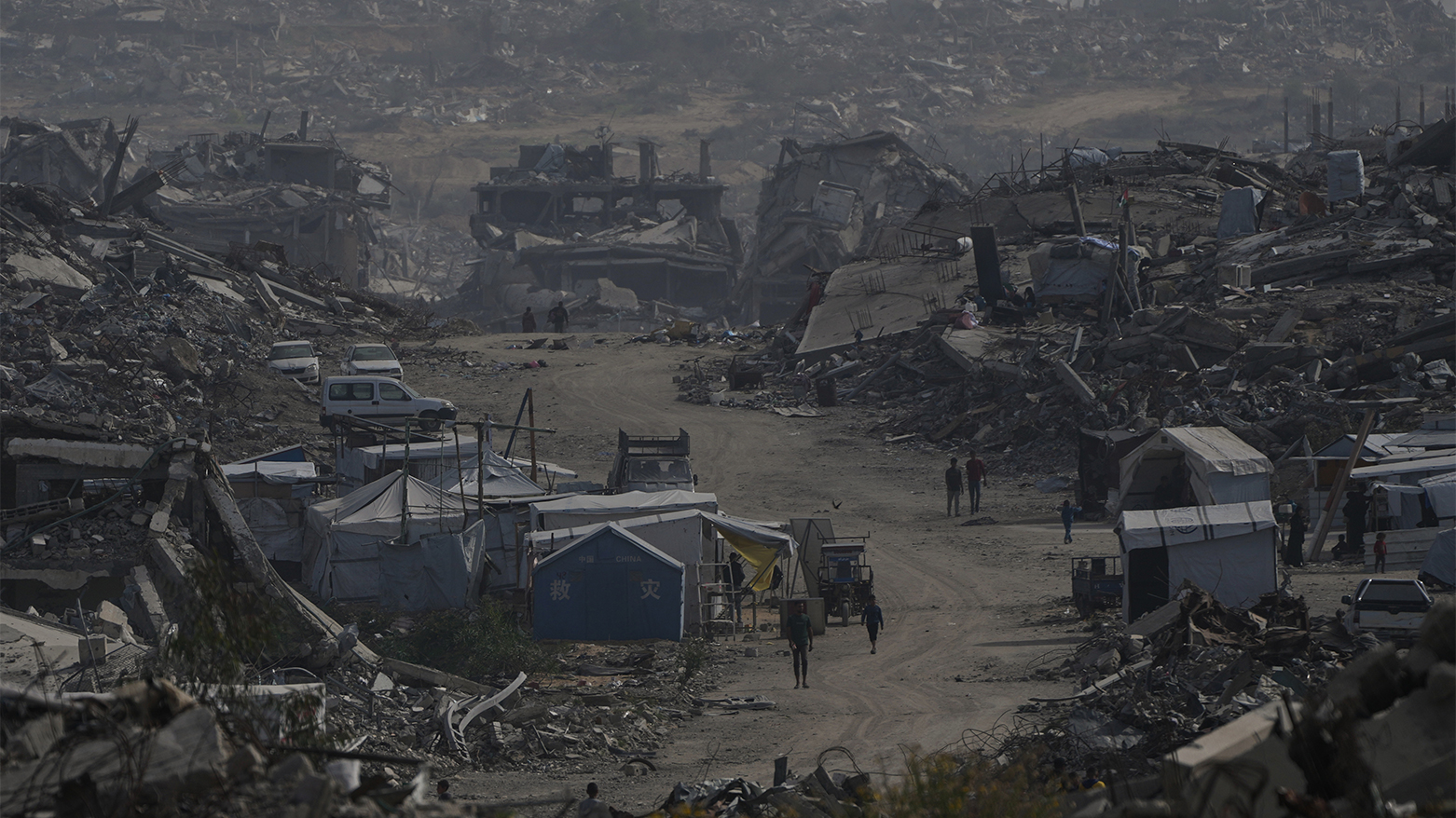
ERBIL (Kurdistan24) – In the devastating aftermath of a conflict that has transformed the urban landscape of the Gaza Strip into a dystopian expanse of ruins, the international community is beginning to grasp the colossal scale of the cleanup required before any reconstruction can even be contemplated.
A detailed assessment reveals that the war has left the enclave buried under approximately 68 million tons of debris—a staggering volume equivalent to the weight of 186 Empire State Buildings.
According to a comprehensive report by The Wall Street Journal (WSJ) published on Monday, clearing this wreckage to pave the way for rebuilding will be a gargantuan task expected to span up to seven years and cost well over a billion dollars, assuming the fragile ceasefire holds and political gridlock is resolved.
The physical destruction is nearly total.
The United Nations' latest review of satellite imagery indicates that thousands of Israeli airstrikes, combined with intense ground fighting and controlled demolitions, have destroyed more than 123,000 buildings in the Gaza Strip.
An additional 75,000 structures have been damaged to varying degrees.
In total, this accounts for 81 percent of all structures in the enclave, leaving virtually no neighborhood untouched. If the accumulated debris were spread evenly across Manhattan, it would cover every square foot of the island with 215 pounds of rubble.
However, the challenge is not merely logistical but lethal. The mountains of concrete and steel are mixed with thousands of unexploded ordnance—bombs, missiles, and artillery shells that failed to detonate.
More grimly, Palestinian health authorities estimate that the bodies of some 10,000 people remain trapped beneath the rubble, turning the cleanup into a massive recovery operation for human remains.
The U.N. Development Program (UNDP), which is spearheading the rubble removal efforts, has warned that the work cannot begin in earnest without the importation of heavy machinery. Yet, this remains a significant hurdle.
Israel, which controls all crossings into Gaza, considers heavy construction equipment such as excavators and crushers to be "dual-use" items that could be repurposed for military ends, specifically pointing to Hamas's history of using such machinery to build its extensive underground tunnel network.
Currently, Gaza possesses only a fraction of the necessary equipment: nine working excavators, 67 wheel loaders, and a single functioning crusher. The U.N. has requested permission to import 120 dump trucks, 80 wheel loaders, and 20 excavators to scale up operations, but approval is contingent on broader political agreements.
The Wall Street Journal highlights that significant progress is unlikely until Hamas and Israel agree on the second phase of a peace plan outlined by U.S. President Donald Trump. These talks are currently gridlocked over Hamas’s refusal to disarm and disputes regarding the future governance of the enclave.
Meanwhile, the U.S. is hoping that Arab Gulf states will foot a substantial portion of the reconstruction bill, which the U.N. estimates could reach $70 billion, though no funding agreement has been reached.
For the more than 2 million residents of Gaza, the situation is dire. Most are living in overcrowded tent camps or amidst the ruins, conditions worsened by the onset of winter rains.
Jaco Cilliers, head of UNDP’s operations in the Palestinian territories, offered a sobering timeline: "The best-case scenario is that it will take at least five, more like seven years" to clear the rubble.
The immediate priority for the UNDP has been clearing roads to facilitate humanitarian access to hospitals, bakeries, and temporary schools.
Approximately 209,000 tons of debris have been collected and recycled so far—a figure that Alessandro Mrakic, head of the UNDP office in Gaza, described as "the very tip of the iceberg." As teams eventually move to clear homes, Mrakic warned, "We will find more and more unexploded ordnance."
The human toll of the delay is visible daily.
Abdullah al-Hindawi, a resident of Gaza City, returned to find his family home destroyed and the street unrecognizable. "It’s just piles of debris, and everything is mixed together—you can’t tell whose house is whose anymore," he told the WSJ.
Similarly, Reem Ajjour, who fled her home leaving her husband and daughter behind, is desperate for machinery to recover their bodies. "I have no other option left," she said.
Demining remains a critical and dangerous component of the cleanup.
The U.N.’s Mine Action Service (UNMAS) has encountered hundreds of remnants of war but lacks the authorization to import specific technical equipment needed to neutralize them.
Julius Van der Walt of UNMAS stated, "Over the past two years we have not been able to clear any explosive ordnance in Gaza."
With medical workers reporting weekly injuries from these remnants, particularly among children, the debris fields remain a deadly hazard long after the airstrikes have ceased.