Maliki Pushes for Strong Iraqi Government Amid U.S. Demands
State of Law Coalition's leader Nouri al-Maliki stated Iraq needs a strong government to manage crises and relations with the US, amid increasing American pressure to disarm Iran-aligned militias, during a meeting with the US Embassy's chargé d'affaires.
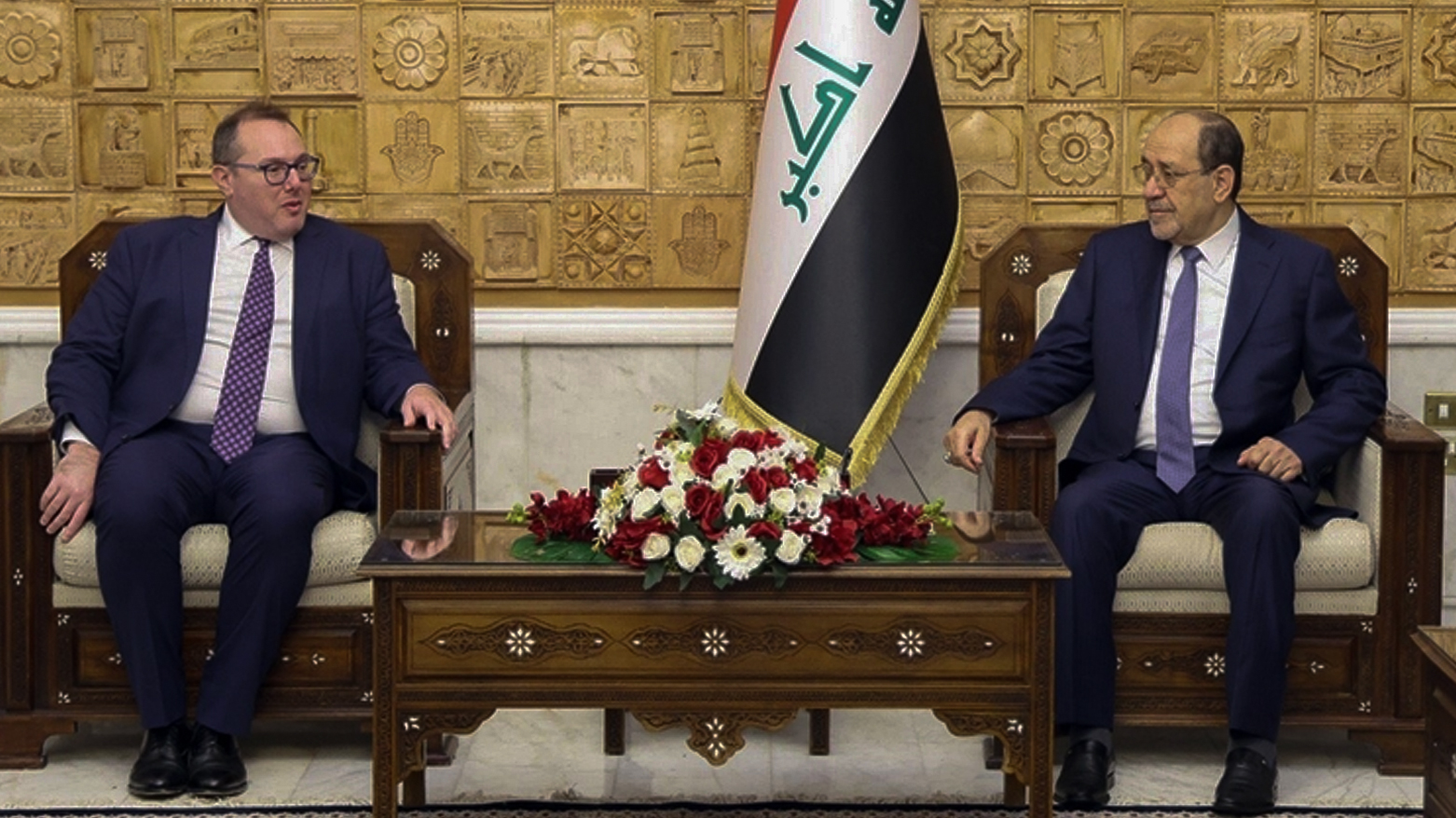
ERBIL (Kurdistan24) - Nouri al-Maliki, leader of the State of Law Coalition, said Iraq urgently needs a strong and capable government to address the escalating crises inside the country and manage its foreign relations—particularly with the United States—at a time when Washington is intensifying its calls for the disarmament of Iran-aligned militias.
His remarks came during a meeting with Joshua Harris, the chargé d’affaires of the U.S. Embassy in Baghdad, as the country remains without a new government nearly one month after parliamentary elections.
According to a statement from Maliki’s office, the State of Law leader welcomed Harris and discussed Iraq’s political and security situation, as well as ongoing negotiations over forming the next government.
During the meeting, Maliki affirmed that the Coordination Framework and national forces remain committed to establishing “a strong government capable of resolving Iraq’s internal and external challenges, and capable of developing its relations with world countries—especially the United States.”
He also stressed the importance of strengthening Iraqi-U.S. economic and trade relations, noting that these ties must continue within the framework of existing agreements.
Joshua Harris reiterated the United States’ desire to strengthen relations with Iraq, emphasizing that Washington maintains partnerships with political actors based on balance, without favoring one side over another.
He noted that the U.S. remains committed to supporting stability and cooperation with Baghdad across political, economic, and security fields.
Maliki’s call for a stronger government comes during a period of intensifying pressure from Washington, particularly from the U.S. Congress.
In a sharply worded statement, U.S. Congressman Joe Wilson called on Iraq to halt support for Iran-backed militias, protect the Kurdistan Region, and recognize that future American assistance will depend on Baghdad’s actions.
Wilson said Iraq must “stop allowing or encouraging Iran-backed puppets from attacking the KRG,” while praising President Donald Trump and his Special Envoy for Iraq, Mark Savaya, for adopting a firmer approach toward Iranian influence.
According to Wilson, Savaya has made clear that “business as usual in supporting Iran-backed militias will not be tolerated,” and that the U.S. seeks to “Make Iraq Great Again.”
Wilson noted that new provisions of the National Defense Authorization Act (NDAA) will—for the first time—condition U.S. support to Iraqi security forces on measurable steps to reduce the influence of Tehran-aligned armed groups.
He also highlighted longstanding congressional prohibitions on U.S. funds reaching organizations such as the Badr Corps and other groups aligned with Iran.
In his statement, Wilson accused previous U.S. officials of enabling Iran-aligned groups and claimed Tehran maintains extensive influence across Iraqi military, security, judicial, and political institutions, through factions such as Kataib Hezbollah, Asaib Ahl al-Haq, Kataib Imam Ali, and the Coordination Framework.
He called on Iraq to take immediate steps to stop funding Iranian proxies through state institutions and to undertake an international audit of all oil-related transactions.
Iraq continues to face political paralysis. Nearly a month after parliamentary elections, parties—particularly the Shiite blocs—have been unable to agree on forming a new government.
According to Maliki’s office, the State of Law Coalition has already declared him its candidate for prime minister, but no consensus has been reached among Shiite factions or other political groups.
Media outlets have reported that several Shiite figures are seeking the post, but none have secured agreement from the major blocs.
As Washington increases pressure on Baghdad to confront Iran-aligned militias and safeguard the Kurdistan Region, Maliki insists that only a strong government can navigate Iraq through its internal instability and complex external challenges.
However, with political negotiations deadlocked and divisions deepening among Shiite parties, Iraq’s path toward forming such a government—and addressing U.S. demands—remains uncertain.