U.S. House Votes to Repeal Caesar Sanctions, Paving Way for Major Syria Policy Shift
The US House voted to repeal Caesar Act sanctions on Syria, with conditions requiring periodic reports on Damascus' progress against extremism and minority rights, as part of the broader NDAA.
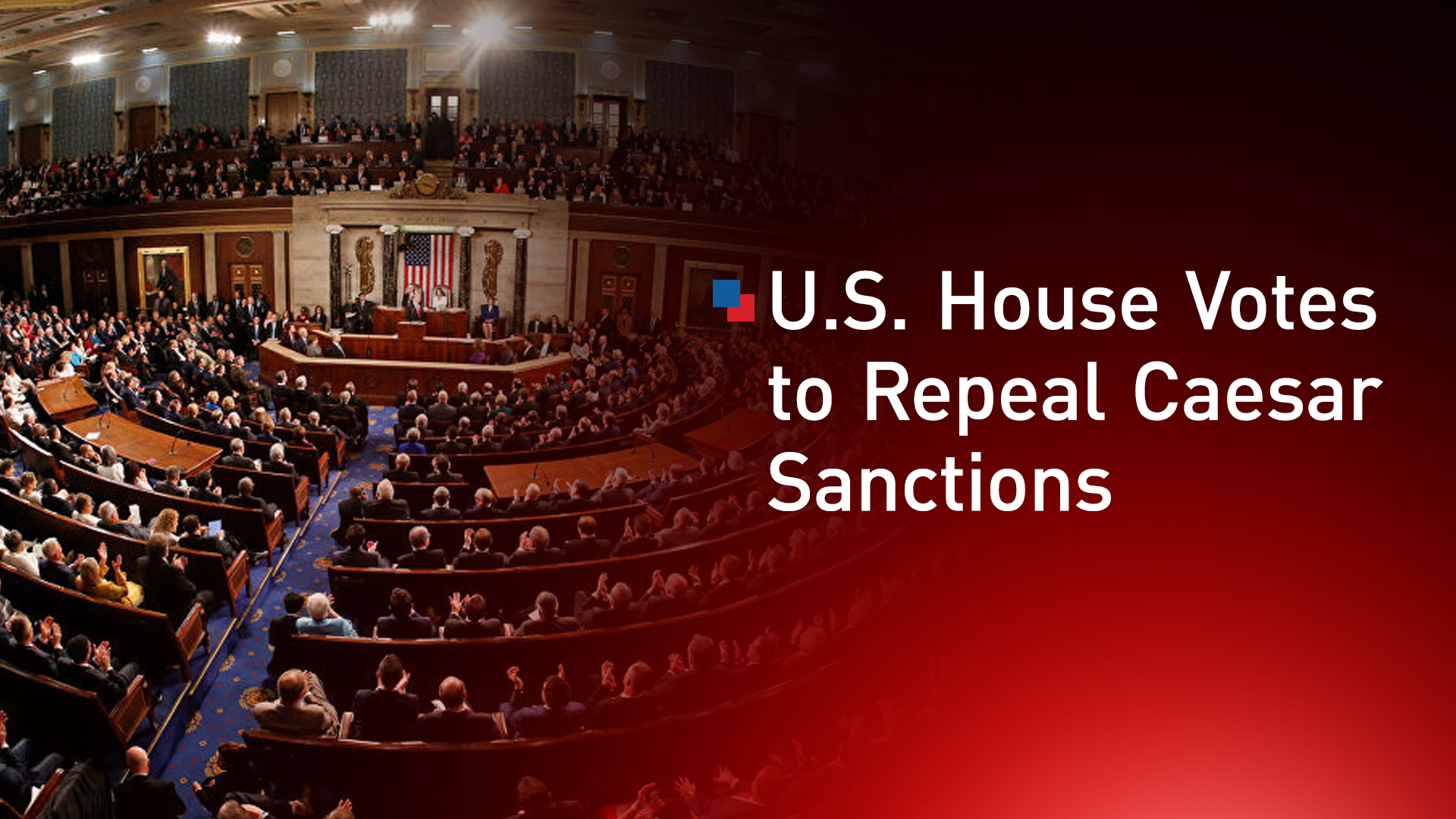
ERBIL (Kurdistan24) - In a landmark vote with far-reaching political and economic implications for Syria, the U.S. House of Representatives has approved a bill that formally ends the Caesar sanctions regime, paving the way for President Donald Trump to sign the repeal into law before the end of the year. The measure—folded into the broader National Defense Authorization Act (NDAA)—marks Washington’s most significant shift in Syria policy since the fall of the Assad regime in December 2024.
The bill now moves to the Senate, where Republicans hold a comfortable majority. A final vote is expected next week, after which the legislation will be delivered to President Trump for signature and immediate implementation.
The repeal raises a central question for millions of Syrians: Is this the beginning of an economic opening—or the start of a more demanding test for the new government?
If enacted, the law will terminate the 2019 Caesar Act, which enforced wide-ranging sanctions on Damascus under the previous regime. The new proposal obliges the White House to submit periodic reports affirming that the new Syrian government combats extremist groups and protects the rights of religious and ethnic minorities.
The move comes amid a political landscape transformed in December 2024, when opposition forces overthrew Bashar al-Assad, who subsequently fled to Russia. Since returning to office, Trump has already lifted numerous sanctions and strengthened cooperation with President Ahmed al-Shara, who played a pivotal role in Assad’s removal.
The bill outlines a series of nonbinding conditions that Washington will use to assess Syria’s progress. Among them:
-Removing or distancing foreign fighters from senior positions in state and security institutions.
-Ensuring rights and protections for religious and ethnic minorities, including freedom of worship, belief, and equitable political representation in ministries and parliament.
-Refraining from unprovoked or unilateral military action against neighboring countries, including Israel.
-Demonstrating progress toward international security agreements.
-Implementing the 10 March 2025 agreement negotiated between the Syrian government and the Syrian Democratic Forces (SDF), including proportional integration of security forces and political representation.
-Taking effective measures against money laundering, terrorist financing, and the proliferation of weapons of mass destruction.
-Ending support, shelter, or financing for any sanctioned individuals or groups posing a threat to U.S. national security and its partners.
The administration must also submit a detailed report to Congress within 90 days of the repeal, and every 180 days thereafter for four years. The report will assess whether the Syrian government is making “effective, tangible efforts” to eliminate the threat of ISIS and other extremist groups—including al-Qaeda and its affiliates—in cooperation with the United States.
The report must also document government steps to pursue accountability for perpetrators of serious human-rights violations, including massacres against religious minorities, and to combat the illegal production and global trafficking of narcotics such as Captagon. The White House is obliged to inform the Syrian government of each report’s findings.
The bill gives the President authority to reconsider sanctions on designated individuals if two consecutive reports fail to show positive progress, though this authority is not mandatory and cannot include sanctions on the import of goods.
As Congress moves to reshape sanctions policy, U.S. military leadership has publicly linked Syria’s future stability to the successful integration of the SDF into the Syrian national army.
Speaking at the Middle East Institute’s “Syria Conference,” U.S. Central Command (CENTCOM) Commander Admiral Brad Cooper said Wednesday that integrating the SDF into the Syrian military would “enhance the security environment.”
Cooper emphasized that U.S. advice and assistance to Syrian partners had significantly weakened ISIS, but warned that the fight is far from over.
“We are cooperating with the Syrian government to eliminate the threat of ISIS in Syria, and this will require international cooperation,” he said.
Cooper stressed that CENTCOM remains focused on the continuation of the war against ISIS, underscoring that defeating the group is essential to restoring stability for the Syrian population.
With the Cesar Act’s repeal on the horizon, expectations and uncertainties collide. The new law does not require the Syrian government to meet its listed conditions before sanctions are lifted—but it does embed a four-year oversight mechanism that could shape Washington–Damascus relations and influence future economic policy.
The coming months will determine whether the end of Caesar sanctions marks the beginning of economic recovery, or whether Syria will face a more complex phase defined by performance-based U.S. monitoring, integration challenges with the SDF, and ongoing counterterrorism obligations.
For now, Syrians find themselves at a pivotal moment—caught between the promise of relief and the weight of expectations from Washington.