Iraqi Coordination Framework Narrows PM Candidates as Government Formation Talks Advance
A source within the bloc told Kurdistan24 on Wednesday that the four names include Sudani, former Prime Minister Haider al-Abadi, and two additional candidates whose identities are being withheld pending an internal vote.
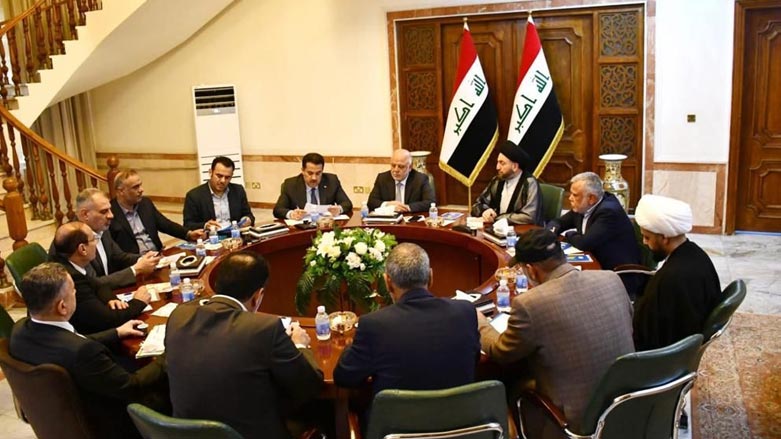
ERBIL (Kurdistan24) – As negotiations to form Iraq’s next government intensify, the Coordination Framework has narrowed its shortlist for the prime ministerial post to four candidates, with Mohammed Shia al-Sudani emerging as the frontrunner.
A source within the bloc told Kurdistan24 on Wednesday that the four names include Sudani, former Prime Minister Haider al-Abadi, and two additional candidates whose identities are being withheld pending an internal vote. The source noted that Sudani currently holds the strongest chance of securing the nomination, while al-Abadi is being considered as a joint consensus candidate within the bloc.
The source added that the upcoming Coordination Framework meeting will not finalize the names but will proceed in line with constitutional deadlines as broader negotiations continue.
According to information obtained by Kurdistan24, Shiite political leaders within the Coordination Framework have also intensified discussions over the allocation of ministerial portfolios. They are seeking to secure 12 ministries in the new cabinet, including a bid for the influential Foreign Ministry. Other ministries expected to remain under Shiite control include the ministries of Health, Interior, Labor and Social Affairs, Higher Education and Scientific Research, along with several additional key departments.
Iraq has been navigating another complex government-formation process following political disputes among major blocs over power-sharing, cabinet appointments, and the selection of the next prime minister. The Coordination Framework—a coalition of Shiite parties—has been working to consolidate its position and unify its stance as it negotiates with other political forces.
The selection of the next prime minister remains a central point in these talks, as competing factions vie for influence over Iraq’s executive branch and key ministries. The outcome of these negotiations will shape the direction of the new government and its ability to address pressing political, economic, and security challenges.
Polling for the sixth session of the Council of Representatives took place on November 11, with voting open from 7:00 a.m. to 6:00 p.m. across all Iraqi provinces, including the Kurdistan Region.
According to the Iraqi Independent High Electoral Commission (IHEC), voter turnout has surpassed 55 percent — an increase compared to recent electoral cycles. The commission said the figure is based on data from most polling centers and reflects the participation of more than 12 million voters out of over 21 million eligible Iraqis.
This year’s election featured a crowded field of political contenders: 38 political parties, 31 coalitions, and 75 individual lists. In total, 7,768 candidates—5,520 men and 2,248 women—competed for seats in the 329-member parliament.
The vote was held under a revised electoral framework, introduced in response to demands that emerged from the nationwide protests of 2019–2021. The system replaced proportional representation with a single non-transferable vote mechanism, dividing the country into 83 multi-member constituencies.