KRG Issues Situation Report as Floods Kill Several, Disrupt Key Infrastructure in the Region
Torrential rains and floods across Kurdistan killed four people, collapsed bridges in Kirkuk and Garmian, and damaged 500 homes in Chamchamal. KRG mobilized aid and compensation teams.
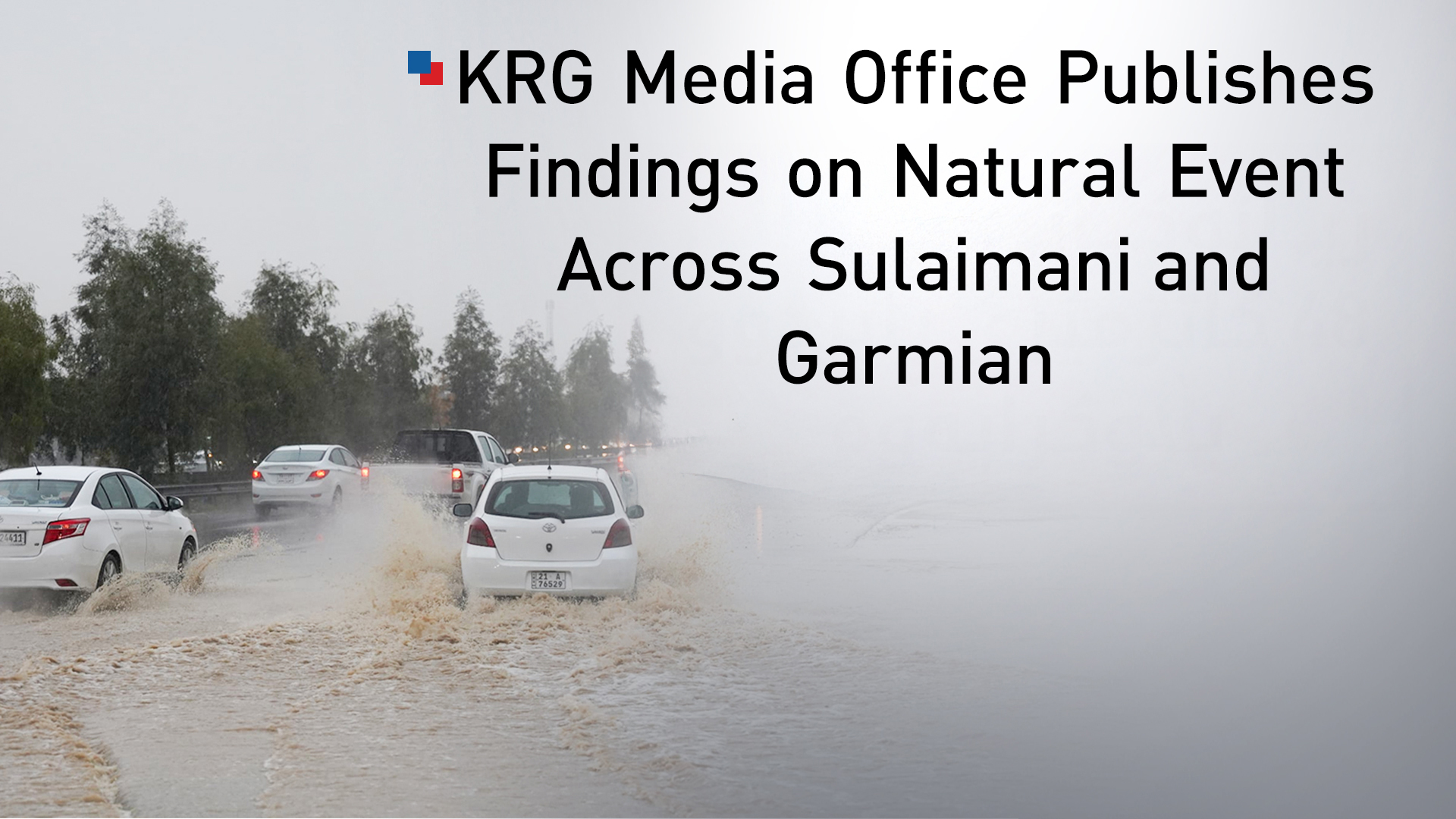
ERBIL (Kurdistan24) — A catastrophic deluge of torrential rain and flash floods swept across the Kurdistan Region over a volatile 48-hour period ending December 10, 2025, leaving a trail of devastation that has claimed lives, severed critical infrastructure, and mobilized a massive government and humanitarian response.
According to a comprehensive situation report released today by the Kurdistan Regional Government’s (KRG) Department of Media and Information, the severe weather system concentrated its fury on the Sulaimani Governorate and the Garmian Independent Administration, precipitating a natural event of significant magnitude.
The crisis has prompted the immediate formation of compensation committees and the deployment of emergency aid convoys, as regional authorities grapple with the aftermath of a storm that saw rainfall levels reach historic intensities in localized pockets.
The sheer scale of the precipitation was laid bare in the government’s data. While the initial wave on December 8 brought moderate rainfall, the system intensified dramatically by the afternoon of Tuesday, December 9.
In the Takiya sub-district alone, meteorologists recorded a staggering 173.5 millimeters of rain, with 80 millimeters falling in a violent four-hour window between 11:00 AM and 2:00 PM. The resulting runoff overwhelmed drainage systems and natural waterways, transforming streets into rivers and damaging hundreds of homes.
Human Toll and the Search for the Missing
The human cost of the storm has been immediate and tragic. Preliminary data from the KRG confirms that two individuals have lost their lives in the Sulaimani Governorate, with two others sustaining injuries and one person currently listed as missing.
The fatality count was further compounded by tragedies in the disputed territories and southern administrations. In the Garmian Independent Administration, a child in the Kalar District drowned after falling into surging floodwaters.
Similarly, in the Kirkuk Governorate’s Farqani village, a seven-year-old child drowned due to rising water levels; the victim’s body was recovered and transported to Laylan Hospital.
In a separate weather-related incident in the Erbil Governorate, six Peshmerga soldiers stationed in the Balisan area were wounded by lightning strikes.
Officials reported that the injuries were largely minor; five of the soldiers were treated at Ranya Hospital and returned to their posts, while one was referred to a hospital in Sulaimani for further care.
The Epicenter: Chamchamal and Sulaimani
The district of Chamchamal bore the brunt of the devastation.
The KRG report details that in Chamchamal District alone, 127.1 millimeters of rain fell on Tuesday, wreaking havoc on residential and public infrastructure.
Approximately 500 houses in the district sustained damage, while floodwaters breached more than 100 shops and warehouses.
The destruction extended to vital public services. The Chamchamal Library sustained significant damage, and five government offices were flooded. In the Dukan District, the Martyr Gharib Haladani Hospital and the Emergency Police Station were inundated, complicating emergency response efforts.
Education officials acted swiftly to ensure student safety. Abdullah Hama, the Director of Education in Chamchamal, told Kurdistan24 that an official holiday had been declared for Thursday, December 11, across all educational centers.
"Because the majority of schools have sustained damage, and in the interest of the students and teachers... we decided that tomorrow will be an official holiday," Hama stated. The pause in operations is intended to allow time for cleanup and repairs, with the Ministry of Education confirming that examinations in the district would be postponed until next month.
The infrastructure damage in Sulaimani has had cascading effects on connectivity. The main arterial roads linking Sulaimani to Chamchamal and Kirkuk to Chamchamal were forced to close, trapping hundreds of travelers at inspection checkpoints.
Utilities were also severed; electricity was cut off in Chamchamal District, internet connectivity was disrupted, and the district’s meteorological station itself sustained significant damage.
Garmian and Kirkuk: Infrastructure Collapse and Isolation
To the south, the Garmian Independent Administration and Kirkuk Governorate faced an infrastructure crisis. In Garmian, where 76.6 millimeters of rain fell late Tuesday, the rush of water severed the road between Kalar and Rizgari districts.
A bridge connecting Kifri and Rizgari in the Sarqala sub-district collapsed, creating major traffic obstacles.
The economic impact on Garmian’s agricultural sector has been severe. The Salam irrigation project in Hawara Sur, described as the "lifeline of Garmian," was completely washed away in sections.
The storm also destroyed numerous fish farming ponds, agricultural plastic houses, and artificial irrigation sprinklers. Livestock losses were reported across villages, with poultry and cattle perishing in the floods.
In Kirkuk, the damage to transport networks has severed a critical national artery. A strategic bridge in the Daquq District collapsed, causing a total cessation of traffic between Kirkuk and Baghdad. Furthermore, in the Laylan sub-district, a bridge in Bayanlu village was swept away, closing the Kirkuk-Laylan road.
Urban flooding in Kirkuk city was exacerbated by infrastructure failures. Soran Kamaran, a Kurdistan24 reporter on the ground, noted that despite a relatively short rainfall duration of 30 to 45 minutes on Wednesday, uncleaned manholes caused water to accumulate rapidly.
"Citizens of Kirkuk are frustrated and trapped," Kamaran reported, noting that residents were pleading for immediate intervention from water and sewerage teams.
Erbil and the Administrations: Turbidity and Snow
While Erbil, the regional capital, escaped the catastrophic structural damage seen in the south, it faces a significant challenge regarding water supply. The heavy rainfall caused a spike in turbidity levels in the Great Zab river.
Consequently, most water production projects located on the Great Zab have halted operations for a period of 24 to 48 hours. Authorities have issued a public request for citizens to conserve water during this production pause.
In the mountainous northern regions, the weather system manifested as heavy snow. The Soran Independent Administration reported that border crossings at Zet and Haji Omran were blanketed in snow, leading to a collision between two trucks. The heavy precipitation triggered landslides in the area.
Karwan Mirawdali, Director of Civil Defense for Soran, confirmed to Kurdistan24 that five cases of landslides onto roads were recorded, along with two instances of landslides affecting homes in Sidekan. Mirawdali emphasized the readiness of emergency services, stating, "Five 115 lines are continuously active, and five citizens can call simultaneously to request emergency assistance."
In the Raparin Independent Administration, the Kele crossing was completely closed on December 10 due to heavy snowfall, suspending all trade and tourism movements.
Government Mobilization and Institutional Response
The Kurdistan Regional Government has moved quickly to institutionalize its response to the disaster. According to the Department of Media and Information, a dedicated committee for compensating victims has already been formed in both Sulaimani Governorate and the Garmian Independent Administration.
This body is tasked with evaluating material damages to facilitate financial recompense for those who have lost homes and livelihoods.
The Ministry of Interior’s Joint Crisis Coordination Centre (JCC) is spearheading the logistical distribution of aid. Civil Defense teams across all cities have been placed on high alert.
In Akre, the Director of Civil Defense, Ibrahim Fariq, reported that his teams had been on alert since Sunday, successfully rescuing a family of four from a flooded home. "We ask people to go to their rooftops if water enters their homes," Fariq advised, urging those in low-lying areas to evacuate proactively.
In the Zakho Independent Administration, authorities are closely monitoring the Khabur River, which saw its water level rise from 95 centimeters to 205 centimeters. Teams from the dam and water resources directorates are maintaining a continuous vigil to prevent potential overflow.
Humanitarian Aid and Civil Society Action
Complementing the government’s efforts, major charitable organizations have launched rapid relief operations. The Barzani Charity Foundation (BCF) announced a significant deployment of resources to the hardest-hit areas. Musa Ahmed, President of the BCF, confirmed in a press conference that teams had reached Chamchamal at dawn on Wednesday.
"We consider it our duty for our teams to be on alert," Ahmed stated.
Ismail Abdulaziz, a member of the BCF administrative board, detailed the logistics of the operation to Kurdistan24: "Currently, 10 trucks of aid have set off toward Chamchamal. The aid consists of clothes, household goods, food, and health supplies."
The foundation is also active in Kalar and Sulaimani, coordinating with local administration to assess damages and register affected citizens.
Simultaneously, the 'Kurdistan Foundation' has initiated a relief campaign focused on Chamchamal. Dr. Yara Barzanji, Director of Programs and Partnerships, announced that the campaign aims to provide "rapid relief for the victims and providing them with basic necessities."
The foundation has begun setting up tents near the Chamchamal Police Station to house families whose homes were rendered uninhabitable. "Supporting more than 500 affected families by providing necessary supplies," Barzanji noted, highlighting the operation as a "national responsibility." The foundation has also called on philanthropists to register via the "Volunteer.krd" platform to assist in the recovery efforts.
Widespread Disruption to Daily Life
The cumulative effect of the storm has been a widespread disruption of daily life across the Kurdistan Region. In addition to the declared holidays in Chamchamal, educational centers in Sharazur, Dukan, Sharbazher, Penjwen, and Halabja have also been closed.
The University of Halabja and other higher education institutions in the affected governorates suspended activities as rainfall in Halabja reached 92.5 millimeters on Tuesday.
In the Shwan sub-district, the economic livelihood of many residents was imperiled as 400 fish ponds were submerged.
The Khalxalan water project was also submerged, adding to the utility strain. In Dukan, the damage extended to the commercial sector, with 15 shops, markets, and restaurants sustaining damage alongside seven residential properties.
As the waters begin to recede in some areas, the focus shifts to recovery and repair. The road repair crews have already cleared obstacles in Soran, where a falling boulder on the Gali Ali Beg-Bekhal road was removed by rapid response teams. However, the collapse of major bridges in Garmian and Kirkuk suggests a long road to full infrastructure recovery.
The KRG’s report concludes with a commitment to ongoing monitoring and support, ensuring that the mechanism for compensation and aid remains active as the full extent of the damage becomes clear.
With the forecast stabilizing, the immediate priority remains the welfare of the displaced and the restoration of critical lifelines connecting the region’s cities.