'Fighting the Invisible Enemy': Kurdistan Clears 576 Square Kilometers of Mines Amid Baghdad’s Delays
Kurdistan has cleared 576 sq km of mines, but 13,600 casualties and Baghdad’s lack of cooperation have delayed full clearance until at least 2028.
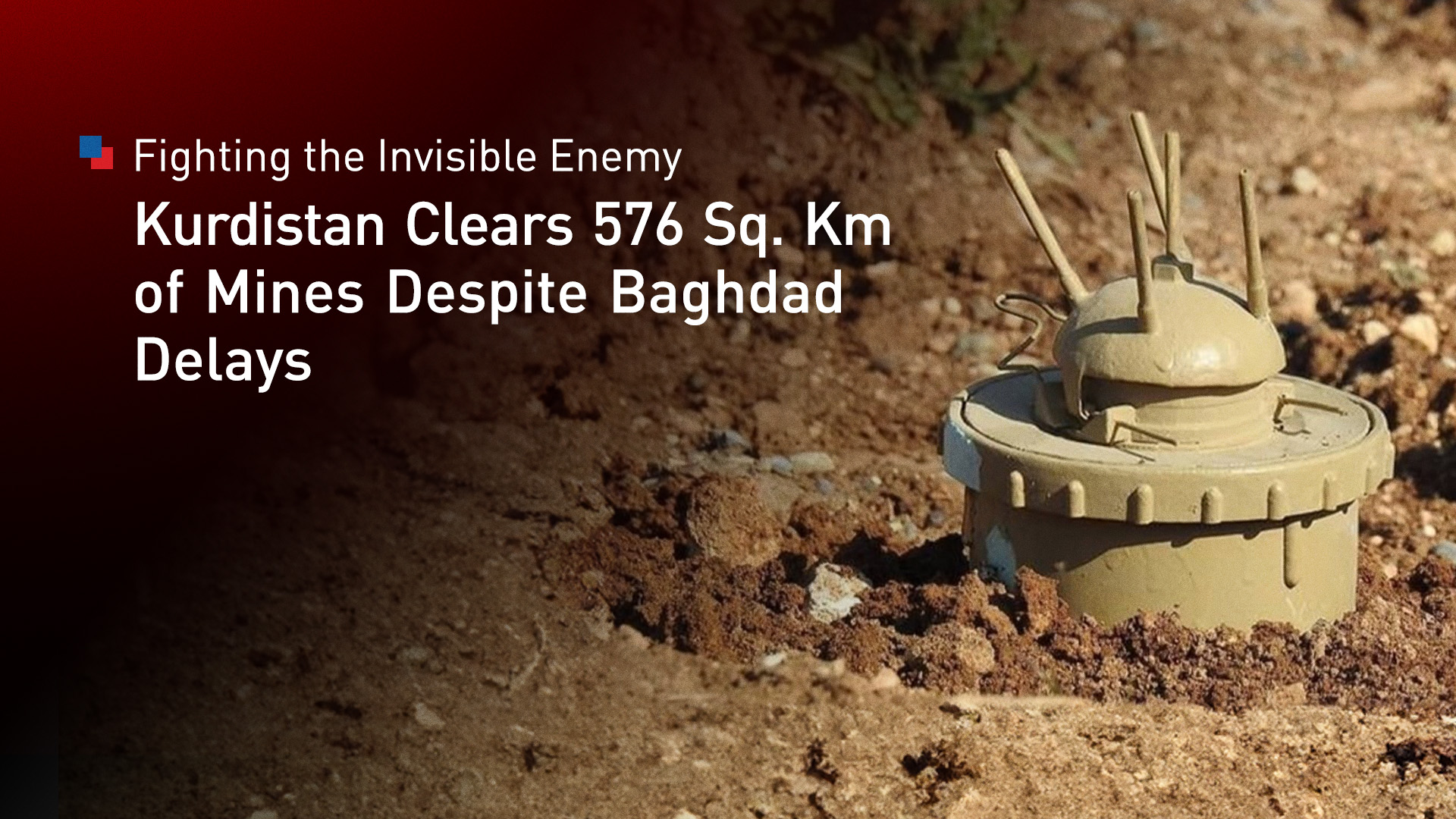
ERBIL (Kurdistan24) – Across the rugged mountains and fertile valleys of the Kurdistan Region, a silent and deadly legacy of the 20th century continues to shape the daily lives of the population, even as a massive government-led effort works to dismantle it one square meter at a time. In a significant milestone for public safety and economic restoration, authorities have successfully cleared approximately 576 square kilometers of land contaminated by landmines and explosive remnants of war.
However, this achievement highlights a grim reality: despite clearing the vast majority of the identified hazardous areas, the region remains hostage to a bureaucratic and logistical impasse.
According to senior Kurdish officials, the lack of cooperation from the federal government in Baghdad has forced a decade-long delay in meeting international disarmament obligations, leaving thousands of hectares of prime agricultural land effectively quarantined by high explosives buried decades ago.
The scope of the contamination is staggering. Out of a total identified area of 779 square kilometers of mined land within the Kurdistan Region, demining teams have managed to sanitize nearly 74 percent of the territory. Yet, the remaining 203 square kilometers represent a formidable challenge, both technically and politically.
The Head of the Mine Action Agency in the Kurdistan Region has issued a stark assessment regarding the timeline for total clearance.
Under the terms of the international Ottawa Treaty, also known as the Mine Ban Treaty, the entirety of the Republic of Iraq was legally obligated to be cleared of anti-personnel mines and explosives by the year 2018. That deadline has long passed.
Officials now indicate that due to a systemic lack of cooperation and support from the Iraqi federal government in managing this critical file, the process has been forcibly delayed by another ten years, pushing the target date for a mine-free Iraq to 2028.
For the residents of the region's rural districts, the removal of these devices is not merely a matter of international compliance but an existential necessity. The clearance operations have allowed for the reclamation of ancestral lands that had been no-go zones for generations.
Adib Akram, a local citizen who has witnessed the transformation of his community, described the profound impact of the demining efforts to Kurdistan24. He noted that citizens are now able to move freely in areas that were once synonymous with death.
"We work on our lands ourselves; we plow it and plant wheat," Akram stated, emphasizing the return of agricultural productivity to the area. "After it was cleared, we no longer have any problems."
His testimony underscores the dual nature of the crisis: the mines not only kill but also economically strangle communities by denying them access to their primary source of livelihood.
Akram recalled a darker time before the clearance teams arrived, noting that "many shepherds had become victims due to mines and explosives," a tragic reality that has scarred families across the region.
The human toll of this "invisible enemy" is quantified in harrowing statistics. Since the proliferation of these weapons began, approximately 13,600 people in the Kurdistan Region have become victims of mines and explosives.
This figure encompasses those killed instantly and those left with life-altering disabilities, creating a long-term medical and social burden on the region’s healthcare infrastructure. The sheer number of casualties reflects the density of the minefields, which were laid with the specific intent of maximizing harm.
These munitions are not remnants of a recent conflict but are the enduring footprints of the 1980s, planted by the former Iraqi Ba'ath regime.
During that era, the government in Baghdad utilized landmines as a tool of demographic engineering and military strategy, aiming to block the movement of Kurdish citizens, depopulate border regions, and facilitate campaigns of extermination against the Kurdish people.
Decades later, the political intent of the Ba'athists has dissipated, but the lethal mechanics of their strategy remain fully functional, lying dormant beneath the soil until triggered by the footstep of a farmer or a child.
Abdulaziz Mohammed Salih, the Head of the Operations Section at the Directorate of Mine Affairs in Duhok Governorate, characterized the ongoing struggle as a war against a foe that refuses to reveal itself.
"It is an invisible enemy; it is not in sight so that you know where it is or where it is not," Salih explained, capturing the psychological terror that defines life in contaminated zones. "It is hidden underground. Whenever it appears, we must deal with it very carefully."
The Directorate’s work involves the meticulous supervision of demining teams and the constant dissemination of awareness campaigns designed to educate the public on how to identify and avoid suspicious objects so that mines can be destroyed safely.
The administrative gridlock in Baghdad has compounded the physical dangers on the ground. Jabar Mustafa, the Head of the General Agency for Mine Affairs in the Kurdistan Region, expressed frustration over the missed milestones.
"The entirety of Iraq should have been cleared of mines and mine remnants by 2018, but they could not adhere to that," Mustafa stated.
Consequently, international bodies extended the deadline by ten years to 2028. However, even this extended timeline appears precarious. Mustafa revealed that the agency is now formulating a new program to submit a memorandum for yet another extension for the Kurdistan Region and Iraq to the Presidency of the Ottawa Convention.
This move signals that without a radical shift in resources and federal coordination, the 2028 goal may also slip out of reach.
The continued presence of these devices constitutes a war that has outlasted the conflict it was meant to serve. Officials argue that the war against mines is no less critical than the war against a conventional enemy of the state.
Kurdistan24 correspondent Bewar Helmi contributed to this report.