Baghdad Infrastructure Grinds to a Halt as Fiscal Paralysis Deepens
Baghdad construction halts as the Ministry of Finance freezes payments; experts blame 2025 budget delays and poor liquidity management for the crisis.
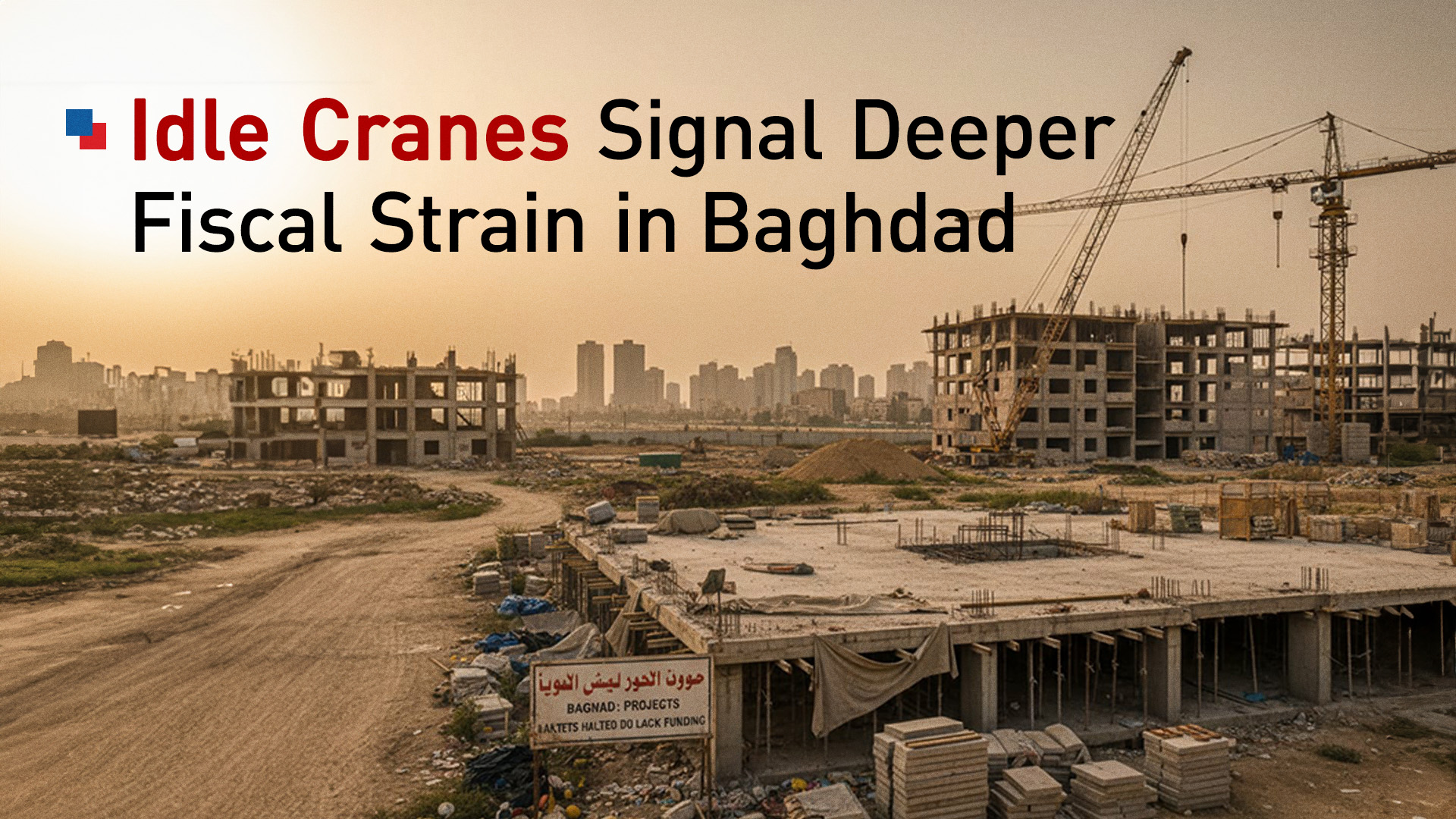
ERBIL (Kurdistan24) – The ambitious reconstruction of Baghdad’s skyline and the revitalization of its crumbling infrastructure have collided with a stark fiscal reality, bringing a significant number of investment projects across the capital to an abrupt and indefinite standstill.
The crisis, driven by the government's failure to disburse vital financial entitlements to contractors, has exposed a deepening rift between the private sector and the state apparatus, specifically targeting the Ministry of Finance for what experts describe as a systemic failure in liquidity management.
As cranes fall idle and construction sites go quiet, the paralysis serves as a grim indicator of a broader economic malaise characterized by record-high domestic debt and the inability of the government to prepare the necessary budget tables for the fiscal year 2025.
The stoppage of work is not merely a logistical pause but a symptom of a profound breakdown in the financial machinery of the Iraqi state.
According to reports from the ground, the relationship between the government and the contracting community—the engines of the country’s physical development—has deteriorated significantly.
This deepening problem is fueled by a breach of the implicit contract between the state and private enterprise, where the latter advances capital and labor with the expectation of reliable reimbursement. However, as day after day passes without payment, that trust has evaporated, leaving behind a landscape of unfinished structures and financial ruin for those who bet on the government's solvency.
Mustafa Dulaimi, a prominent contractor operating in the capital, provided a sobering account of the situation to Kurdistan24, illustrating the operational hazards facing the industry.
Under standard practices, contractors such as Dulaimi leverage their own resources to purchase construction materials on an annual basis, operating on the good-faith assumption that the government will honor its commitments and disburse financial entitlements corresponding to the completion of implementation stages.
This cycle of investment and reimbursement is the lifeblood of the construction sector. However, this rhythm has been shattered.
"Shocked to Find the State Treasury Empty"
Dulaimi described a scenario of utter dismay when contractors attempted to claim their due payments, only to be "shocked to find that the state treasury is empty." This revelation of insolvency has had a cascading effect, forcing the suspension of dozens of projects as companies simply lack the cash flow to continue operations without state reciprocity.
The attribution of blame for this gridlock has been squarely placed on the Ministry of Finance by economic observers and industry insiders.
Experts argue that the Ministry bears the primary responsibility for the current impasse, citing a failure to establish and implement a sound method for financial management.
The inability of the Ministry to navigate the complexities of the state’s finances has created a bottleneck that is choking off development.
This administrative inertia is most visibly manifested in the Ministry's failure to prepare and send the budget tables for the year 2025 to the Parliament. Without these tables, the legal and bureaucratic mechanisms required to release funds remain frozen, leaving the economy in a state of suspended animation.
Dr. Safwan Qusay, a noted economist, offered a detailed diagnosis of the structural failures underpinning the crisis.
In his assessment, the root cause of the non-disbursement of contractors' entitlements during the current year is unequivocally the delay by the Ministry of Finance in preparing the tables related to the 2025 budget.
Dr. Qusay nuanced the situation, suggesting that the crisis is not necessarily one of absolute destitution but of mismanagement.
"The money is not that significant," Qusay noted, implying that the funds required to keep these projects moving are within the realm of the state's potential resources. The critical failure, he argues, lies in the Ministry's inability to "manage the available liquidity."
The economist emphasized that a competent financial strategy would prioritize the management of funds first in the form of entitlements and subsequently in the form of funded expenditures.
The failure to distinguish between these priorities and to organize cash flow accordingly has resulted in a situation where available liquidity is locked within a dysfunctional system, inaccessible to the contractors who keep the city’s infrastructure development alive.
This mismanagement has transformed what should be a routine administrative process of payment into a crisis that threatens the economic stability of the capital.
The implications of this standoff extend far beyond the construction sector.
The halting of projects is a visible stress test for the entire Iraqi economy, which is currently groaning under the weight of accumulating financial pressures. Reports indicate that Iraq’s debts, particularly domestic debts owed to local banks and the central bank, have risen to record figures.
This accumulation of internal liability, coupled with the continued absence of a general budget, has created a climate of fear and uncertainty among economists and the public alike.
The anxiety is no longer confined to whether roads will be paved or buildings completed; it has metastasized into a dread regarding the fundamental obligations of the state.
There is a growing consensus among experts that if the current trajectory continues, the government may face challenges that dwarf the issue of unpaid contractors.
The fear permeating the economic sector is that the liquidity crisis could eventually impact the government's ability to provide employee salaries, the cornerstone of social stability in a nation where the public sector is the dominant employer.
The complete halt of projects serves as a warning sign of this potential escalation. If the Ministry of Finance cannot manage the flow of funds to pay for tangible assets like infrastructure, confidence in its ability to meet the monthly payroll obligations for millions of civil servants is severely eroded.
The narrative emerging from Baghdad is one of a government struggling to perform its most basic economic functions.
The "empty treasury" described by contractors is a potent symbol of a disconnect between the state’s ambitions and its administrative capacity. While the government projects an image of reconstruction and progress, the reality on the ground is one of stagnation.
The deepening problem between contractors and the government is a microcosm of a wider systemic failure, where the lack of a sound financial management strategy has allowed bureaucratic delays to metastasize into real-world paralysis.
As the Ministry of Finance continues to delay the submission of the 2025 budget tables, the costs of inaction are mounting. Every day that projects remain halted incurs losses not just for the contractors, but for the city of Baghdad itself, which remains deprived of essential services and modernization.
The shock experienced by contractors finding the treasury empty is rippling through the economy, undermining investor confidence and raising the specter of a broader financial collapse.
Unless the Ministry can swiftly rectify its management of liquidity and finalize the budgetary framework, the silent construction sites of Baghdad will stand as monuments to a fiscal policy that has lost its way, threatening to drag the rest of the economy down with it.
Kurdistan24 correspondent Seif Ali contributed to this report.