At Christmas Party, Trump Publicly Acknowledges U.S. Envoy to Iraq
Trump praised U.S. Envoy to Iraq Mark Savaya at a White House Christmas event, as the U.S. President praised sweeping first-year achievements.
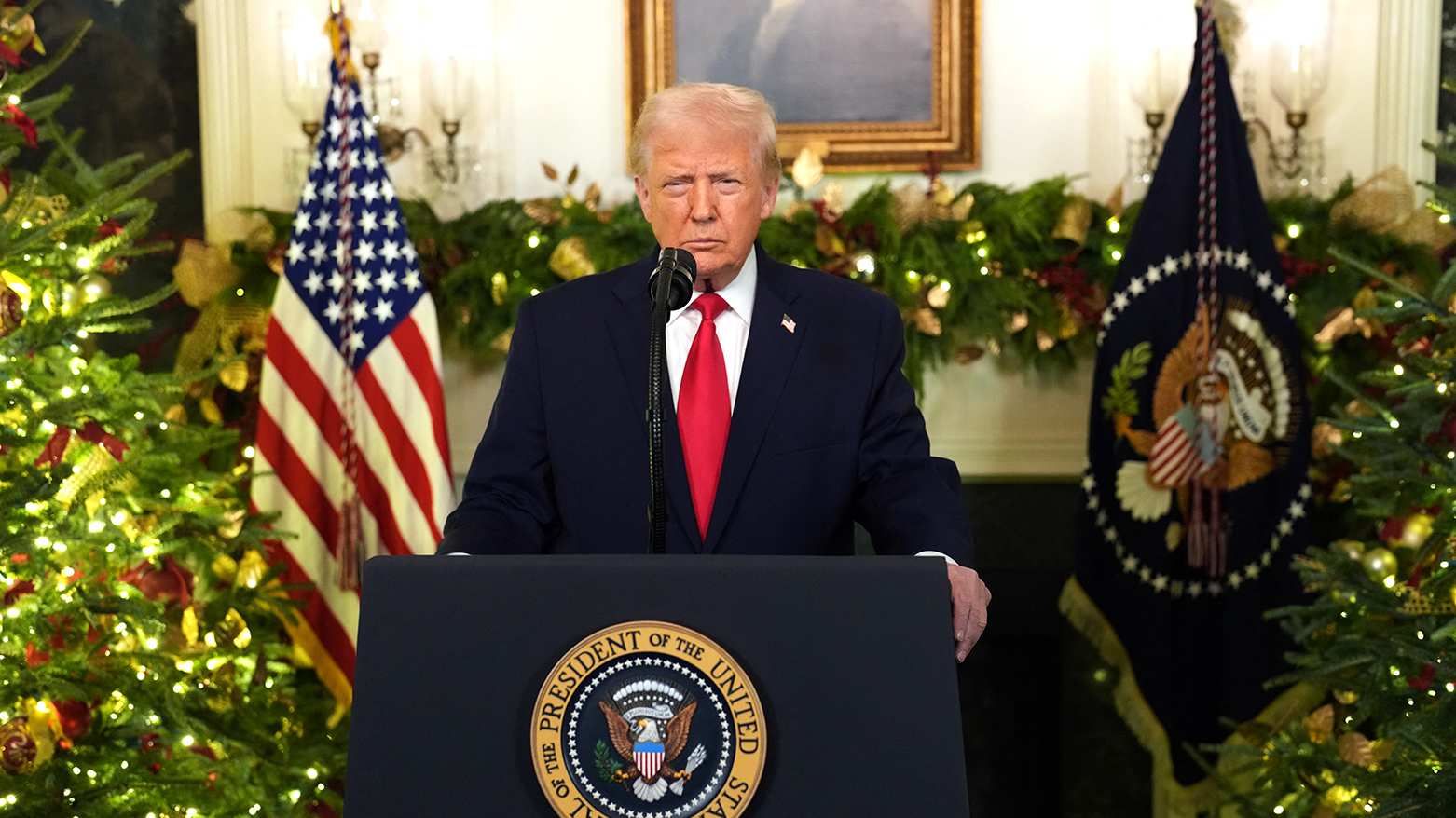
ERBIL (Kurdistan24) – A brief but pointed acknowledgment by U.S. President Donald Trump of America’s envoy to Iraq, Mark Savaya, during the White House’s 2025 Christmas party has drawn attention in diplomatic and political circles, symbolizing both personal rapport and the broader confidence projected by the administration as it declares sweeping domestic and international achievements.
In a post on X dated Dec. 19, 2025, Savaya publicly thanked President Trump for recognizing him during the White House Christmas gathering, writing: “President Trump, thank you for your kind acknowledgment at the 2025 White House Christmas party. You are truly the greatest president this country has ever had. Merry Christmas and may God bless you and the United States of America.”
The post was accompanied by a video capturing the moment in which President Trump acknowledged Savaya among a select group of invited guests, offering praise in front of the assembled audience.
The exchange occurred during what President Trump described as a particularly exclusive and tightly attended event.
Addressing the crowd, the president reflected on the significance of the gathering, noting that the Christmas party was “the toughest invitation,” emphasizing that attendance was limited and that those present held “special significance.”
Within that context, Trump called out Savaya by name, remarking, “Mark Savaya. Hey Mark! You’re looking good,” before continuing to recognize others in attendance and expressing pride in those gathered.
The moment, though brief, was emblematic of the administration’s broader messaging during the holiday season—an effort to project unity, loyalty, and confidence as the White House closed out its first year in office.
Savaya’s public response, effusive in its praise of the president, underscored the personal dimension of that acknowledgment and highlighted the envoy’s visibility within the administration at a time of heightened focus on U.S. foreign policy in the Middle East.
President Trump, thank you for your kind acknowledgment at the 2025 White House Christmas party.
— Mark Savaya (@Mark_Savaya) December 19, 2025
You are truly the greatest president this country has ever had.
Merry Christmas and may God bless you and the United States of America. 🎄 🇺🇸 pic.twitter.com/pjJzY3YBzl
The acknowledgment came against the backdrop of a sweeping year-end address delivered by Trump the previous evening, in which he outlined what the White House described as “transformative progress” achieved in just 11 months.
According to an official White House article published on Thursday, the President used the primetime address to frame his administration’s record as an unprecedented turnaround for the United States, both economically and strategically.
In that address, Trump declared that “over the past 11 months, we have brought more positive change to Washington than any Administration in American history,” a claim that set the tone for an expansive list of accomplishments cited by the White House.
He contrasted his presidency with the previous four years, asserting that the country had been governed by politicians serving insiders and foreign interests, while portraying his own leadership as focused on “the law-abiding, hardworking people” of the United States.
Central to Trump’s address was the issue of border security, an area the administration has consistently emphasized.
According to the White House article, Trump said the United States had inherited “the worst border anywhere in the world” but had transformed it into “the strongest border in the history of our country” within months.
He also claimed dramatic reductions in drug trafficking, stating that drugs brought in “by ocean and by sea” were down by 94 percent, language that echoed the administration’s broader narrative of aggressive enforcement and restored control.
The president also highlighted what he described as major foreign policy successes, telling the nation that he had “restored American Strength,” “settled eight wars in ten months,” “destroyed the Iran nuclear threat,” and “ended the war in Gaza”.
These claims, presented without elaboration in the White House article, were framed as evidence that the United States had regained global respect under his leadership.
Economic themes dominated much of the address.
Trump asserted that his administration had reversed rising costs inherited from the previous government, citing declines in car prices, gasoline, hotel rates, and airfares after sharp increases in prior years.
He further claimed that gasoline prices had fallen below $2.50 a gallon in much of the country following his declaration of a national energy emergency on his first day in office .
In a message aimed squarely at the military and their families, Trump announced a “special Warrior Dividend,” stating that more than 1.45 million service members would receive $1,776 before Christmas, a figure chosen to honor the year of America’s founding.
He also pointed ahead to what he described as the largest tax cuts in American history, predicting annual family savings of between $11,000 and $20,000 and the “largest tax refund season of all time” in the coming spring.
Additional claims included a reversal of migration trends, reductions in mortgage costs, record-breaking investment totaling $18 trillion, and efforts to confront health insurance companies and reduce prescription drug prices.
The White House article concluded with Trump’s assertion that, after 11 months, “our border is secure, inflation is stopped, wages are up, prices are down, our nation is strong, America is respected, and our country is back,” predicting an economic boom unlike any seen before.
Seen in this broader context, Trump’s acknowledgment of Savaya at the Christmas party was more than a casual aside.
It occurred within a carefully choreographed moment in which the president was reinforcing loyalty, celebrating his team, and projecting confidence as he summarized his administration’s record.
As the administration enters a new year promising further economic growth and sustained American strength, such moments of recognition serve to underline the internal cohesion the President seeks to display.