KRG Education Minister Honors Kirkuk Teacher as Symbol of Resilience Amid Flag Day Tensions
KRG Education Minister honors Kirkuk teacher for patriotism and refusing strikes, highlighting resilience amid Flag Day tensions and statue protests.
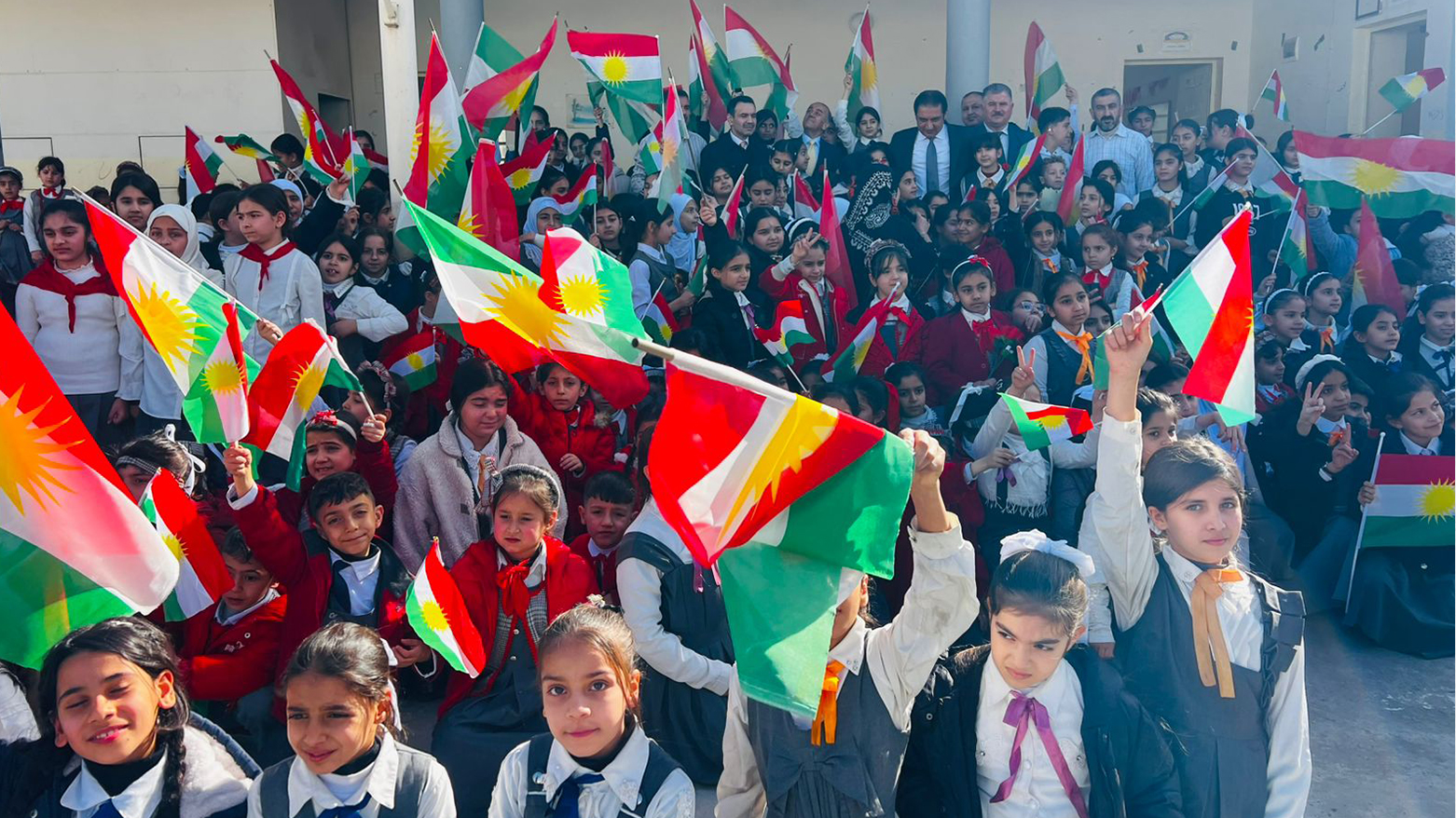
ERBIL (Kurdistan24) — The Minister of Education for the Kurdistan Regional Government (KRG) paid a high-profile visit to Kirkuk on Sunday to personally honor a local schoolteacher, a gesture designed to underscore the resilience of Kurdish educators in the Kurdistani territories following a week of heightened focus on national identity and symbols in the city.
Alan Hama Saeed, the KRG Minister of Education, traveled to the city to recognize "Mamosta" Amed, a teacher whose impassioned observance of Kurdistan Flag Day was captured in a widely circulated video.
The visit served as a focal point for broader grievances and pride within the Kurdish community in Kirkuk, coming just days after the official Flag Day commemorations on December 17 and amid ongoing public disputes regarding the display of the Kurdish flag on municipal monuments.
During the ceremony at the school, Minister Saeed framed the visit not merely as an individual commendation but as a symbolic act of support for all Kurdish educators working in areas outside the Kurdistan Region’s direct administrative control.
The minister referenced the viral footage that prompted his trip, noting that the teacher was seen educating students "with a high sense of patriotism."
"We were pleased to come to Kirkuk personally today to honor all the teachers of Kirkuk and the Kurdistani areas outside the Region's administration," Mr. Saeed said.
He emphasized that the recognition of Mamosta Amed was intended to serve "as a symbol for all those dear teachers," praising the educational centers in the city for playing a "significant role" during the Flag Day ceremonies earlier in the week.
He also emphasized that after the New Year, they will visit the schools of Khanaqin to support Kurdish education in that city.
Minister Saeed added, "In the Ninth Cabinet of the Kurdistan Regional Government, headed by Masrour Barzani, supplies worth more than one billion and 800 million dinars have been provided for educational centers in Kirkuk; meanwhile, several schools have also been renovated by the Barzani Charity Foundation." He emphasized that they will continue supporting Kurdish education.
Regarding granting land to employees and teachers of the area, the Minister of Education said: "We are in coordination with the Ministry of Municipalities to distribute land to teachers, and priority will be given to teachers of Kurdish education."
Alan Hama Saeed also said, "By order of Masrour Barzani, Prime Minister of the Kurdistan Regional Government, 2,159 Kurdish language non-tenured teachers have been converted to contract status, similar to non-tenured teachers in the Kurdistan Region. At the same time, for those teachers who were previously on contract and were made permanent, the decision was implemented in the same way in Kirkuk and other areas, and no distinction has been made between teachers of the Kurdistan Region and the Kurdistani areas outside the administration of the Kurdistan Region."
He also indicated, "The role of schools and the efforts and toil of teachers of Kurdish education in these areas to protect the Kurdish language are worthy of respect and praise, especially on December 17, Kurdistan Flag Day, when we saw how high and sacred the national sentiment is in this area; therefore, I want to commend them, and we respect all teachers of Kurdish education."
The recognition appeared to overwhelm Mamosta Amed, who described the minister's arrival as a shock.
"Words fail me when speaking to you," the teacher told reporters. "It’s like... you know how it is when they tell you 'a guest is coming,' but you don't know who it is? But when the guest arrives and His Excellency the Minister of Education honors us with his presence... truly, for me and for all the teachers of Kirkuk, this is very important."
However, Mamosta Amed quickly pivoted from her personal gratitude to the economic and political realities facing her colleagues. She dedicated the award to the "loyal and dedicated teachers of Kirkuk," specifically highlighting their refusal to interrupt the education of Kurdish children despite severe financial hardships.
"I dedicate this to those who did not boycott classes for even a single minute," Mamosta Amed said.
She alluded to the broader fiscal crisis that has frequently delayed public sector salaries, noting that "despite all the circumstances regarding salaries," the teachers in Kirkuk remained steadfast.
"Because we are in a Kurdistani territory and we are in Kirkuk living among other components of the city—they were never willing to boycott, and they were never willing to give up on serving the Kurdish children in Kirkuk," she added.
The emphasis on steadfastness in Kirkuk comes against a backdrop of deep historical and political resonance regarding the Kurdistan flag.
The Kurdistan Region officially marks Flag Day on December 17 to commemorate the day in 1945 when the flag was lowered from the official buildings of the Republic of Kurdistan in Mahabad. The date has since evolved into a symbol of perseverance.
The flag’s history is intertwined with the Kurdish national movement, dating back to 1919 when Dr. Kamuran Bedir Khan presented it to European powers.
Following the 1991 uprising and the subsequent fight against the Islamic State starting in 2014, the flag gained global recognition as a symbol of Peshmerga resistance. The Kurdistan Parliament formalized the flag's status in 1999 and designated the annual commemoration in 2009.
While schools within the Kurdistan Region observed the day with dedicated ceremonies before first-semester exams, the celebration carries additional weight in Kirkuk, a territory disputed between the federal government in Baghdad and the KRG in Erbil.
The sensitivity of the issue was highlighted earlier in the week when Kurdish youth staged a demonstration near the city’s Peshmerga statue.
According to previous reports by Kurdistan24, protesters gathered on Tuesday demanding that the Kurdistan flag be raised on the monument, from which it has been absent since October 16, 2017, when Iraqi federal forces and the Popular Mobilization Forces assumed security control of the province.
"The Kurdistan flag has been removed from the statue since October 16, 2017, and we feel unrepresented in Kirkuk," one demonstrator told Kurdistan24.
The protest reflected a fracture in public sentiment, with some activists demanding the flag fly alone and others suggesting it be displayed alongside the Iraqi flag. Security forces were deployed in large numbers to manage the gathering.
The dispute over the statue required the intervention of Kirkuk Governor Rebwar Taha, who met with the demonstrators to ease tensions.
The governor reportedly asked for time to address the administrative hurdles involved.
"Give me a couple of days, and I promise to raise the Kurdistan flag on the statue of the Peshmerga," Governor Taha was quoted as saying. Based on these assurances, demonstrators refrained from hoisting a large flag they had prepared.
The intersection of these events—the youth protests at the statue and the minister’s honoring of a teacher in the classroom—illustrates the dual pressure on Kirkuk’s Kurdish population to maintain their identity through both public symbols and institutional perseverance.
For the KRG, supporting the educational infrastructure in Kurdistani territories remains a strategic priority.
By highlighting the refusal of teachers to strike despite salary delays, Minister Saeed spotlighted a commitment to maintaining Kurdish cultural and linguistic presence in the city regardless of the financial or political climate.
Mamosta Amed, standing with the award, reiterated that the day was a victory for collective service over individual hardship.
"This award is dedicated to all those teachers," she said, framing his actions not as a political stunt, but as a necessary duty to the next generation in a city where identity remains a daily struggle.
The article was updated on Sunday, Dec. 21, 2025, at 02:14PM. Further statement and comments by the KRG Minister was added.