Macron Authorizes Construction of New Nuclear Aircraft Carrier to Replace Charles de Gaulle
The French president frames the decision as a strategic necessity amid global security tensions and deepening defense ties with the UAE.
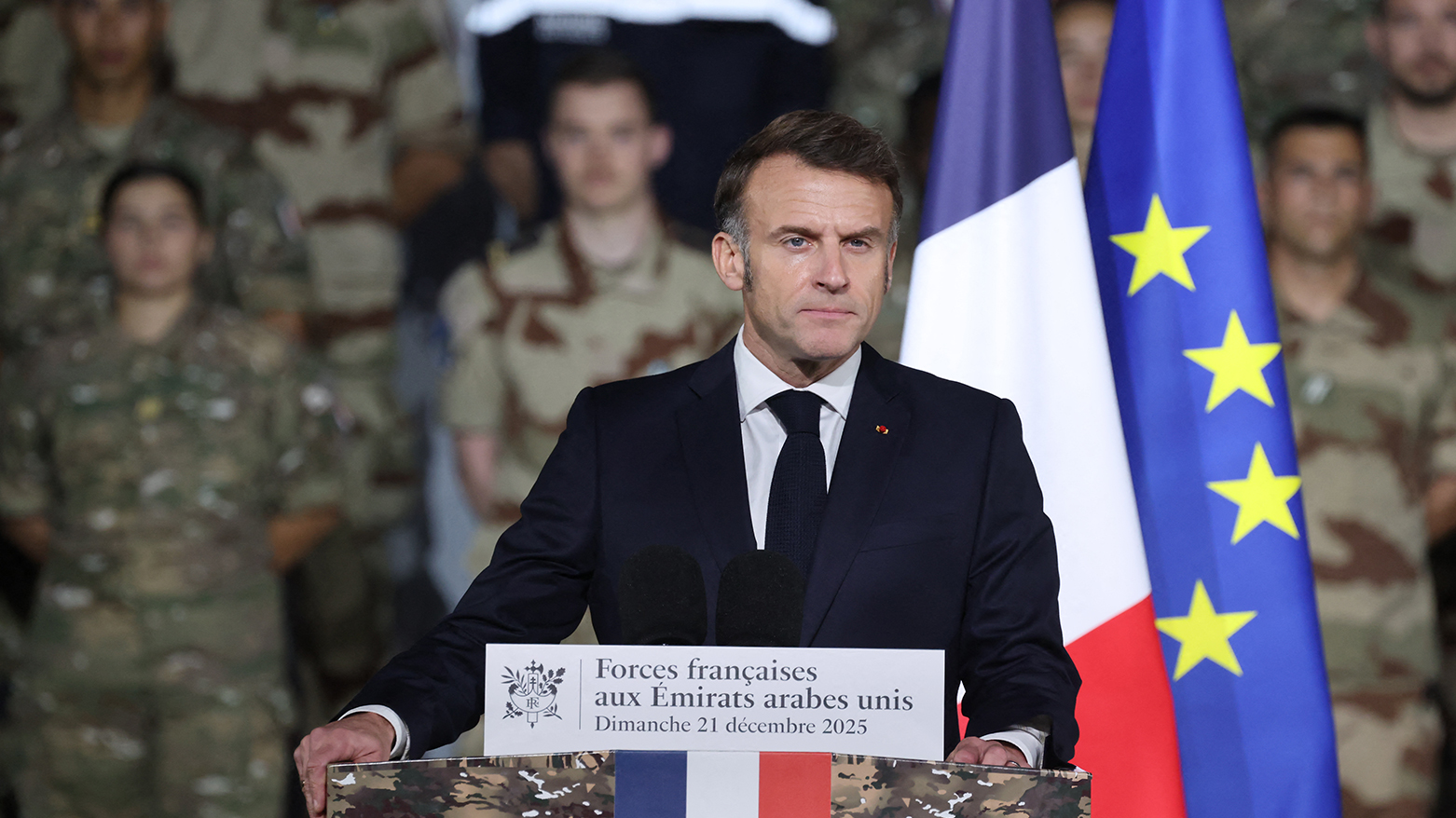
ERBIL (Kurdistan24) — French President Emmanuel Macron has formally authorized the construction of a new nuclear-powered aircraft carrier to replace France’s flagship Charles de Gaulle, underscoring Paris’s determination to maintain strategic military capabilities amid mounting global and regional security challenges.
Speaking on Sunday during a visit to French troops stationed in the United Arab Emirates, Macron said he had given the official go-ahead for the project following a comprehensive review conducted under France’s latest military programming laws.
“In an age of predators, we must be strong in order to be feared,” the French president said, framing the decision as a matter of national resilience and deterrence.
The Charles de Gaulle, which entered service in 2001 after more than a decade of construction, is currently the only nuclear-powered aircraft carrier in operation outside the United States Navy. Studies into its replacement began in 2018, with preliminary work launched two years later, as French defense planners warned that the vessel would reach the limits of its operational lifespan in the 2030s.
Macron said the final decision to move forward was taken this week, allowing the government to sign all contracts necessary to begin full-scale construction. The announcement comes despite a budgetary deadlock at home, with France facing fiscal pressures that have fueled political debate over defense spending priorities.
Critics, including Chief of the Defense Staff General Fabien Mandon, have questioned whether resources should instead be directed toward more immediate needs, particularly as European security concerns intensify amid fears of a wider confrontation with Russia.
Supporters of the project, however, argue that a next-generation carrier is essential for preserving France’s status as a global military power capable of independent force projection.
The new aircraft carrier will be significantly larger than its predecessor. It will displace nearly 80,000 tons and measure around 310 meters in length, compared with the Charles de Gaulle’s 42,000 tons and 261 meters.
Also nuclear-powered, the future vessel will carry a crew of about 2,000 and be capable of hosting up to 30 fighter jets. While still smaller than the United States Navy’s 11 supercarriers—each exceeding 100,000 tons—it will place France among a small group of nations with similarly sized carriers, alongside China and the United Kingdom, whose vessels are conventionally powered.
Macron’s announcement was made during a broader diplomatic visit to the UAE, where he spent Christmas with French forces deployed in the Gulf and held talks with Emirati President Mohamed bin Zayed Al Nahyan.
In a post on X, Macron said the two leaders discussed strengthening their strategic partnership, particularly in support of “stability in the Middle East.” The UAE is a major purchaser of French military equipment, and Paris is reportedly considering deeper cooperation with Abu Dhabi as it seeks to safeguard its future fighter jet program.
More than 900 French troops are stationed in the UAE, where they play roles ranging from regional security cooperation to counter-narcotics efforts.
Drug trafficking featured prominently in Macron’s discussions, as France seeks greater Emirati cooperation against major criminal networks. French authorities believe several high-profile traffickers have taken refuge in the UAE—particularly in Dubai—where some are suspected of building extensive real estate holdings.
The French delegation included Justice Minister Gérald Darmanin, who last month publicly urged the UAE to extradite around 15 suspected drug traffickers wanted by French courts.
Together, Macron’s defense announcement and Gulf diplomacy highlight Paris’s dual focus on long-term strategic military investment and near-term security cooperation, as France navigates an increasingly volatile international environment while seeking to protect its global interests.