Maliki, Sudani Discuss Presidential Election, Constitutional Process Amid Escalating PMF Tensions
Debate Over ‘One Army’ and State Control of Weapons Intensifies as Government Formation Talks Continue.
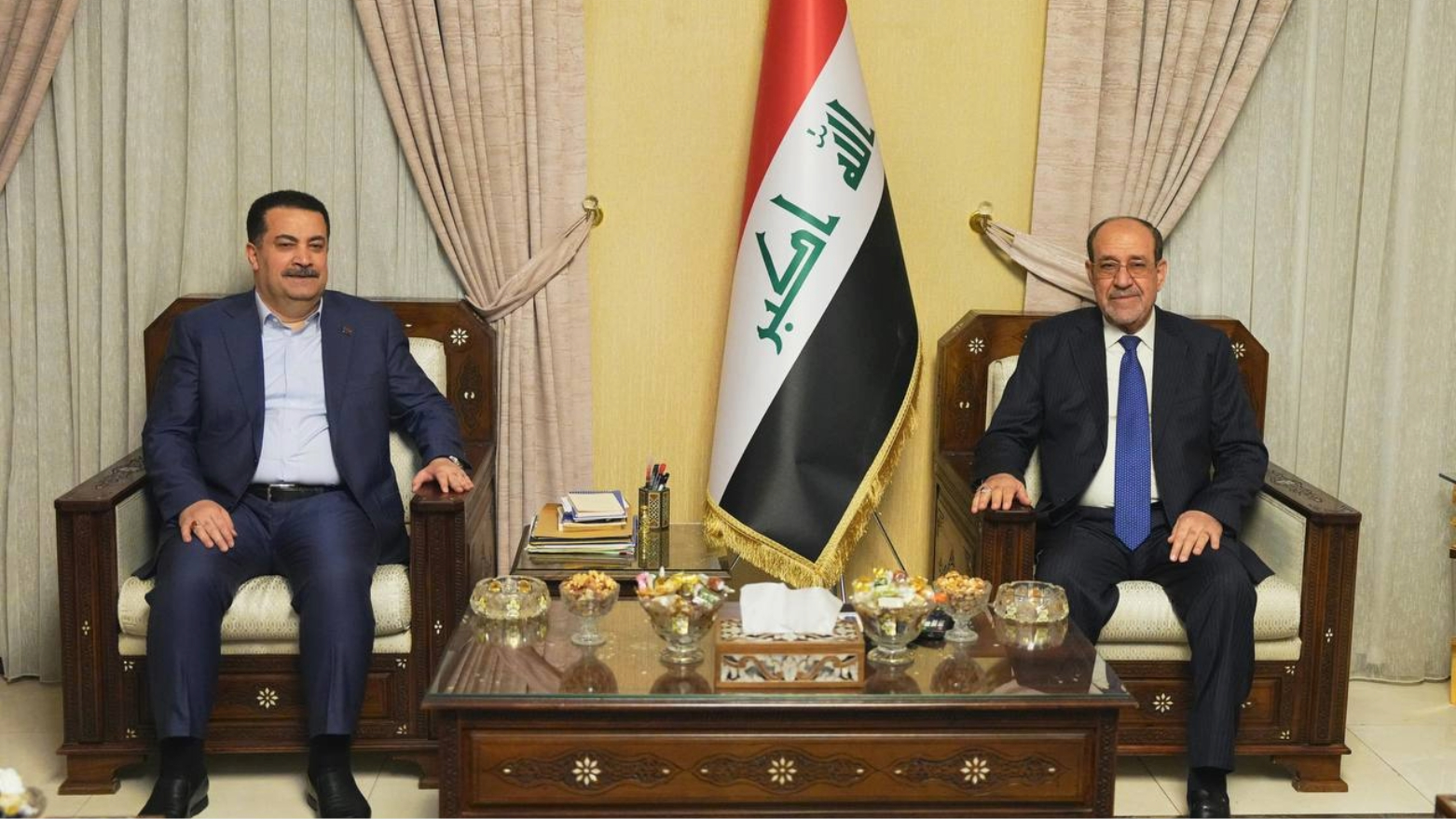
ERBIL (Kurdistan24) — Iraq’s former Prime Minister Nouri al-Maliki and current federal Prime Minister Mohammed Shia al-Sudani met on Wednesday evening to discuss the election of Iraq’s next president and ongoing political negotiations aimed at completing constitutional requirements, amid rising tensions over the future of the Popular Mobilization Forces (PMF).
According to a statement issued by Sudani’s office, the two leaders reviewed the general political situation and the trajectory of dialogue among national forces “to complete constitutional entitlements.” Discussions also focused on efforts by political blocs to reach a consensus to finalize the election of the Iraqi president in parliament and move forward with the remaining constitutional steps.
Maliki, head of the State of Law Coalition and the Coordination Framework’s candidate for prime minister, and Sudani, who leads the Reconstruction and Development Coalition, also stressed the importance of government continuity in delivering public services, advancing development projects, and strengthening the national economy.
Escalating Political Dispute
The meeting comes as tensions escalate within Shiite political circles over Maliki’s candidacy and his recent remarks on state authority and the structure of Iraq’s armed forces.
Leaders of the Services Alliance, affiliated with Asaib Ahl al-Haq, strongly opposed Maliki’s bid for the premiership, stating they would not allow any candidate to assume the post if he is perceived as hostile or even neutral toward the PMF.
On Thursday, Shibl al-Zaidi, head of the Services Alliance, stated that any candidate for prime minister must be an explicit and firm supporter of the PMF “in private and in public.”
The remarks followed the publication of a handwritten note attributed to Qais al-Khazali, Secretary-General of Asaib Ahl al-Haq, in which he sharply criticized the Dawa Party and reaffirmed that the PMF would remain in place “until the appearance of Imam Mahdi,” signaling resistance to any restructuring efforts.
The reactions were triggered by Maliki’s recent emphasis on “confining weapons to the state” and ensuring the existence of “one army” under the authority of the Commander-in-Chief of the Armed Forces.
‘One Army’ Debate
In remarks published through his media office on Wednesday, Maliki stressed that Iraq’s stability depends on “de-escalation, unity among all parties, the extension of the rule of law, confining arms to the state, and the presence of one army that includes members of all components of the people under the leadership of the Commander-in-Chief.”
He argued that such a framework would create a secure environment capable of attracting investment, generating employment opportunities for youth, and accelerating reconstruction.
While Maliki did not explicitly call for dissolving the PMF, observers have interpreted his reference to “one army” as potentially signaling the integration of the paramilitary force into Iraq’s regular armed forces — a highly sensitive issue within the Coordination Framework.
The controversy is compounded by the fact that in August 2025, Maliki had strongly opposed calls to disarm the PMF, describing such proposals at the time as part of an “American-Zionist plan.”
His recent emphasis on state sovereignty and centralized military authority is therefore viewed by some as a notable shift in tone, prompting concerns among PMF commanders.
Maliki has indicated that any restructuring would occur strictly through constitutional mechanisms, suggesting that integration or reform — if pursued — would require parliamentary approval.
International Dimension
The dispute unfolds against the backdrop of reported opposition by US President Donald Trump to Maliki’s return as prime minister. Trump has previously criticized Maliki’s past tenure, particularly regarding governance challenges, sectarian tensions, and the security deterioration preceding the rise of ISIS in 2014.
According to reports, Washington has warned that Maliki’s premiership could complicate security cooperation and economic engagement, with Trump reportedly threatening to suspend US support if Maliki refuses to step aside.
Despite these external pressures, Maliki has maintained that the selection of Iraq’s prime minister is a sovereign matter to be decided through constitutional procedures and parliamentary consensus. Leaders within the Coordination Framework have reiterated their backing of his candidacy.
As negotiations continue among Iraq’s political blocs, Maliki’s position — and his evolving rhetoric on state authority and armed factions — has intensified debate over the future configuration of Iraq’s security institutions.
The outcome of discussions surrounding the presidential election and subsequent government formation is expected to shape not only the country’s internal political balance but also its external relations and long-term security architecture.
With domestic rivalries intersecting with regional and international considerations, Iraq’s political process appears poised for further contestation in the weeks ahead.