Venezuela Gripped by Fear of U.S. War as Maduro Warns Washington Seeks His Ouster
Such fears have become part of daily life—spoken of quietly in a country where thousands were arrested for protesting Maduro’s widely disputed reelection claim in 2024.
ERBIL (Kurdistan24) — Venezuelans are living under a growing fear of war with the United States, amid sweeping U.S. naval deployments in the Caribbean and mounting pressure on President Nicolás Maduro, who claims Washington is seeking to remove him from power—raising public anxiety over the prospect of airstrikes, mainland attacks, or even an invasion.
For months, the United States under President Donald Trump has positioned a powerful naval fleet off Venezuela’s coast, sinking alleged drug-smuggling vessels and, more recently, seizing tankers carrying sanctioned Venezuelan oil under a blockade announced by the White House. More than 100 people have reportedly been killed so far in related operations, deepening fears inside the country.
Maduro has repeatedly warned that the United States is plotting to oust him, a claim that resonates with many Venezuelans who already live under constant political pressure. Such fears have become part of daily life—spoken of quietly in a country where thousands were arrested for protesting Maduro’s widely disputed reelection claim in 2024.
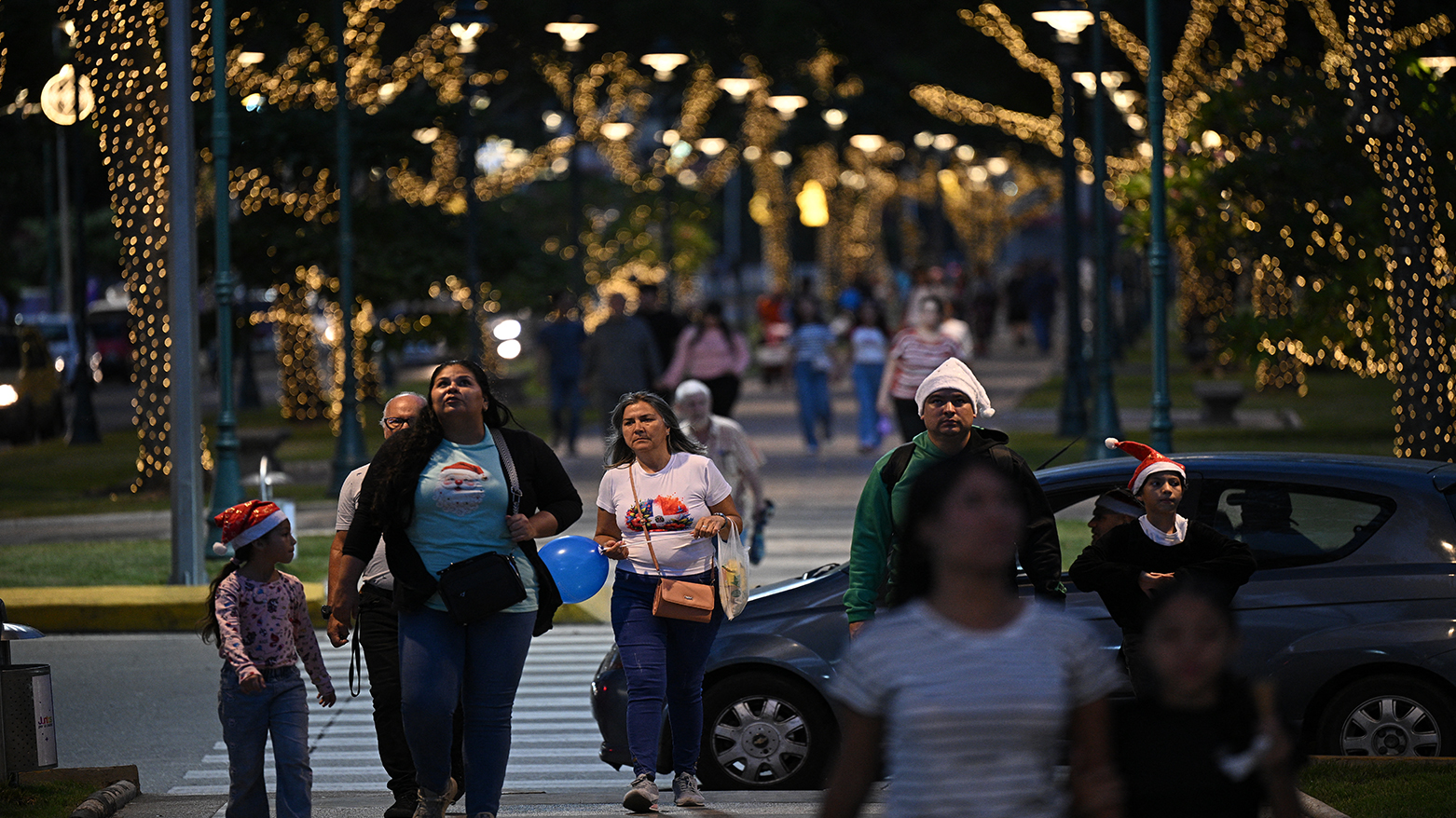
In public, however, the government projects calm and celebration. Maduro declared the Christmas season open as early as October, saying it was meant to defend citizens’ “right to happiness.” State television frequently airs footage of the president urging Venezuelans to “party,” including clips of him chanting “no war, yes peace” in English, set to electronic music, which he dances to at rallies.
In Caracas, the Paseo Los Próceres national monument is brightly illuminated, its statues of independence heroes glowing despite persistent power blackouts elsewhere in the capital. Families stroll, couples pose for photos, and children play—scenes that contrast sharply with the country’s deep economic crisis.
Shopping malls, too, are filled with holiday decorations and window displays, even as hyperinflation has drained purchasing power for most Venezuelans.
“We’re trying to ignore that we’ve got a ton of political problems,” said 21-year-old art student Mara Mendoza. “We’re trying to celebrate.”
Mental health professionals warn that the psychological toll is mounting. Clinical and social psychologist Yorelis Acosta cautioned that Venezuela could face a “mental health pandemic” marked by anxiety, stress, hopelessness, sleep disorders, and irritability.
“To cope, people try to find some emotional stability within the crisis,” she said, describing denial and avoidance as common defense mechanisms.
For many, sports offer a temporary escape. Caracas’s largest baseball stadium routinely fills to capacity, with fans cheering passionately despite the broader national gloom.
“The situation isn’t good—economically, socially—but here you forget about that,” said Magda Acosta, a 52-year-old shopkeeper attending a night game. “To live here you have to get away every now and then.”
Even in moments of respite, politics intrude. During one game, 66-year-old fan Luis Enrique Albarran condemned U.S. actions and Trump’s claims that Venezuela had stolen U.S.-owned oil.
“They have no right to expropriate what belongs to us,” he said, before his words were drowned out by the roar of the crowd.
Others turn to faith. “One has to breathe,” said Carleimy Gonzalez, 38. “God’s timing is perfect.”
Behind the music, lights, and cheers, however, fear remains pervasive—of war abroad, repression at home, and an uncertain future shaped by a confrontation many Venezuelans feel powerless to escape.