Nechirvan Barzani, Rubio Discuss US–Kurdistan Ties, Syria Developments at Munich Security Conference
U.S. Secretary of State Praises Kurdistan Region as "Key Partner and Stabilizing Factor" in Volatile Region.
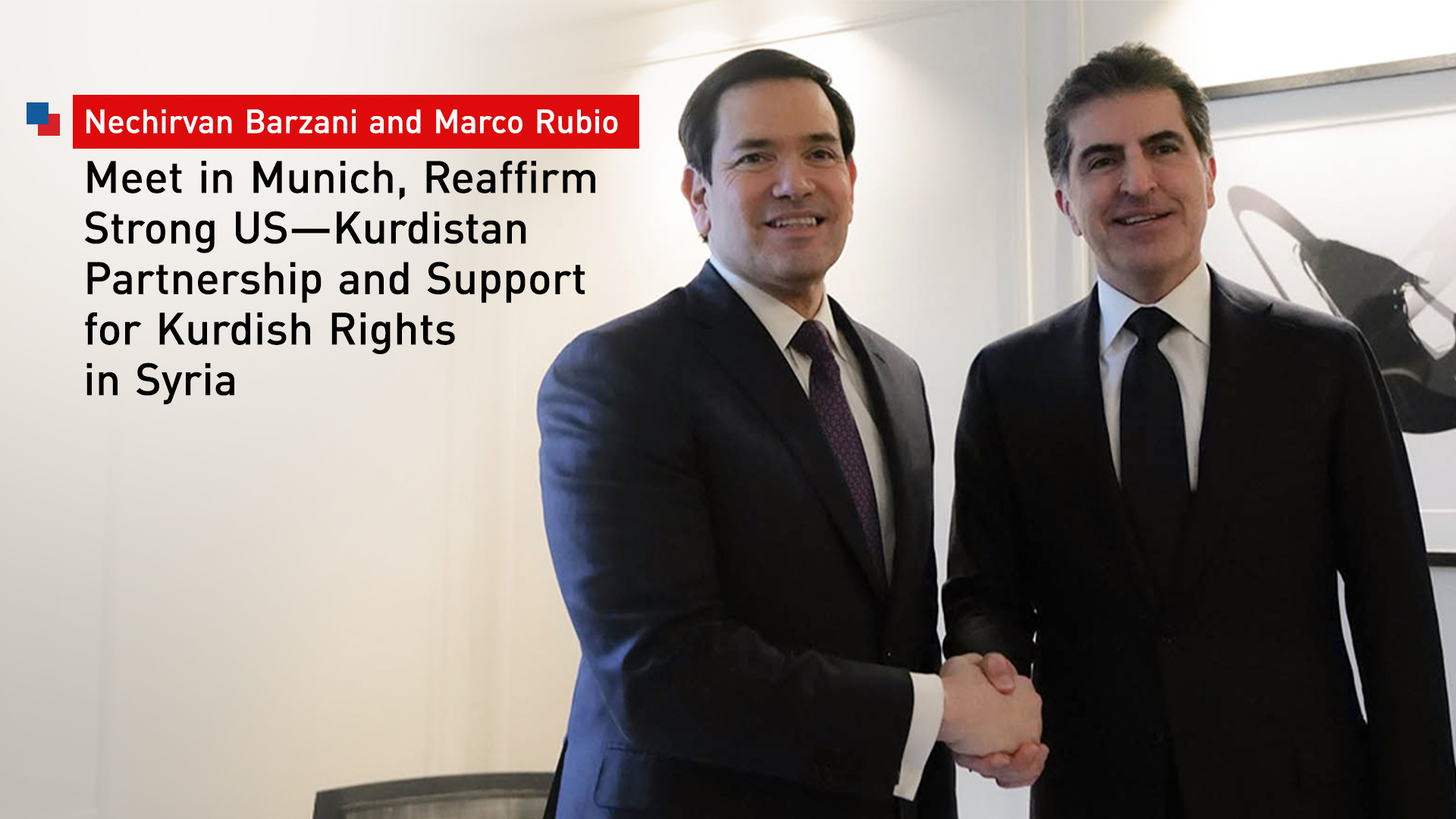
ERBIL (Kurdistan24) — Kurdistan Region President Nechirvan Barzani met U.S. Secretary of State Marco Rubio on Saturday, on the sidelines of the 62nd Munich Security Conference, as part of a series of high-level engagements with global leaders.
During the meeting, the two sides reviewed U.S. relations with Iraq and the Kurdistan Region, as well as prospects for expanding joint cooperation. President Barzani reiterated his appreciation for longstanding American support to both Iraq and the Kurdistan Region, particularly in the security, political, and economic spheres.
For his part, Rubio reaffirmed Washington’s commitment to supporting Iraq and the Kurdistan Region, stressing the importance of preserving stability across the broader Middle East. He praised the Kurdistan Region’s position as a key partner and a stabilizing factor in a volatile region.
Developments in Syria and the rights of Kurds there were also central to the discussions. Both sides emphasized the need to safeguard Kurdish and minority rights within a unified Syrian state, amid ongoing political and security transformations in the country.
"I thanked @SecRubio for the continued United States support to Iraq and the Kurdistan Region, and underscored the depth of our strategic partnership, built on shared interests and a common commitment to regional stability," President Nechirvan Barzani wrote on X.
I thanked @SecRubio for the continued United States support to Iraq and the Kurdistan Region, and underscored the depth of our strategic partnership, built on shared interests and a common commitment to regional stability. pic.twitter.com/BgLLr3L5iW
— Nechirvan Barzani (@IKRPresident) February 14, 2026
The talks come at a time when regional actors are closely monitoring efforts to integrate Kurdish-led structures in northeastern Syria into Damascus’s state framework, alongside broader diplomatic initiatives aimed at reducing tensions and preventing renewed conflict.
The 2026 Munich Security Conference, held annually in Germany since 1963, brought together heads of state, foreign and defense ministers, and senior security officials to deliberate on pressing global challenges, including the war in Ukraine, Middle East instability, transatlantic relations, and emerging security threats.
President Barzani’s participation included multiple bilateral meetings with international leaders and senior officials, reflecting the Kurdistan Region’s continued diplomatic outreach and its effort to position itself as a constructive actor in regional and international affairs. In recent years, the Kurdistan Region has leveraged the Munich forum to deepen ties with Western partners, particularly in security cooperation and energy diplomacy.
Relations between the Kurdistan Region and the United States date back to the 1991 uprising and the subsequent establishment of the no-fly zone that paved the way for Kurdish self-administration. Since 2003, cooperation has expanded significantly, particularly in counterterrorism and institutional development.
The Kurdistan Region emerged as a principal partner of the U.S.-led Global Coalition against ISIS after 2014, with Peshmerga forces playing a pivotal role in halting and reversing the group’s territorial expansion in northern Iraq. American military assistance, training programs, and political backing have been central to sustaining security coordination.
Beyond security, bilateral engagement has increasingly encompassed energy investment, governance reform, and economic diversification. U.S. officials have repeatedly described the Kurdistan Region as a reliable partner and a relative zone of stability within Iraq.
Saturday’s meeting in Munich thus underscored both continuity and recalibration in the partnership—anchored in shared security interests, support for minority rights in the region, and a mutual emphasis on sustaining stability amid shifting geopolitical dynamics.