Iran’s President Calls Hunger in Oil-Rich Nation ‘Unacceptable’ as He Defends Austerity Budget
Iranian President Pezeshkian presented a deficit-free budget to Parliament, condemning hunger in the oil-rich nation and proposing direct subsidies and tax cuts to combat inflation and inequality.
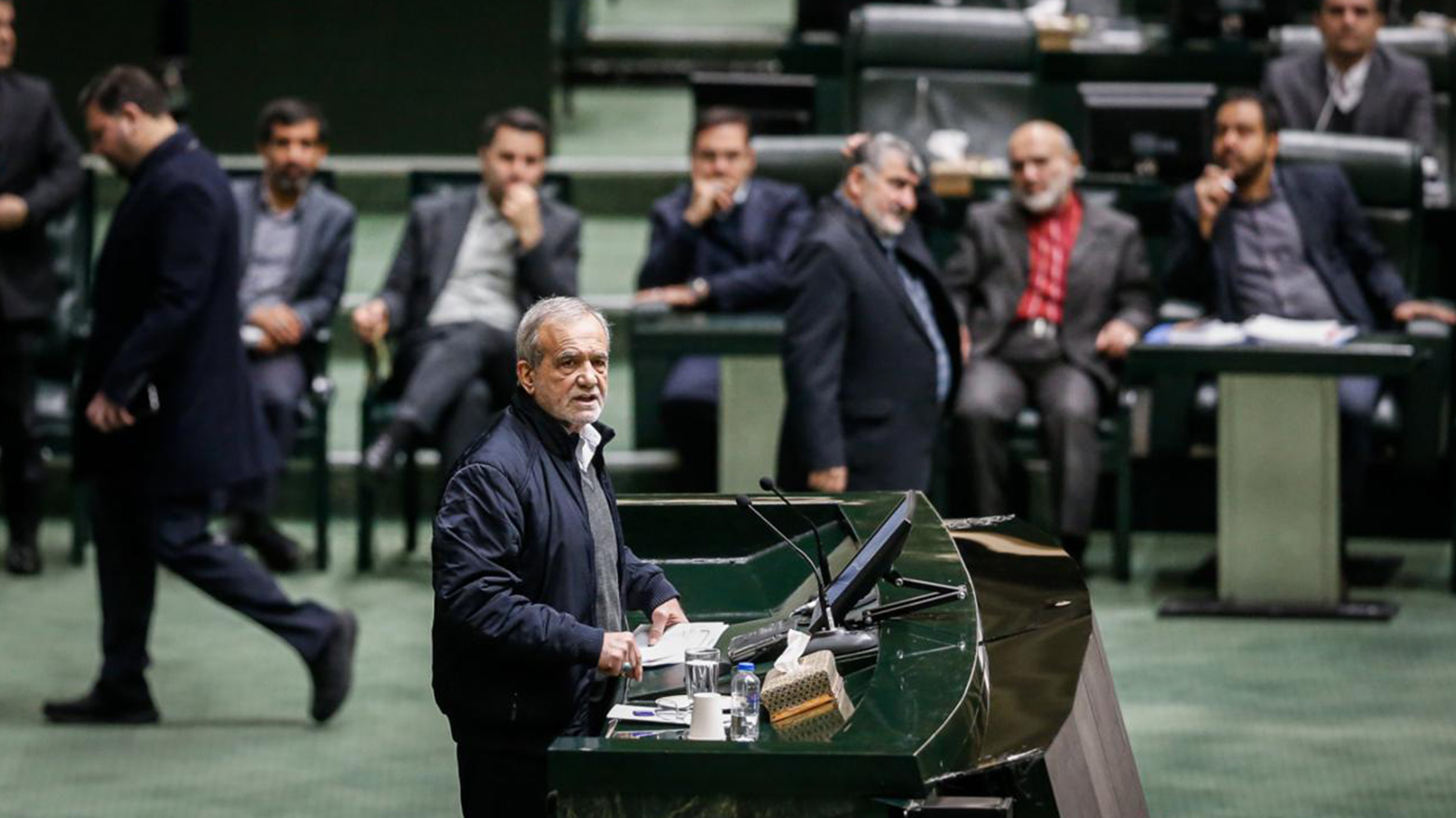
ERBIL (Kurdistan24) – Iranian President Masoud Pezeshkian delivered a stark assessment of the nation’s socio-economic disparities on Sunday, declaring it "unacceptable" that hunger persists in a country producing millions of barrels of oil daily. Speaking before an open session of the Iranian Parliament to defend his administration's budget bill for the upcoming Iranian calendar year of 1405 (2026), Pezeshkian framed the fight against poverty and inflation as a moral imperative, stating, "It is unacceptable to live in a country that is endowed with the blessing of oil and gas and produces nearly eight million barrels of oil and petroleum products daily, yet in that same country some are hungry, and at the same time we claim management."
Pezeshkian’s address, reported by the Islamic Republic News Agency (IRNA), outlined a fiscal strategy centered on eliminating the budget deficit, controlling inflation, and enhancing transparency. He argued that the government's primary effort is to secure a "deficit-free budget," which he identified as the root cause of the country's soaring inflation.
"Inflation in the country is caused by the government budget deficit and the irregularity of banks," he told lawmakers. "Alongside efforts to regulate the banks, the government tried in this bill not to have a budget deficit next year," he added.
The proposed budget reflects the severe economic pressures facing Tehran.
Pezeshkian noted that the current year has been marked by "serious differences" compared to previous periods, citing the "greatest drought of the last half-century," a severe decrease in global oil prices, and intensified international sanctions. He described an "economic war" imposed by adversaries but asserted that the country had weathered these storms through national cohesion.
To achieve fiscal discipline, the President explained that the government has increased the total budget by only two percent for the coming year, a figure significantly below the inflation rate.
This restraint was achieved by reducing agency expenses and eliminating unnecessary credit lines. "From now on, the budget will be allocated to them only based on operational budgeting. Agencies must say what service they provide to the government in order to receive a budget," Pezeshkian stated.
Despite the austere overall spending cap, the budget proposal includes targeted measures aimed at shielding vulnerable populations from the "fire of inflation."
The administration plans to increase public sector employee salaries by twenty percent. To bridge the gap between this raise and the inflation rate, Pezeshkian highlighted significant tax reforms. "Those who receive a salary up to 40 million Tomans have been totally exempted from paying taxes," he said, adding that earners between 40 and 93 million Tomans would face a tax rate of only ten percent.
The President also emphasized direct subsidies as a tool for redistribution. He questioned the efficacy of current subsidy models, particularly for fuel and bread, suggesting that the funds would be better utilized if given directly to citizens.
"Currently, we provide 290 trillion Tomans in bread subsidies, but reviews have shown that bread reaches the people at a high price; why not give this same amount to the people?" he asked.
Pezeshkian proposed a shift toward direct cash transfers, arguing that the government could provide households with a monthly subsidy of "several million Tomans" by reallocating resources from inefficient import subsidies.
Pezeshkian underscored the inequity of current energy subsidies, noting that wealthier individuals benefit disproportionately. "Today, an individual who owns a car receives about eight million Tomans in subsidies monthly just from one tank of gasoline. The higher the consumption goes, the greater the amount of subsidy received becomes," he explained.
The budget bill also projects a substantial increase in infrastructure spending. Pezeshkian announced that the construction budget would grow by more than 80 percent, driven by new initiatives allowing government agencies to barter surplus assets to complete unfinished projects.
He highlighted a special allocation of 2.1 billion dollars from oil exports specifically for rail and transit corridors, emphasizing the strategic importance of the Chabahar–Zahedan–Sarakhs route to boost trade with neighboring countries.
In the energy sector, the President pointed to a rapid acceleration in solar energy development and a focus on upstream oil and gas projects to ensure sustainable supply for industries. He stressed that sustainable production is key to resolving winter gas shortages and summer power outages.
Addressing the broader political context, Pezeshkian called for unity between the government and Parliament, warning that failure to address the people's livelihood problems would undermine their legitimacy to rule.
"I have no motivation either to rule or to remain President. If we cannot solve the people's problem, especially the deprived, and while people are grappling with livelihood problems, it is not possible to rule," he said.
The President urged lawmakers to avoid adding "illusory revenues and definite expenses" to the budget, a practice he suggested has contributed to past deficits. He concluded by reiterating that justice and the people's livelihood remain his administration's top priorities. "We cannot speak of management in this country if we cannot manage these resources fairly," Pezeshkian asserted.