Humanity and Kurdish identity shape my musical philosophy, says Kurdish Musicologist
Kurdish musicologist Parang Farazmand says her musical philosophy is rooted in humanity and Kurdish identity, highlighting the distinct features of Kurdish music, challenges facing contemporary production, and differences in the Hozam maqam.

ERBIL (Kurdistan24) - Music is not merely an art form but a defining force of identity and humanity for Kurdish musicologist and university professor Parang Farazmand, who says her musical philosophy is rooted in serving humanity while expressing Kurdish identity through sound, rhythm, and maqam.
In an interview with Kurdistan24, Farazmand discussed her academic work, artistic philosophy, and research into Kurdish music, with a particular focus on rhythmic structures and the differences between Kurdish and Arab interpretations of the Hozam maqam.
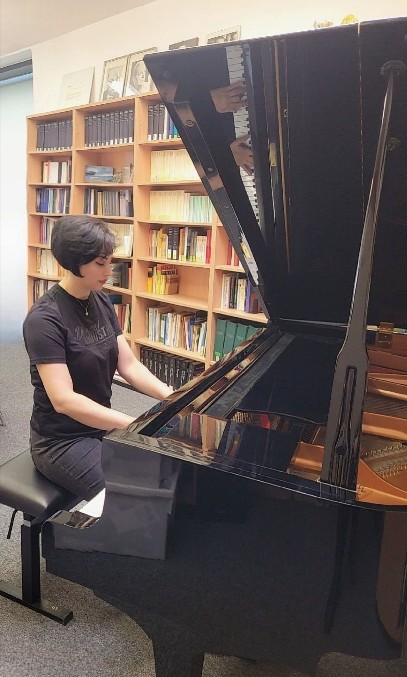
Farazmand said she is currently focused primarily on academic and scientific work in the field of music. She teaches at Martin Luther University in Germany in the Department of Musicology and is actively engaged in field research and academic writing on Kurdish music. Within the university framework, she also works with two music groups composed of musicians from various countries, focusing on maqams and Eastern musical forms, particularly Kurdish music. She said these projects have been well received by German musicians.
Explaining her artistic philosophy, Farazmand described music as inseparable from her identity. She said music constitutes a major part of her personality and existence, adding that for her, music means life itself and gives meaning to her being. She stressed that art holds little value if it does not serve humanity. For Kurds, she said, who at times lack political power, music becomes a means of expressing national identity. Through a single piece of music, an important message can be conveyed, she noted, explaining that music, as a conceptual art, can communicate its message more effectively than dozens of books or written texts. According to Farazmand, messages delivered through music are thousands of times more impactful than those conveyed through speech alone, which is why she believes in the power of music as a supernatural force. “Therefore,” she said, “my musical philosophy is humanity and Kurdish identity.”
Addressing the question of whether Kurdish music has its own distinct identity, Farazmand said Kurdish music clearly possesses its own character and markers of identity. She explained that the cultural diversity of the Kurdish nation can be precisely reflected through Kurdish music. Musical elements such as vocal range, modalities, rhythm, instrumental sonority, and, above all, vocal and song forms are unique and express a Kurdish spirit. She added that lyrics and language, as core components of Kurdish music, openly affirm Kurdish identity. Kurdish music, she said, has specific characteristics that distinguish it from the music of other peoples.
On the difficulty of learning and performing music, Farazmand said musical education is not easy and requires dedicating a large portion of one’s life to learning and practice to reach a professional level. She described music as a highly sensitive field that demands continuous engagement. She explained that stepping away from playing, singing, or vocal training for a period leads to a noticeable decline in performance quality. Unlike theoretical fields, she said, music is directly connected to muscle memory and psychological factors. For this reason, she stated that every genre and style of music has its own level of difficulty and cannot be labeled as simpler or more complex than another.
Farazmand also addressed the growing use of foreign musical styles and sounds in contemporary Kurdish songs. She identified two main reasons for this trend. The first, she said, is cultural interaction, which is an undeniable phenomenon that cannot be prevented. Due to the expansion of media and easier access to data and information, Kurds today are more exposed to different cultures than ever before. Gradually, artistic elements from other nations have entered Kurdish music and become part of it. The second reason, she said, is the lack of responsibility among some musicians, who aim to produce work based on market demands and global trends without considering that, in the future, this could weaken the Kurdish identity of Kurdish music.
Despite these challenges, Farazmand said Kurds undoubtedly have highly skilled musicians and vocalists. She noted, however, that economic constraints sometimes affect the quality of musical production, emphasizing that existing talent and ability need to be used appropriately.
Discussing the Hozam maqam, Farazmand explained that Kurds, Arabs, and Turks all share this maqam, but perform it differently. Based on her research and analysis of modes and maqams, she said Kurds often perform the second tone of the tetrachord, or the Hijaz genus, in the Hozam maqam using microtones, whereas Arab performers present it using full tones.
Regarding her current projects, Farazmand said her new academic project involves completing the writing of a book on the classification and analysis of Kurdish maqams and music. Artistically, she is working on establishing a new fusion music group.
Parang Farazmand was born in 1982 in Mahabad, in eastern Kurdistan. She began learning music at the age of eight, starting with piano. She completed her bachelor’s degree in Western classical piano at the University of Tehran, earned a master’s degree in musicology with a specialization in ethnomusicology, and obtained her PhD in ethnomusicology from Martin Luther University in Germany. Since 2020, she has been teaching ethnomusicology at the same university while pursuing postdoctoral research. Since 2000, she has been active with various Kurdish, Iranian, and Western classical music groups, performing concerts, teaching piano, and training numerous students.