Maduro’s Whereabouts Unknown After U.S. Strikes, Venezuela Demands Proof of Life
Venezuela demands proof of life for Maduro after Trump claims U.S. forces captured him in airstrikes. Caracas alleges civilian hits; Colombia deploys troops.
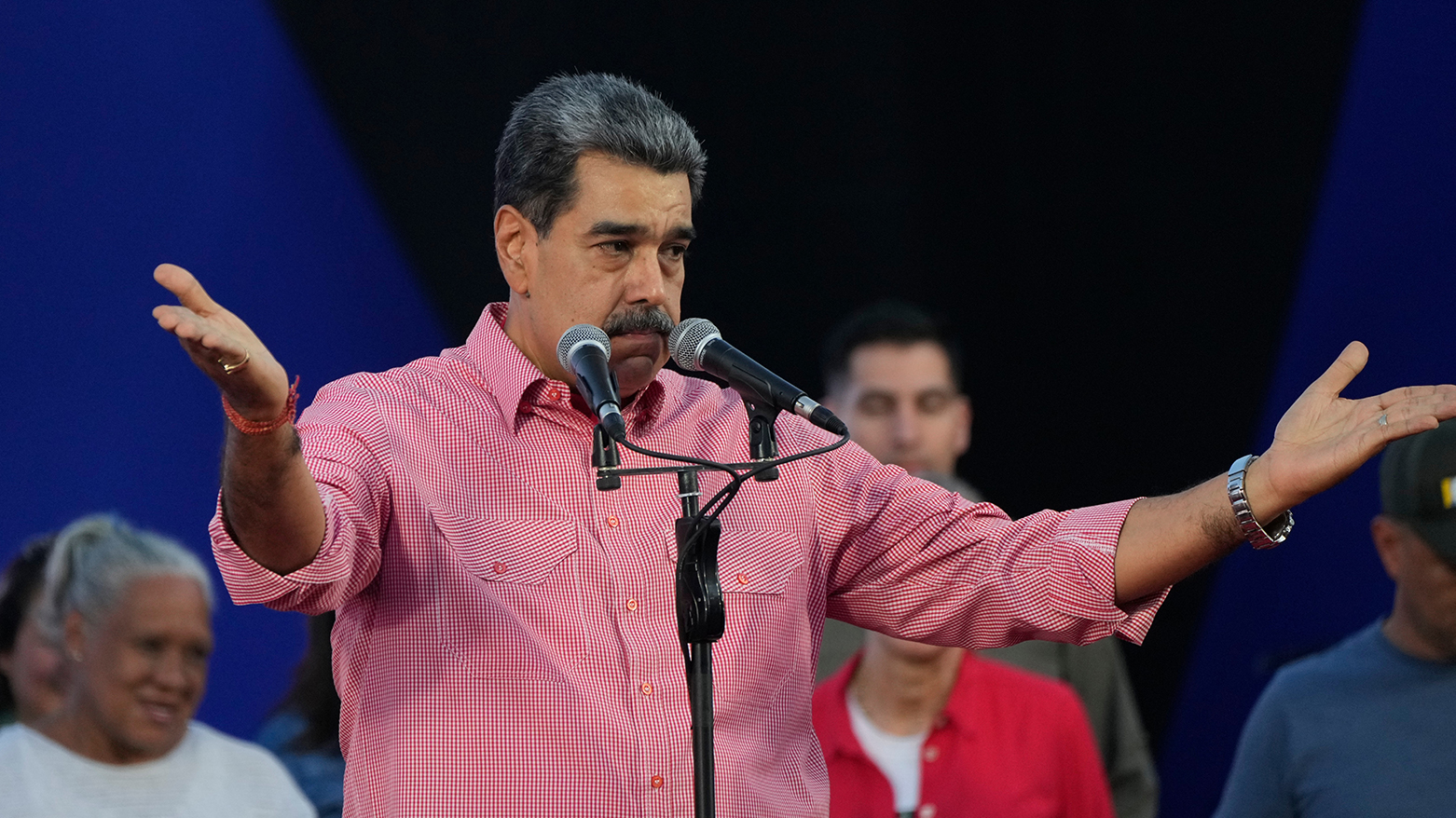
ERBIL (Kurdistan24) — The Venezuelan government on Saturday acknowledged that the whereabouts of President Nicolás Maduro remains unknown following a series of intense U.S. military strikes on the capital, prompting Vice President Delcy Rodriguez to demand "proof of life" from Washington.
The demand came hours after U.S. President Donald Trump announced on social media that American forces had captured Maduro and his wife, Cilia Flores, and transported them out of the country, marking a seismic escalation in the geopolitical standoff between the two nations.
In a televised address that underscored the confusion gripping Caracas, Vice President Rodriguez confirmed that she had lost contact with the country’s leadership.
Speaking by telephone to Venezuelan television, Rodriguez admitted she did not know the location of Maduro or Flores following the bombardment of Caracas and other cities. "We demand that the United States government issue proof of life of President Nicolás Maduro," Rodriguez said, responding directly to Trump’s assertion that the Venezuelan leader was now in U.S. custody.
The crisis began early Saturday when President Trump posted a statement to his Truth Social platform declaring that the United States had "successfully carried out a large scale strike against Venezuela."
Trump stated explicitly that Maduro and his wife had been "captured and flown out of the Country" in an operation conducted in conjunction with U.S. law enforcement. The White House has scheduled a news conference for 11:00 a.m. at the President’s Mar-a-Lago resort in Florida to provide further details on the operation.
Accusations of Civilian Casualties and Military Mobilization
While the fate of Maduro remains the central political question, the situation on the ground in Venezuela has devolved into a military confrontation.
The Venezuelan government accused the United States of targeting residential areas during the early morning assault. Defense Minister Vladimir Padrino Lopez, in a video statement shared on social media, condemned the "invading" U.S. forces.
"They have desecrated our soil, going so far as to strike, using missiles and rockets fired from their combat helicopters, residential areas populated by civilians," General Padrino Lopez said.
He announced that the Venezuelan armed forces would launch a "massive deployment of all land, air, naval, riverine and missile capabilities" for the purpose of "comprehensive defense."
This account of the strikes aligns with reports of widespread bombardment but differs sharply regarding the nature of the targets. David Smolansky, a spokesman for Venezuelan opposition leader María Corina Machado, told CBS News that the U.S. strikes had targeted strategic military infrastructure.
These targets reportedly included Fuerte Tiuna, the main military base in Caracas; La Carlota, the city’s primary airbase; the El Volcán signal antenna; and the port of La Guaira on the Caribbean coast. Images broadcast by international media earlier in the day showed smoke rising from military hangars and fires burning at the Fuerte Tiuna complex.
"A New Dawn" and Strategic Context
In Washington, officials projected confidence regarding the outcome of the operation. Deputy Secretary of State Christopher Landau took to the social media platform X to declare the end of the Maduro era. "A new dawn for Venezuela! The tyrant is gone. He will now -- finally -- face justice for his crimes," Landau wrote.
The operation appears to be the culmination of a months-long pressure campaign orchestrated by the Trump administration.
According to U.S. officials speaking on condition of anonymity, the President had authorized the land strikes days prior to their execution. Military planners had initially eyed Christmas Day for the operation, but weather conditions and competing operational priorities—specifically airstrikes against ISIS targets in Nigeria—forced a delay until Saturday.
The legal framework for the capture rests on longstanding U.S. indictments. In 2020, the U.S. Justice Department charged Maduro and top officials with narcoterrorism and drug trafficking, accusing them of conspiring to flood the United States with cocaine.
The administration recently doubled the reward for information leading to Maduro’s arrest to $50 million. Secretary of State Marco Rubio has consistently described the Maduro government as complicit with criminal groups like Tren de Aragua, which U.S. officials allege are used to destabilize the region.
Regional Destabilization and Colombian Response
The strikes have triggered immediate alarm in neighboring Colombia, a key U.S. ally in the region. Colombian President Gustavo Petro announced on Saturday that he had ordered the deployment of military forces to the Venezuelan border in response to the U.S. attacks.
Petro described Washington's actions as an "assault on the sovereignty" of Latin America and warned that the military intervention would result in a humanitarian crisis.
The mobilization of Colombian troops adds a volatile layer to an already precarious situation. The U.S. State Department had issued an urgent warning to American citizens in Venezuela early Saturday to "shelter in place," citing reports of explosions.
Simultaneously, the Federal Aviation Administration (FAA) issued a ban on all U.S. commercial flights over Venezuelan airspace due to "safety-of-flight risks associated with ongoing military activity."
International Reactions
The U.S. action faced swift condemnation from global adversaries. Russia, a longtime backer of the Maduro government, denounced the operation as "armed aggression."
n a statement released Saturday, the Russian Foreign Ministry said there was no tenable justification for the attack. "This morning, the United States committed an act of armed aggression against Venezuela. This is deeply concerning and condemnable," the ministry stated, adding that "ideological hostility has triumphed over businesslike pragmatism."
Iran also issued a strong condemnation following the accusations from Caracas regarding the explosions.
The Iranian Foreign Ministry stated that it "strongly condemns the American military attack on Venezuela and the flagrant violation of the national sovereignty and territorial integrity of the country."
Domestic U.S. Reaction and Military Buildup
Within the United States, the operation has reignited debate over presidential war powers. Prior to the confirmation of Maduro's capture, Democratic Senator Ruben Gallego of Arizona, a Marine Corps veteran, condemned the strikes as illegal.
"This war is illegal," he wrote on social media, calling it the second "unjustified war" of his lifetime. Republican Senator Mike Lee of Utah expressed similar skepticism, questioning the constitutional justification for the action in the absence of a declaration of war or congressional authorization.
The strikes follow a significant accumulation of U.S. military power in the Caribbean theater since September. The Pentagon has amassed approximately 15,000 troops in the region and deployed a naval armada that includes the USS Gerald R. Ford aircraft carrier group.
This force posture had previously facilitated more than 30 strikes on alleged drug smuggling vessels and the seizure of oil tankers, but Saturday’s operation marks the first direct land strikes and the targeted removal of a foreign head of state during this campaign.
As the world awaits the 11:00 a.m. (07:00 PM Erbil time) press conference at Mar-a-Lago, the leadership vacuum in Caracas presents immediate challenges.
The Venezuelan government had earlier declared a "state of external disturbance," granting extraordinary powers to the armed forces, but with the Vice President admitting she does not know the President's whereabouts, the chain of command remains opaque.