President Barzani, Iraqi Dawa Party Delegation Discuss Iraq’s Political Landscape
Talks in Pirmam Emphasize Coordination and Unity to Overcome Challenges
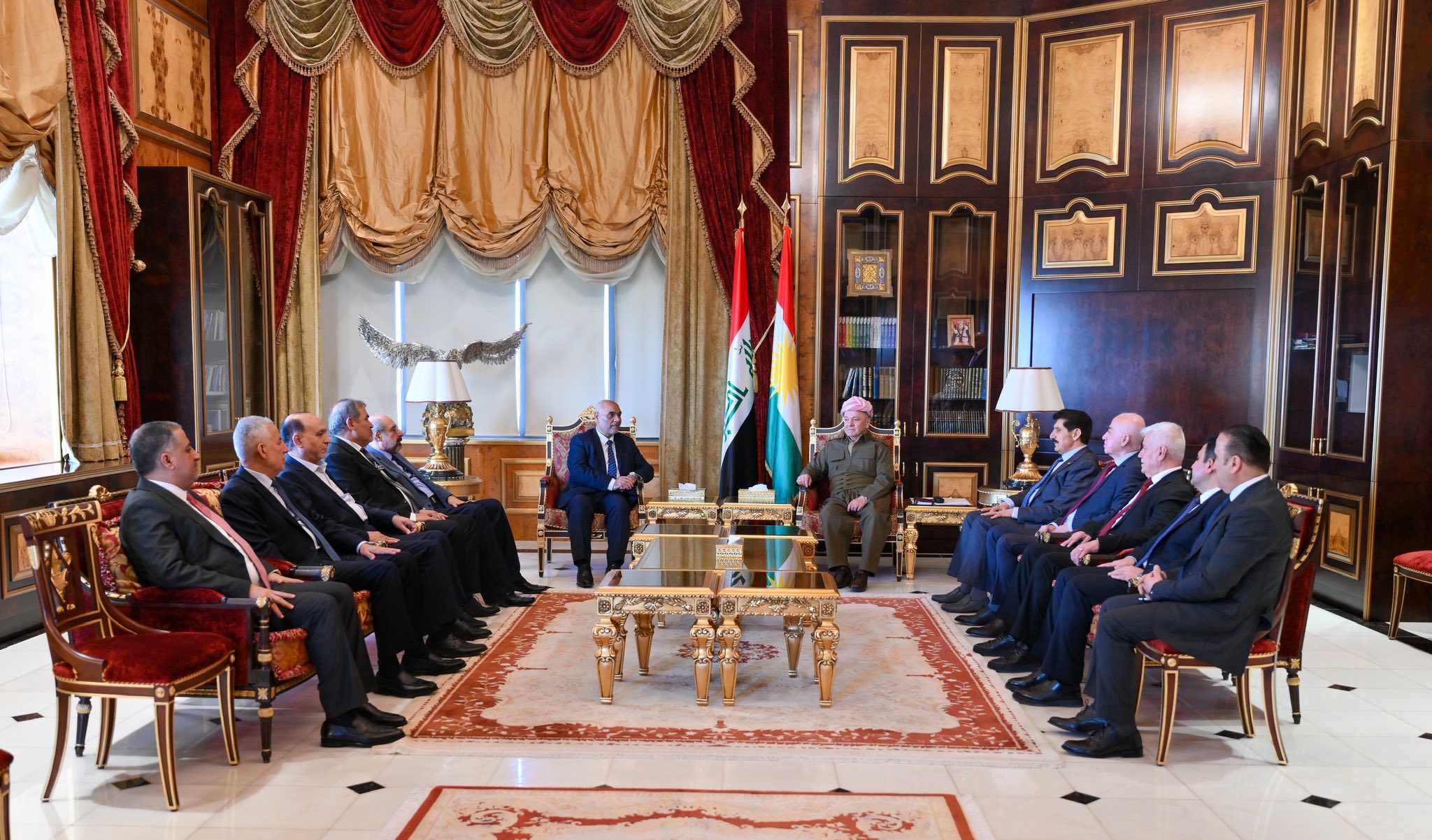
ERBIL (Kurdistan24) — President Masoud Barzani on Saturday received a high-level delegation from the Islamic Dawa Party to discuss Iraq’s political situation and the latest regional developments, according to a statement from the Barzani Headquarters.
The meeting took place in Pirmam, where Barzani welcomed the delegation and held talks focusing on the current political landscape in Iraq and unfolding events across the wider region.
According to the statement, both sides exchanged views on Iraq’s internal dynamics, as well as broader geopolitical developments affecting the country and its surroundings.
The discussions addressed ongoing political challenges and the necessity of safeguarding stability during a period marked by heightened regional tensions.
The statement added that the meeting underscored the importance of strengthening relations and coordination among political parties to overcome existing difficulties and challenges.
Both sides stressed that enhanced dialogue and cooperation between Iraqi political actors remain essential to navigating complex domestic and regional circumstances.
The talks come amid continued efforts by key Iraqi and Kurdish stakeholders to maintain political cohesion and manage the impact of regional shifts on Iraq’s internal stability.
President Barzani has been a central Kurdish interlocutor in Baghdad since the fall of dictator Saddam Hussein, playing a decisive role in negotiations over the 2005 Iraqi Constitution, federal arrangements, disputed territories, and revenue-sharing mechanisms between Erbil and the federal government.
As former president of the Kurdistan Region and long-time leader of the Kurdistan Democratic Party, he has remained an influential power broker in shaping Kurdish strategy toward successive Iraqi governments.
Beyond Iraq’s internal politics, Barzani has also maintained active channels with regional and international actors, positioning the Kurdistan Region as a strategic partner in counterterrorism efforts—particularly during the fight against ISIS—and as a relatively stable political and economic hub amid regional volatility.
His engagements frequently extend to discussions on Iraq’s sovereignty, regional de-escalation, and the balance of relations between Baghdad, Erbil, and neighboring states.
In periods of political deadlock in Baghdad, Barzani has often acted as a mediator or consensus-builder among Shiite, Sunni, and Kurdish blocs, reinforcing his role not only as a Kurdish leader but as a stakeholder in Iraq’s broader statecraft and regional alignment.