Farhad Atroushi Warns of ‘Bad Intentions’ in Baghdad Toward Kurdistan Region
Deputy Speaker Says Shiite Blocs Seeking to Dominate Parliament and Key Committees
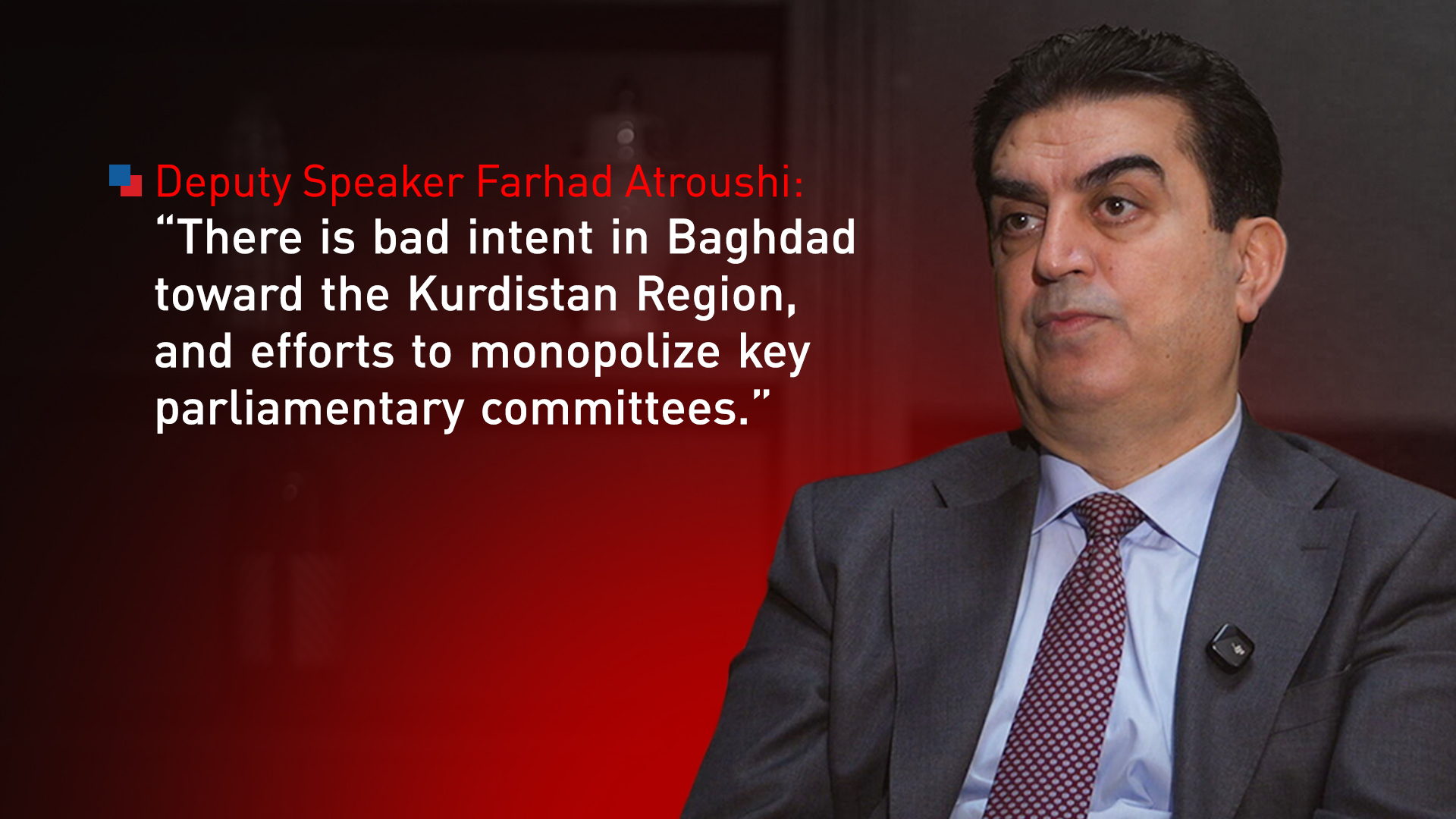
ERBIL (Kurdistan24) — Farhad Atroushi, Second Deputy Speaker of the Council of Representatives of Iraq, has accused political forces in Baghdad of pursuing policies aimed at weakening the Kurdistan Region, warning of what he described as “bad intentions” and growing Shiite dominance within Iraq’s legislature.
Speaking to Kurdistan24 on Saturday, Atroushi warned of deep political and economic turmoil in Baghdad and escalating pressure on Erbil–Baghdad relations.
Secret Plan to Control Border Crossings
Atroushi revealed that factions within the Coordination Framework—some of which he said consider themselves allied with the Patriotic Union of Kurdistan (PUK)—had submitted a confidential letter to the Council of Ministers without his knowledge.
According to Atroushi, the letter called for withdrawing legal recognition and legitimacy from all Kurdistan Region border crossings except the Ibrahim Khalil crossing. A copy, he said, was sent only to the Speaker of Parliament.
“We exerted significant pressure and were able to block the letter,” Atroushi stated, arguing that the move formed part of a broader effort to reduce and weaken the institutional standing of the Kurdistan Region.
Economic Strains and Sudani’s Admission
On Iraq’s fiscal outlook, Atroushi disclosed details of a conversation with Prime Minister Mohammed Shia' al-Sudani.
“Sudani told me frankly that Iraq’s economic situation is bad and that the revenues available to us are limited,” Atroushi said.
He warned that the deteriorating financial climate poses risks to salary payments and broader fiscal entitlements, particularly given what he described as hostile political intent toward the Kurdistan Region.
Dispute Over Military Post and Legal Challenge
Atroushi sharply criticized the recent parliamentary vote concerning the Iraqi Chief of Staff position, describing the procedure as unlawful. He said Speaker Haibat al-Halbousi had previously assured him the issue would not be placed on the agenda, but later reversed course.
“As the Kurdistan Democratic Party, we reject this and will file a complaint before the Federal Supreme Court,” Atroushi said, stressing that the position constitutes a Kurdish share in Iraq’s power-sharing system and is not subject to compromise.
He also voiced concern that Kurdish factions in Baghdad failed to adopt a unified stance following the vote, highlighting internal fragmentation.
Shiite Bid to Dominate Parliamentary Committees
Atroushi warned that Shiite blocs are seeking to consolidate control over the legislature’s most influential committees. Of 19 members typically assigned to key committees, he said, Shiite parties are demanding 11 seats on the grounds of majority representation.
“There are nearly 10 important committees in parliament, and they want all of them for themselves,” he said, adding that such a move would effectively concentrate legislative authority in Shiite hands.
He confirmed that Kurdish parties have requested the Legal Committee and said they are likely to gain it
Presidency Dispute and Kurdish Divisions
Regarding Iraq’s presidency, Atroushi criticized the current strategy of the PUK, arguing that its approach makes it highly difficult for Kurds to present a single unified candidate in Baghdad.
“We made extensive efforts to form a joint Kurdish front in Baghdad to speak with one voice, but unfortunately, the parties did not respond, and internal disputes in the Region have been transferred to Baghdad,” he said.
Atroushi further alleged that Shiite factions are directly intervening in the process of selecting and finalizing the Kurdish candidate for president—an outcome he attributed in part to Kurdish disunity.
Maliki’s Premiership Bid
On the race for prime minister, Atroushi said Nouri al-Maliki remains determined to maintain his candidacy and is unwilling to withdraw.
“Maliki believes that stepping down at this stage would mean the end of his political future and that of the Dawa Party,” Atroushi said, noting that Maliki is awaiting a final decision from the Coordination Framework.
He added that under U.S. pressure, some Shiite factions appear to be reconsidering their support for Maliki.
As for President Masoud Barzani, Atroushi said the Kurdish leader has rejected any interference in the Shiite blocs’ internal deliberations over their prime ministerial nominee, viewing the matter as an internal Shiite issue.
Atroushi’s remarks underscore intensifying political maneuvering in Baghdad, with disputes over committee control, executive posts, and federal-regional relations converging at a pivotal moment for Iraq’s fragile power-sharing framework.