President Barzani Receives Head of U.S.-Based Assyrians for Justice Foundation in Pirmam
Meeting underscores Kurdistan Region’s longstanding support for religious and ethnic pluralism amid renewed focus on Assyrian historical justice.
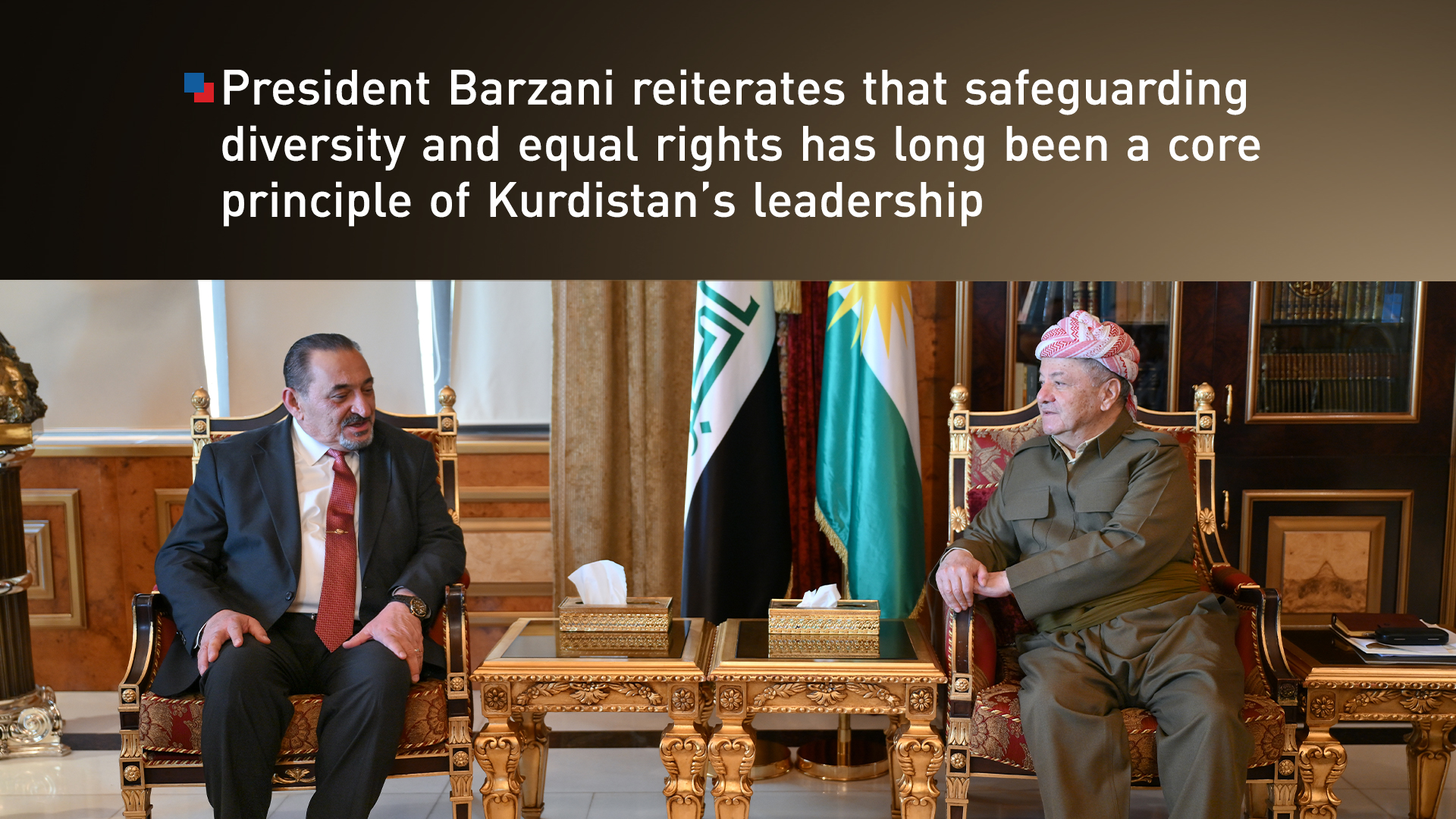
ERBIL (Kurdistan24) — President Masoud Barzani on Monday received Sam Darmo, head of the Assyrians for Justice Foundation in the United States, in Pirmam, Erbil, according to a statement released by Barzani’s office.
The meeting focused on issues related to justice, coexistence, and the rights of religious and ethnic components in the Kurdistan Region and Iraq more broadly. Darmo praised Barzani’s continued role in supporting Kurdistan’s diverse communities and expressed appreciation for his backing of initiatives commemorating Assyrian victims of past atrocities.
According to the statement, Darmo specifically thanked President Barzani for supporting the Assyrian Martyrs Monument in Semel, whose foundation stone was laid on Sunday, describing the project as a historic step toward preserving memory and honoring the victims of the 1933 massacre against Assyrians.
For his part, President Barzani reaffirmed his support for the Assyrian community and all other components of Kurdistan’s social fabric. He noted that the principles of equality, justice, and protection of national and religious rights have deep roots in the Barzani legacy, dating back to the era of Sheikh Abdul Salam Barzani and Sheikh Ahmed Barzani.
The two sides also exchanged views on the political situation in Iraq, broader regional developments, and ongoing changes affecting the Middle East.
Historical context and renewed remembrance
The meeting comes amid renewed attention to the legacy of the 1933 Semel massacre, one of the earliest large-scale crimes committed against minorities in modern Iraqi history. On Sunday, senior Kurdish and Assyrian figures attended a ceremony in the town of Semel to mark the laying of the foundation stone for a memorial honoring Assyrian victims of the killings carried out by the then-Iraqi government.
Duhok Governor Ali Tatar, speaking at the ceremony, emphasized what he described as a shared destiny among the peoples of Kurdistan, highlighting a long history of collective suffering endured by Kurds, Assyrians, Yazidis, and other indigenous communities.
The ceremony was held under the supervision of President Barzani and attended by Mar Awa III, Patriarch of the Assyrian Church of the East, along with senior political, military, and religious officials.
Speakers placed the Semel massacre within a broader historical pattern of repression, including campaigns against the Barzanis in the early 1930s and later atrocities such as the Anfal campaign of the late 1980s.
Patriarch Mar Awa III described the construction of the Assyrian Martyrs Monument as a meaningful act of recognition by the Kurdistan Regional Government, thanking President Barzani for his support and stressing that the wounds of the 1933 genocide remain unhealed in the absence of official recognition by the Iraqi state.
Kurdish officials have repeatedly stated that Assyrian victims are regarded as martyrs of Kurdistan, underscoring the region’s commitment to coexistence, minority protection, and acknowledgment of historical injustices—principles reiterated during Barzani’s meeting with Darmo.