U.S. Highlights Partnership with SDF in Ongoing Efforts to Defeat ISIS and Stabilize Syria
“The United States has long supported efforts to defeat ISIS and promote stability in Syria, including through OIR and its partnership with the SDF, whose sacrifices have been instrumental in achieving lasting gains against terrorism,” the special envoy said.
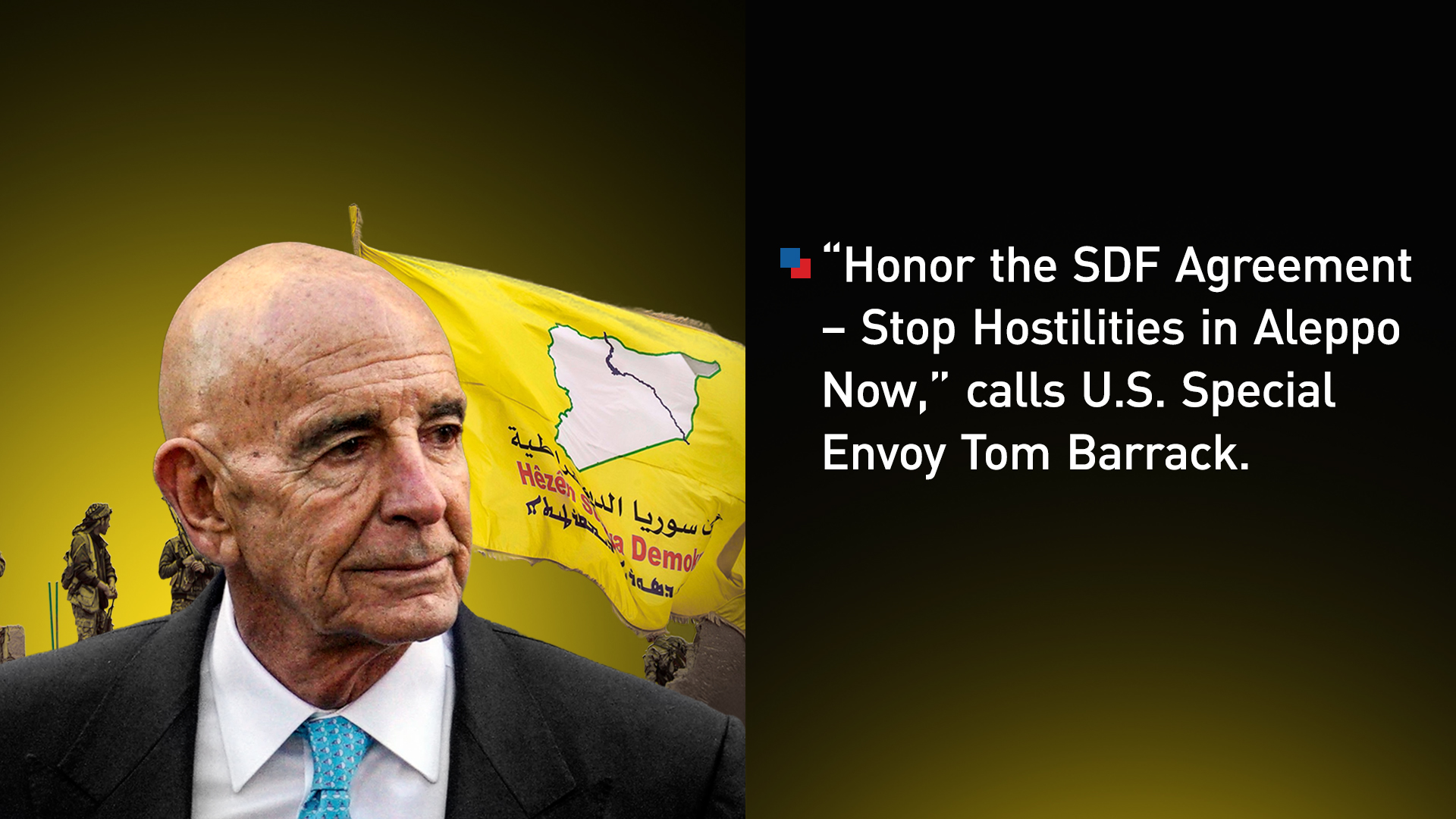
ERBIL (Kurdistan24) — The United States has reaffirmed its support for Syria’s post-Assad political transition while warning that renewed violence in Aleppo could jeopardize fragile gains achieved since the collapse of the former regime, according to a statement released by U.S. Ambassador to Türkiye and Special Envoy for Syria Tom Barrack.
Barrack said he met in Damascus on Saturday with Syrian President Ahmed al-Sharaa, Foreign Minister Asaad al-Shaibani, and senior members of the Syrian leadership team to discuss recent developments in Aleppo and the broader trajectory of Syria’s historic transition. The meeting was held on behalf of U.S. President Donald Trump and Secretary of State Marco Rubio.
“President Trump recognizes this moment as a pivotal opportunity for a new Syria,” Barrack said, describing Washington’s vision of a unified country in which all communities — including Arabs, Kurds, Druze, Christians, Alawites, Turkmen, Assyrians, and others — are treated with dignity and granted meaningful participation in governance and security institutions.
In a significant policy shift, Barrack confirmed that President Trump has agreed to lift U.S. sanctions on Syria in order to “give Syria a chance” to move forward, signaling Washington’s willingness to engage with the new leadership as it seeks to stabilize the country and rebuild state institutions after years of conflict.
The United States welcomed what it described as Syria’s “historic transition” and expressed support for the government under President al-Sharaa as it works to restore security, revive national institutions, and address the aspirations of Syrians for peace and economic recovery.
At the same time, Barrack underscored the enduring U.S. role in counterterrorism efforts in Syria, highlighting Washington’s leadership of the Global Coalition against ISIS through Operation Inherent Resolve and its long-standing partnership with the Syrian Democratic Forces (SDF).
He noted that the SDF’s sacrifices were instrumental in rolling back the territorial defeat of ISIS and maintaining relative stability in large parts of the country.
Within this framework, the Syrian government has reaffirmed its commitment to the March 2025 integration agreement with the SDF, which outlines a roadmap for incorporating SDF forces into national security institutions while preserving Kurdish rights and reinforcing Syria’s unity and sovereignty.
However, Barrack warned that recent developments in Aleppo appear to challenge the spirit and terms of that agreement. He described the escalation as “deeply concerning” and urged all parties to exercise maximum restraint, immediately halt hostilities, and return to dialogue in line with the March 10 and April 1, 2025, agreements concluded between Damascus and the SDF.
“Violence risks undermining the progress achieved since the fall of the Assad regime and invites external interference that serves no party’s interests,” the statement said.
Barrack added that Secretary Rubio’s team stands ready to facilitate constructive engagement between the Syrian government and the SDF to advance what he described as an inclusive and responsible integration process — one that respects Syria’s territorial integrity, upholds the principle of a single sovereign state, and supports the formation of one legitimate national military.
The U.S. objective, he said, remains the establishment of a sovereign and unified Syria at peace with itself and its neighbors, where equality, justice, and opportunity are extended to all citizens regardless of ethnic or religious background.
The statement concluded with a call on Syria’s neighbors and the broader international community to support this vision and provide the political, economic, and technical assistance needed to help ensure the success of Syria’s transition after more than a decade of devastating conflict.
Sheikh Maqsud and Ashrafiyeh, Kurdish-majority neighborhoods in northern Aleppo, have long been vulnerable to conflict due to their strategic location and demographic composition. Earlier this week, clashes between Aleppo’s Internal Security Forces and the Syrian Arab Army escalated into five days of sustained fighting, involving tanks, artillery, and heavy weapons, forcing more than 155,000 residents to flee to surrounding areas.
Civilian casualties and damage to infrastructure have been severe, with at least 23 killed and dozens wounded. Khalid Fajr Hospital in Sheikh Maqsud was reportedly struck multiple times, prompting the Autonomous Administration’s Health Authority to warn that attacks on civilians and medical facilities could constitute war crimes.
Amid the violence, Syrian authorities allegedly began transferring Kurdish fighters from Sheikh Maqsud to northeastern Syria following their reported surrender. The incidents highlight the ongoing fragility of Aleppo’s security, the risks to civilians, and the challenges of stabilizing the city under competing authorities.