Aleppo’s Kurdish Security Says Recent Violence Was Intended to ‘Exterminate Kurds’
Aleppo’s Internal Security Forces accused pro-government units of a systematic offensive in Sheikh Maqsud and Ashrafiyeh aimed at “exterminating” residents and altering the districts’ demographics.
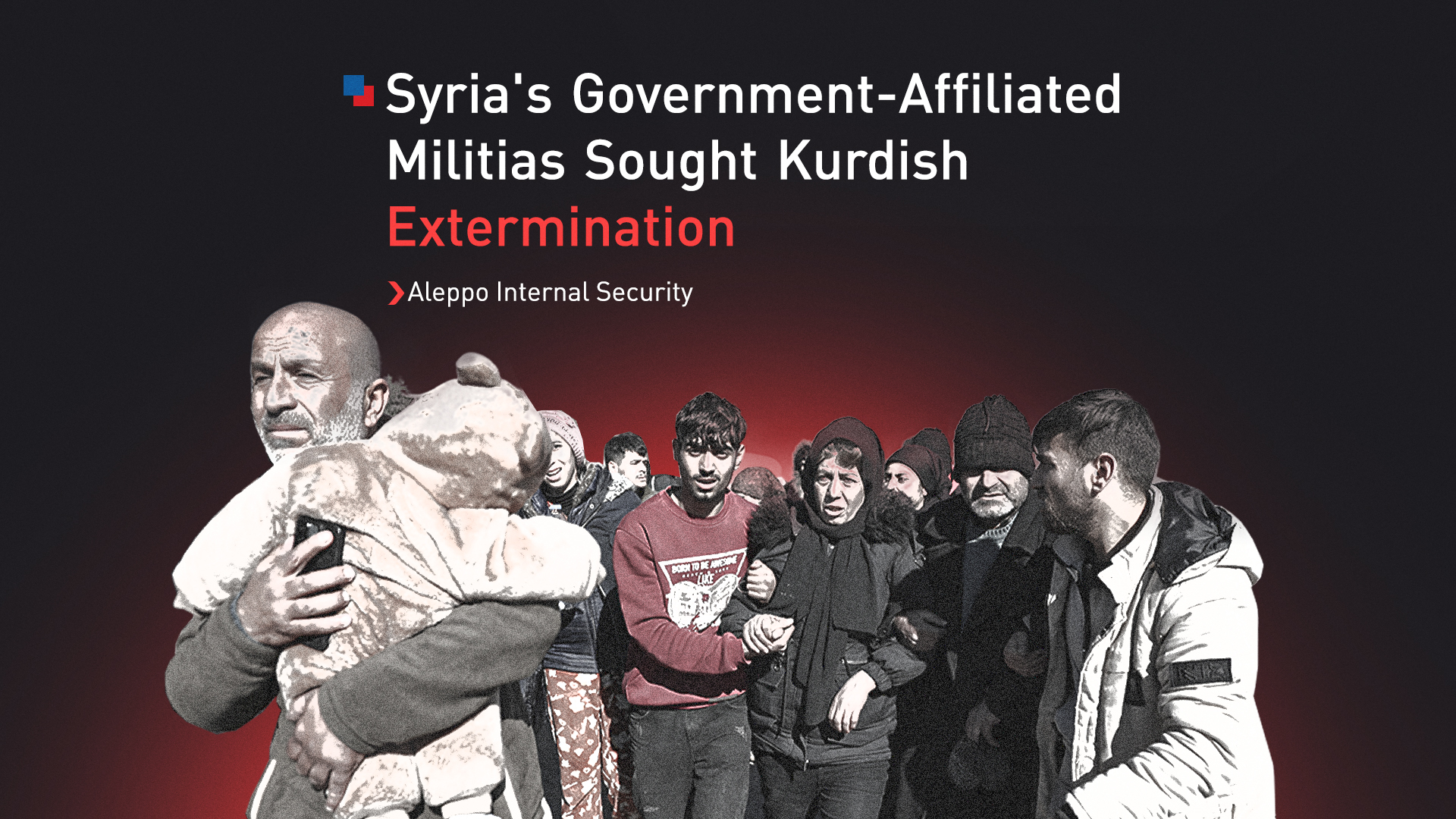
ERBIL (Kurdistan24) – The Internal Security Forces operating in the Sheikh Maqsud and Ashrafiyeh neighborhoods of Aleppo issued a statement on Sunday accusing paramilitary units affiliated with the Syrian government of launching a systematic military offensive aimed at the "extermination" of the local population and the permanent alteration of the districts' demographic structure.
The statement, released following days of intense urban combat, detailed a large-scale assault that reportedly began on January 6, 2026.
According to the security forces, the operation involved thousands of fighters described as "mercenaries affiliated with the Syrian government," who were supported by a significant array of heavy military hardware, including drones, tanks, artillery, and armored vehicles.
The security forces asserted that the primary objective of these incursions was not merely territorial control, but a deliberate effort to violate the dignity of the residents and manipulate the long-standing demographic composition of these Kurdish-majority neighborhoods.
The release of these allegations coincides with a major shift in the security architecture of Aleppo. Earlier on Sunday, Mazloum Abdi, the General Commander of the Syrian Democratic Forces (SDF), confirmed that an agreement had been reached through international mediation to implement a ceasefire.
This agreement facilitates the evacuation of Kurdish fighters, wounded individuals, and besieged civilians from Sheikh Maqsud and Ashrafiyeh to areas administered by the Autonomous Administration of North and East Syria.
Allegations of Targeted Infrastructure Attacks
In their detailed account of the hostilities, the Internal Security Forces emphasized the severity of the bombardment directed at civilian infrastructure. A focal point of the allegations concerns the Khalid Fajr Hospital, identified in the report as the sole medical facility operating within the neighborhood capable of receiving and treating patients.
The statement alleged that government-affiliated forces targeted the hospital "dozens of times" using heavy weapons and drones.
The security forces described these strikes as an attempt to commit a "massacre" against the wounded and the medical staff inside. The bombardment reportedly rendered the facility out of service, a development that exacerbated the humanitarian crisis as casualties mounted during the week of fighting.
According to the statement, the decision to agree to a "partial ceasefire" was driven primarily by the need to prevent further loss of life and to secure the evacuation of the hospital.
The security forces noted that they dealt with the ceasefire "with the utmost respect" to ensure the safe transfer of the wounded, civilians, women, and children from the devastated medical facility to safer areas.
Resistance and Casualties
The Internal Security Forces characterized their response to the government offensive as a "courageous resistance" authorized by the Council of Sheikh Maqsud and Ashrafiyeh.
The statement declared that local forces had "sacrificed their lives without hesitation" to defend the neighborhoods. It further asserted that the defenders had refused to accept surrender during the active combat phase.
While the security forces did not provide a specific casualty count in their Sunday release, noting only that information regarding the identities of "martyrs" would be published later, background data indicates a significant human toll.
Reports emerging from the week-long conflict suggest that at least 60 civilians were killed and nearly 100 others were wounded. The fighting has also triggered a massive displacement crisis. Aleppo Governor Azam al-Gharib reported that approximately 155,000 people had fled their homes due to the violence.
The Barzani Charity Foundation provided corroborating figures regarding the scale of the displacement, documenting the movement of more than 27,000 families.
The Foundation’s daily report indicated that the majority of these families have sought refuge in the Afrin district and its surrounding villages. These displaced populations are reportedly facing harsh winter conditions, with shortages of shelter and basic necessities creating a precarious humanitarian situation.
Diplomatic Maneuvering and Ceasefire Terms
The cessation of hostilities appears to be the result of high-level diplomatic interventions.
In his statement on the social media platform X, SDF Commander Mazloum Abdi stated that the understanding was reached after "much effort and with the mediation of international parties."
While Abdi did not explicitly name the mediators, he described the agreement as a necessary measure to halt attacks and protect civilians after five days of heavy combat.
The diplomatic context for the ceasefire includes direct engagement by the United States.
On Saturday, U.S. Ambassador to Türkiye and Special Envoy for Syria Tom Barrack met with Syrian President Ahmed al-Sharaa in Damascus.
According to reports following the meeting, Barrack conveyed warnings from President Donald Trump and Secretary of State Marco Rubio that continued violence in Aleppo could jeopardize Syria's political transition following the fall of the Assad government.
Barrack reportedly urged a return to the terms of the "March 2025 integration agreement" between Damascus and the SDF, which outlines the incorporation of SDF forces into national institutions.
The European Union also weighed in as the fighting escalated, calling for an immediate end to hostilities and emphasizing the protection of civilians.
Under the terms of the current agreement, as outlined by Abdi, the evacuation includes the transfer of fighters and civilians out of the contested neighborhoods.
Abdi called on the mediating parties to ensure the implementation of these terms and to prevent violations that would hinder the potential return of displaced residents to their homes and properties.
Withdrawal and Uncertainty
On the ground, the implementation of the withdrawal began on Sunday. Syrian state media reported that the military had concluded operations in Sheikh Maqsud and that buses were transporting surrendering Kurdish fighters toward northern Syria.
An Agence France-Presse correspondent reported witnessing convoys, escorted by Syrian security forces, leaving the area.
However, the situation remains tense. Reports indicated that Syrian security forces were seen separating young men from crowds of evacuating civilians, with one official claiming these individuals were fighters being transferred to detention centers.
Civilians expressed desperation regarding family members trapped inside the neighborhoods, with one resident telling reporters she feared for her children still inside the conflict zone.
Despite the withdrawal, the Internal Security Forces in Sheikh Maqsud signaled a continued ideological commitment to their cause.
Their statement concluded with a vow to "continue the struggle without hesitation to protect the free will and dignity of our people," asserting that they would follow in the footsteps of their fallen comrades.
The fall of these districts to government-affiliated control marks a decisive shift in Aleppo’s balance of power, ending years of autonomous administration by Kurdish forces in Sheikh Maqsud and Ashrafiyeh. While the fighting has halted, the future of the displaced population and the long-term governance of these strategic neighborhoods remain unresolved questions.