Kurdistan Official Pushes Back on Baghdad’s Allegations Over Border Trade
KRG official Hawre Kemal refuted Baghdad's claims of unofficial border crossings, defending them as vital for local livelihoods, while the Finance Ministry rejected accusations regarding federal revenue losses.
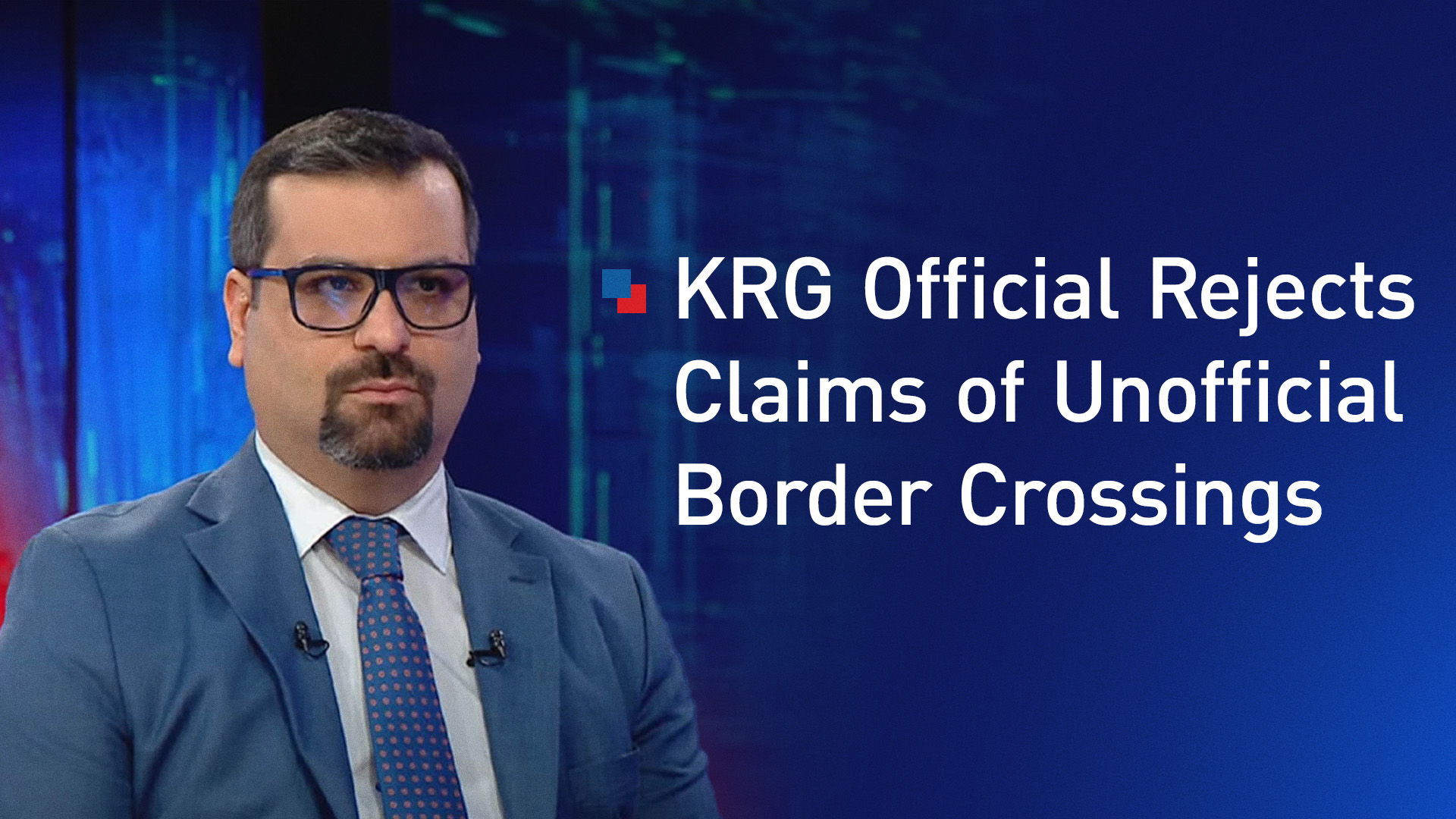
ERBIL (Kurdistan24) – A senior legal advisor at the Kurdistan Regional Government’s (KRG) Ministry of Finance formally disputed allegations made by federal authorities regarding the legality of border entry points in the Kurdistan Region on Friday. Hawre Kemal rejected assertions by Omar Waeli, the Head of the Iraqi Border Ports Commission, that "unofficial" crossings are operating within the Kurdistan Region, maintaining instead that all facilities handling commercial traffic function under strict government regulation and are vital for local economies.
In a statement to Kurdistan24, Kemal characterized Waeli’s recent remarks as factually incorrect and damaging to the perception of the region's administration.
"Those remarks by Omar Waeli are untrue, and all those border crossings in the Kurdistan Region where commercial traffic takes place are official crossings," Kemal stated. He argued that the federal official’s categorization presented a "very ugly image" of the region's governance that does not align with the operational reality on the ground.
The dispute highlights a persistent divergence in classification between Erbil and Baghdad regarding what constitutes a sanctioned port of entry.
Kemal acknowledged that while federal authorities recognize major logistical hubs such as Parvizkhan, Bashmakh, Ibrahim Khalil, and Haji Omaran, they fail to acknowledge several other operational points that the KRG considers fully official.
He specifically highlighted the Kele crossing in Qaladze as a prime example of this disconnect. While Baghdad views Kele as an unofficial entity, the KRG treats it as a fully sanctioned facility that is essential for the economic survival of the surrounding population.
Kemal explained that the livelihood of the area's residents depends heavily on these specific nodes.
He argued that it is logistically impossible and economically unfeasible for people in those districts to travel to distant, federally recognized crossings like Haji Omaran or Bashmakh for their routine travel and trade needs.
Consequently, the KRG maintains these crossings to serve the immediate needs of its citizens.
Beyond the Kele crossing, Kemal enumerated a list of other border points—including Shushmi, Sayran Ban, Sarzer, Zet, and Peshkhabur—that remain subjects of contention. He defended their operation as crucial drivers of "very good economic movement" between the Kurdistan Region and neighboring territories in Eastern (Iran), Northern (Türkiye), and Western (Syria) Kurdistan.
Kemal remained defiant regarding the region's right to manage these economic arteries.
"We cannot close all those crossings just to look good in the eyes of Omar Waeli," he said. He further directed a sharp personal criticism at the federal official, suggesting that Waeli himself faces restrictions on his movements within federal borders.
"He himself, because his name is Omar, is not allowed to reach their own border crossings," Kemal remarked, alluding to internal security and political dynamics within federal Iraq.
He also issued an open invitation to federal officials, stating, "We have told them several times to come and look at the crossings, because they believe we have such crossings that no one knows about; rather, this is untrue, and all crossings are organized by a system and are operational."
This specific exchange regarding border nodes follows a broader and more heated exchange of accusations between the KRG and federal authorities earlier in the week.
On Thursday, the KRG Ministry of Finance and Economy issued a comprehensive statement rejecting claims that the Kurdistan Region was culpable for a decline in federal port revenues. The ministry described accusations leveled by Waeli during a session of the Iraqi Council of Representatives as misleading, legally unfounded, and politically motivated.
The KRG Ministry of Finance argued that any decline in federal revenue should be attributed to systemic failures within the federal administration rather than regional operations. In its Thursday statement, the ministry cited "administrative and financial corruption," collusion with smugglers, and the influence of certain tribal figures as primary drivers of revenue loss in federal Iraq.
The statement further alleged that widespread "settlements" and exemptions are granted to trucks at federal ports, and criticized the abrupt implementation of higher tariffs by Baghdad without a phased plan.
The ministry also highlighted contradictions in federal reporting, pointing out that Waeli had previously claimed a 100 percent increase in revenues. The KRG attributed that temporary spike to a flawed "per-container" customs system that had briefly diverted trade away from Kurdistan Region border crossings to federal ones, rather than organic economic growth.
Tensions also extend to the mechanics of customs enforcement. The KRG Ministry of Finance dismissed claims that goods enter Iraq through the Kurdistan Region specifically to evade federal tariffs as "entirely unfounded."
Instead, officials in Erbil argued that the federal government has undermined trade by establishing internal customs checkpoints at locations such as Al-Sad, Chiman, and Dareman, situated between the Kurdistan Region and federal provinces.
The ministry contended that these checkpoints amount to a system of double taxation that fosters bribery and forces merchants to relocate their supply lines away from the region.
Furthermore, the dispute over borders is inextricably linked to the wider conflict over federal budget allocations. Responding to federal comments regarding public sector salaries and oil revenues, the KRG emphasized that its share of the federal budget is a constitutional right rather than "a gift or charity."
The ministry accused Baghdad of systematically withholding salaries over the past 12 years. According to the ministry's data, of approximately 94 trillion dinars owed to the region over the last seven years, only 33 trillion dinars had been transferred, covering just three years of salaries.
The KRG concluded its defense by reiterating its call for formal federal recognition of the disputed crossings, noting that points described by Baghdad as "unofficial" are fully recognized by the Kurdistan Regional Government as well as by Iran and Türkiye.
The ministry stated it was prepared to substantiate all its claims and reserved the right to pursue legal action against any official who continues to level what it views as baseless accusations against the region.