Thousands Rally in Paris to Protest Siege of Rojava
Thousands protested in Paris on Saturday to support Rojava as a siege on Kobani continues. Five children have reportedly died from cold and medical shortages while access routes remain closed.
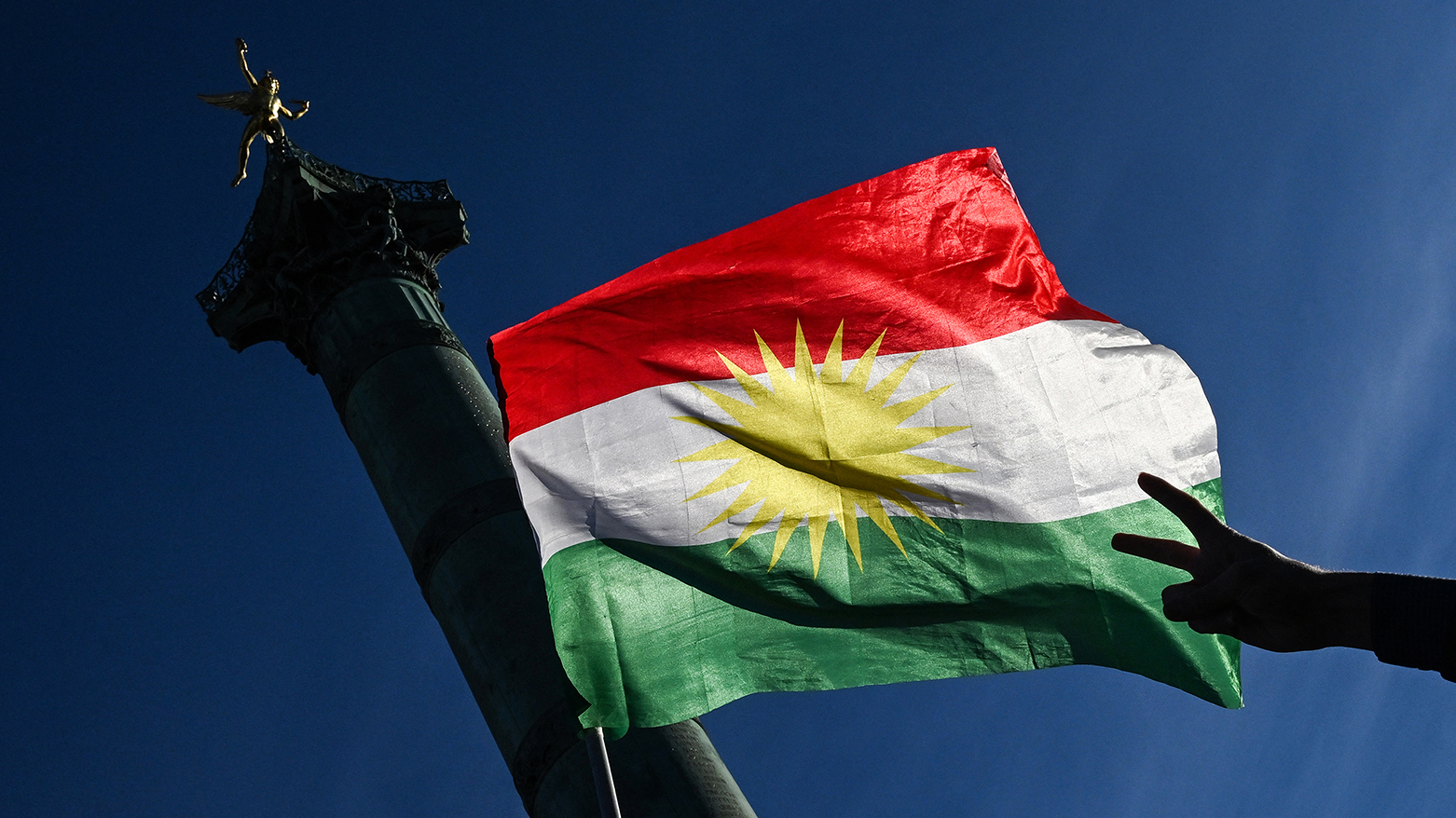
ERBIL (Kurdistan24) – Thousands of Kurdish demonstrators and human rights advocates gathered in Paris on Saturday to demand immediate French intervention in northeastern Syria, where a tightening military siege by the Syrian Arab Army has led to a collapse of essential services and the reported deaths of several children.
The protest in the French capital serves as a focal point for the growing anxiety within the European diaspora as the region of Western Kurdistan, known as Rojava, faces renewed military pressure and a catastrophic winter storm.
According to official statistics provided by the French police, approximately 7,500 participants marched through the streets of Paris.
Raising banners and chanting slogans such as "Kurds will win," "Kobane will not fall," and "Defend Rojava," the protesters expressed their opposition to the ongoing offensive launched by the Syrian Arab Army (SAA) and various other armed groups affiliated with government in Damascus against the autonomous regions.
The demonstration highlights the escalating tension between Kurdish authorities and the government in Damascus, which has moved to reimpose its authority over territories that have maintained de facto autonomy for much of the 14-year Syrian conflict.
Demet Sahin, a lawyer participating in the Paris protest, told Agence France-Presse (AFP) that there is a profound sense of "great fear for the future of the Kurds in the region."
Sahin noted that while international rhetoric often favors supporting the Kurdish population, "in reality, we see no practical measures" being taken to alleviate the crisis.
Other demonstrators echoed this sentiment, describing a feeling of betrayal and a sense of helplessness in the face of what they characterized as the international community’s silence.
For its part, the French government issued a statement on Thursday asserting that it has not abandoned its Kurdish allies. Government officials expressed their appreciation for the significant role Kurdish forces played in the territorial defeat of the Islamic State (ISIS).
However, these diplomatic assurances have proven unsatisfactory to the Kurdish diaspora in France.
With a population estimated by the Kurdish Institute in Paris to be between 320,000 and 400,000, France is home to the second-largest Kurdish community in Europe, making its domestic political response a matter of significant concern for the diaspora.
The intensity of the protests has resulted in friction with local law enforcement. In recent days, 24 individuals have been arrested and 21 police officers have been injured during clashes on the sidelines of various demonstrations.
This volatility prompted authorities in Marseille, in southern France, to issue a temporary ban on all demonstrations scheduled for Saturday.
Humanitarian Collapse in Kobani
The protests in Europe are a direct response to a deteriorating security and humanitarian landscape in northern Syria, specifically within the city of Kobani.
As the military siege of the city entered its seventh day on Saturday, the Democratic Autonomous Administration of North and East Syria (DAANES) announced a lethal escalation in the medical crisis.
Avin Qamishlo, Co-chair of the Media Office of the DAANES, told Kurdistan24 that a child died in a Kobani hospital on Saturday, Jan. 24, 2026, due to a lack of medical oxygen. The death occurred as the city’s health facilities struggle to maintain basic operations amidst a total cutoff of electricity and fuel.
Dr. Haqi Ali Demir, a specialist in anesthesia and intensive care in Kobani, warned that hospitals are relying entirely on emergency generators, leaving patients dependent on ventilators at immediate and critical risk.
The DAANES and various Kurdish political organizations have described the current environment in Kobani as a "slow death."
In a joint statement, these groups alleged that the Syrian Arab Army’s siege constitutes "collective punishment" against the civilian population.
"Children are without milk, patients have no medicine, families lack flour and food, and hospitals and vital institutions have stopped functioning due to the absence of fuel," the statement read. The organizations characterized these measures as crimes against humanity and a violation of the Geneva Conventions.
The lethal toll of the siege extends beyond medical shortages to extreme environmental exposure.
The Kurdish Red Crescent reported on Saturday that five children, including an infant, have died in Kobani specifically due to the cold. The organization attributed these fatalities to a significant drop in temperatures combined with a lack of heating fuel.
This crisis is underscored by meteorological reports indicating that the region is currently experiencing its heaviest snowfall in more than 50 years.
International Responses and Obstruction of Aid
The United Nations has voiced increasing alarm over the isolation of the city’s 150,000 residents. Farhan Haq, the Deputy Spokesperson for the UN Secretary-General, stated on Friday that all access routes to Kobani have been closed.
"The humanitarian situation is worsening day by day," Haq said, adding that while the UN has successfully delivered aid to Hasakah, Raqqa, and Deir ez-Zor, it has been forced to request specific "facilitation" from officials in Aleppo to reach Kobani.
This obstruction has hindered regional relief efforts as well. The Barzani Charity Foundation (BCF) reported that although it has scaled up its mission in Rojava—delivering 102 trucks of aid and 300,000 liters of fuel to the region—none of these supplies have been able to reach Kobani.
Karzan Nuri, a member of the BCF Administrative Board, noted that while the foundation has treated 685 individuals and provided kerosene to families in Qamishlo and Amuda, the blockade of Kobani remains absolute.
The demographic pressure within the city has further strained dwindling resources. Thousands of Kurdish migrants previously displaced from the Tal Samen camp and districts like Ain Issa and Raqqa have sought refuge in Kobani's city center.
Kurdistan24's correspondent in Western Kurdistan, Dilan Barzan, reported that these families are being sheltered in mosques and schools, often possessing nothing more than the clothes they were wearing. Many others are reportedly sleeping outdoors or in vehicles, directly exposed to the freezing winter weather.
Ceasefire Extension and Security Standoff
Amidst the humanitarian emergency, the Syrian Democratic Forces (SDF) announced on Saturday that an agreement has been reached to extend a standing ceasefire with Damascus for fifteen days. The extension was brokered through international mediation as dialogue between the two sides continues.
The Syrian Ministry of Defense confirmed the extension, stating it would apply across all operational fronts of the Syrian Arab Army starting at 11 p.m.
Damascus indicated that the pause in hostilities is intended to facilitate operations by United States forces, specifically the ongoing transfer of approximately 7,000 ISIS detainees from SDF-run prisons to Iraqi territory.
On Wednesday, a convoy of 150 ISIS fighters, including prominent European militants, was reportedly moved to Iraq. Turkey’s Foreign Minister Hakan Fidan also publicly supported the continuation of the ceasefire to ensure the secure transfer of these prisoners.
Despite the formal extension of the truce, the siege of Kobani persists, and Kurdish authorities remain skeptical of the government's long-term intentions.
The SDF has recently released a dossier documenting what it claims are war crimes committed during the 17-day military campaign, including arbitrary detentions and attacks on medical facilities.
The Autonomous Administration continues to appeal for the opening of "safe and calm corridors" to allow for the delivery of medical aid and the evacuation of the wounded.
As thousands in Paris call for a more robust French and international response, the residents of Kobani remain trapped between a stalled political process and a winter disaster that has already proven fatal for the city’s youngest inhabitants.