Regional Militias Signal Escalation as US Carrier Reaches Middle East
Threats from armed groups in Iraq, Lebanon, and Yemen emerge amid mounting tensions and US military buildup.
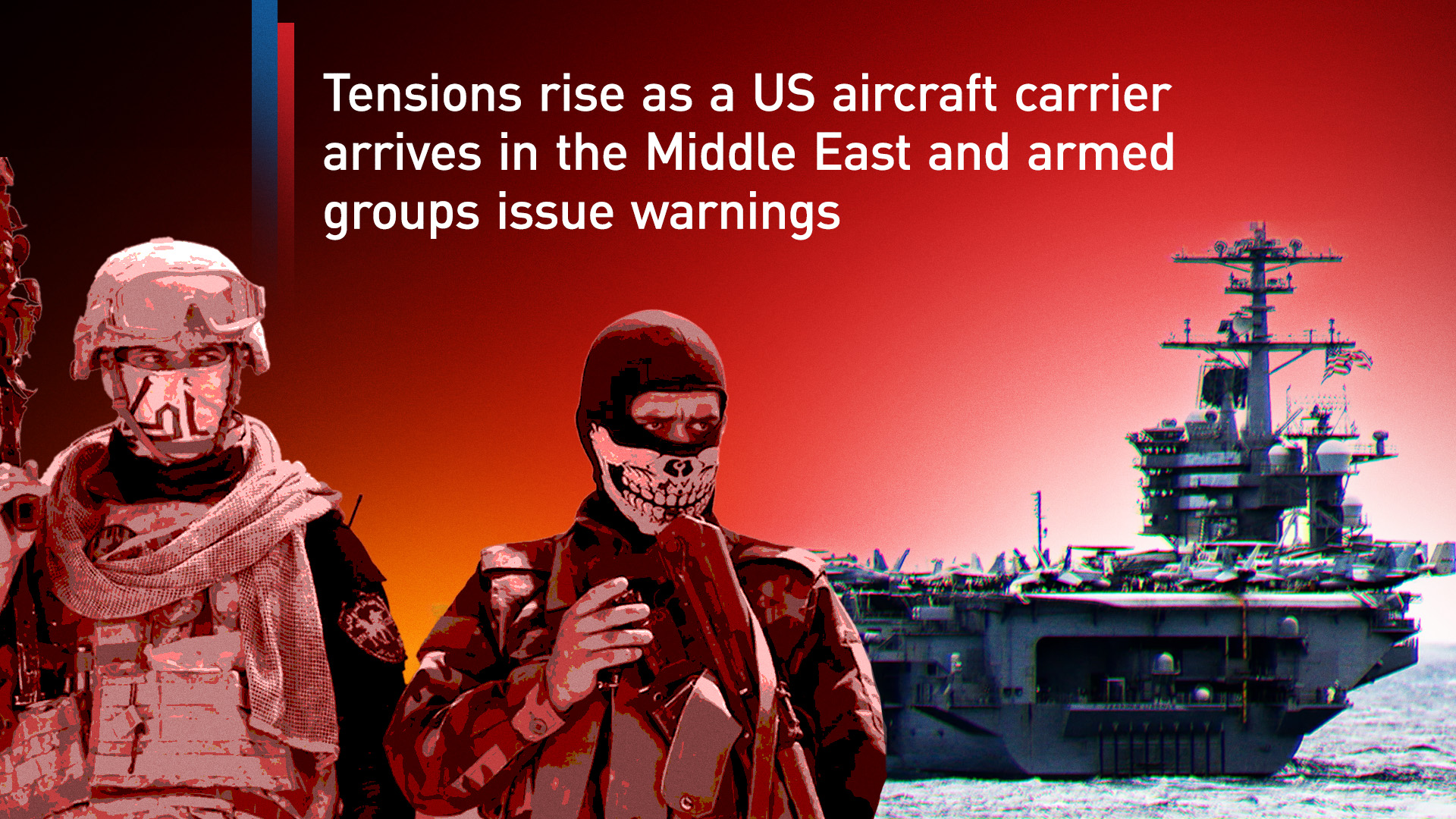
ERBIL (Kurdistan24) — Armed groups across the Middle East signaled readiness to escalate attacks on Monday as a US aircraft carrier strike group arrived in the region, heightening fears of a broader confrontation following warnings from Washington over unrest and human rights abuses.
The arrival of the USS Abraham Lincoln and accompanying guided-missile destroyers comes as several militias aligned with Tehran issued threats that were widely interpreted as attempts to deter potential US military action.
Officials said the carrier group was deployed to promote regional security and stability, while President Donald Trump described the move as a precautionary step.
In Yemen, the Houthis hinted it could resume attacks on commercial shipping in the Red Sea, releasing a short video showing a vessel ablaze with the caption “Soon.” In Iraq, Kataib Hezbollah, a powerful paramilitary group, warned late Monday that any strike against Tehran would trigger what it described as a “total war” across the region.
The statements have intensified a tense waiting period across the Middle East as governments and armed groups assess whether Washington will follow through on its threats of military action.
US Central Command confirmed Monday that the Abraham Lincoln strike group had entered the region, saying its presence was intended to reinforce deterrence and stability. Trump said the deployment was ordered “just in case” he decides to take action.
Senior Iranian military officials, speaking on state television, dismissed the US move as exaggerated and said Tehran had increased its own military readiness. They described the carrier as “an accessible target” rather than a deterrent.
The latest threats underscore the evolving posture of Iran’s so-called “Axis of Resistance,” a network of allied armed groups in Iraq, Yemen, Lebanon, Syria, and Gaza. While these groups were once viewed as a unified front, their responses during recent conflicts have varied.
Both the Houthis and Kataib Hezbollah largely refrained from involvement during Israel’s 12-day war with Iran in June, when the United States bombed Iranian nuclear sites. Analysts say their earlier reluctance highlighted internal disarray within the alliance after sustained Israeli strikes against Hamas in Gaza and Hezbollah in Lebanon, as well as the collapse of the Assad government in Syria in 2024 after a prolonged civil war.
The Houthis previously halted their Red Sea attacks following a ceasefire in Gaza, though they have repeatedly warned they could resume operations. On Monday, the group rebroadcast footage of its January 2024 attack on the Marshall Islands-flagged tanker Marlin Luanda in the Gulf of Aden.
In Iraq, Kataib Hezbollah leader Ahmad “Abu Hussein” al-Hamidawi issued a stark warning. “We affirm to the enemies that the war on the Islamic Republic will not be a picnic; rather, you will taste the bitterest forms of death, and nothing will remain of you in our region,” he said in a statement.
Iraq’s Al-Nujaba Movement, one of the country’s armed factions, said all of its forces are on full alert and ready to take part in any response to a potential attack on Iran. Firas Yasser, a member of the group’s political bureau, told reporters on Monday that any strike on Iran would push the entire region toward a comprehensive confrontation, drawing in Gulf states and Iraq as well.
He added that senior religious authorities in Najaf or other Shiite scholars could issue a religious decree (Fatwa) backing Iran in the event of a large-scale attack, stressing that coordination among “resistance” groups across the region has reached an advanced stage.
Yasser said the group does not expect fighting to reach Iraqi territory, but warned it would act from the outset of any attack, cautioning that any weakening of Iran would pave the way for Iraq to be targeted and for terrorist groups to expand inside the country.
Lebanon’s Hezbollah, one of Tehran’s closest allies, has taken a more cautious tone. In a video address to supporters in Beirut’s southern suburbs, Secretary-General Sheikh Naim Qassem said the group was preparing for “possible aggression” but stopped short of committing to direct intervention.
“We are not neutral,” Qassem said, adding that Hezbollah would decide how to act based on circumstances on the battlefield and its perceived interests. He warned that any new war would ignite the region and said an attack on Tehran would also be considered an attack on Hezbollah.
More than a year of hostilities with Israel, which largely ended with a November 2024 ceasefire, significantly weakened Hezbollah. The Lebanese government has since begun implementing a plan to disarm the group in the south.
The United Arab Emirates said it would not allow its territory, airspace, or waters to be used for attacks against Iran. In a statement on Monday, the foreign ministry said Abu Dhabi was committed to dialogue, de-escalation, and respect for sovereignty, despite hosting thousands of US personnel at Al Dhafra airbase.
Meanwhile, Iranian officials issued fresh warnings to Washington and Israel. Defense Ministry spokesperson Gen. Reza Talaei-Nik on Monday said any attack would be met with a response “more painful and more decisive than in the past,” while Foreign Ministry spokesman Esmail Baghaei cautioned that insecurity in the region would spread beyond Iran.
The scale of the unrest and the mounting regional threats have raised concerns among diplomats and analysts that miscalculation could push the Middle East into a wider and more destabilizing conflict.