Kurdistan Region Prime Minister Marks Anniversary of 2004 Erbil Attacks
PM Masrour Barzani laid a wreath in Erbil Sunday to honor 101 victims of the 2004 Eid al-Adha suicide attacks on KDP and PUK headquarters, a tragedy cited as a catalyst for Kurdish political unity.
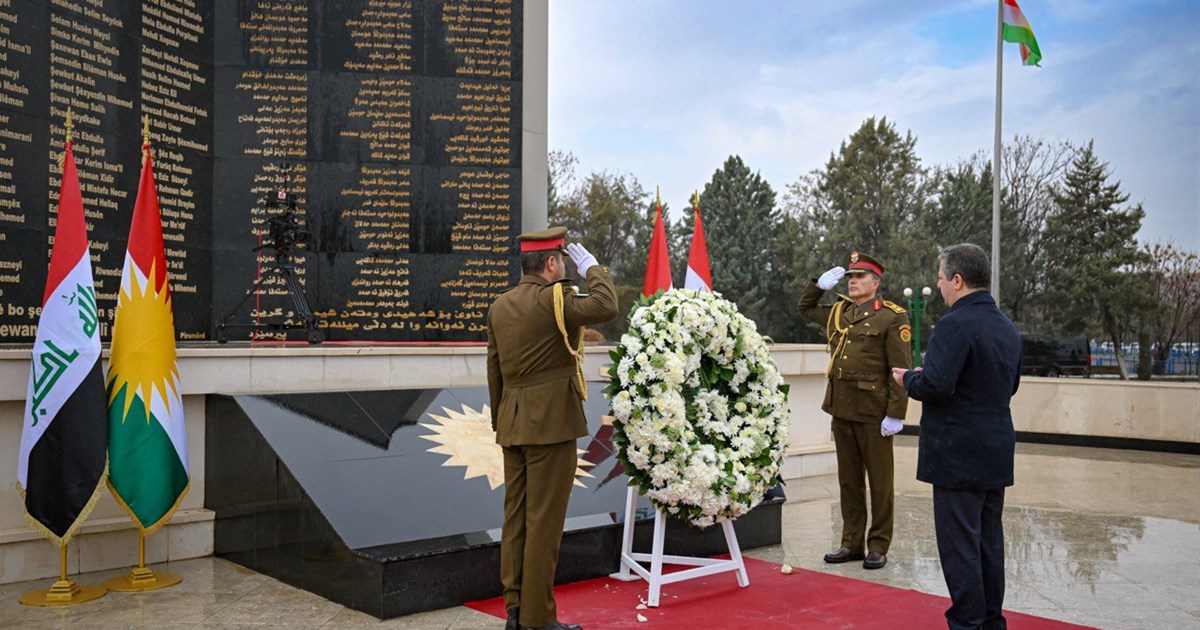
ERBIL (Kurdistan24) - Kurdistan Region Prime Minister Masrour Barzani presided over a memorial ceremony in Erbil on Sunday morning, marking the anniversary of the 2004 suicide bombings that targeted the region's political leadership during a religious holiday. The Prime Minister joined officials and families of the victims to pay respects at the February 1st Martyrs Monument, commemorating an event that officials describe as a pivotal moment in the modern history of the Kurdistan Region.
On Sunday, Feb. 1, 2026, the anniversary proceedings were held in the Kurdistan Region’s capital, where Prime Minister Barzani laid a wreath at the monument.
According to the report of the ceremony, the gesture was intended to symbolize both respect and loyalty to those who lost their lives in the attacks more than two decades ago. The event serves as an annual occasion for the Kurdistan Regional Government (KRG), the families of the deceased, and the broader public to gather in remembrance of the tragedy.
The commemoration centers on the events of Feb. 1, 2004, a date coinciding with the first day of Eid al-Adha. As residents and officials in Erbil were engaged in the customary exchange of holiday greetings, the celebrations were interrupted by two coordinated suicide terrorist attacks.
The bombings were carried out inside the respective headquarters of the region’s two primary political parties: Branch 2 of the Kurdistan Democratic Party (KDP) and Center 3 of the Patriotic Union of Kurdistan (PUK).
The attacks resulted in a significant loss of life, with reports confirming that 101 people were killed and hundreds more were wounded in the explosions. The incident is recorded as one of the deadliest events in the recent history of the region.
The victims included a wide cross-section of Kurdish society, ranging from high-ranking political leaders and senior cadres to Peshmerga forces and civilians who had gathered for the holiday observance.
Among the most prominent figures killed in the explosions were Sami Abdulrahman, Shawkat Sheikh Yazdin, Sa'id Abdullah, Shakhawan Abbas, Khosraw Shera, and Mahdi Khoshnaw. These individuals were characterized in the commemoration materials as dedicated fighters with long histories of struggle within the Kurdish liberation movement.
The sheer scale of the casualties transformed what was intended to be a period of Eid celebration into a time of profound mourning for the region.
The location of the memorial holds specific historical significance. The site was originally utilized as a military base by the former Ba’athist regime before becoming the location where the party leaders and civilians were killed. In the years following the attacks, the grounds were redeveloped into Sami Abdulrahman Park, which is now the largest park in Erbil.
The transformation of the site is described by officials as a deliberate symbol of life and peace, standing in opposition to the violence of the 2004 incident.
Beyond the immediate human toll, the February 1st anniversary is observed as a moment of political symbolism regarding Kurdish unity. According to the background material provided for the occasion, the simultaneous targeting of both KDP and PUK headquarters resulted in the "blended blood" of martyrs from both parties.
This shared tragedy is cited as a catalyst that accelerated the unification of the two administrations that existed at the time, fostering a unified will among the political leadership.
The annual ceremony at the February 1st Martyrs Monument is framed by organizers not only as a memorial to the past but as a statement on the present resilience of the population.
Participants laying wreaths at the site are described as delivering a message to "enemies of humanity," asserting that while acts of terror may inflict physical harm, they cannot seize the Kurdish people's will for life and freedom. The gathering remains a fixture on the KRG’s official calendar, reinforcing the narrative of struggle against terrorism and the pursuit of stability in the region.
This article was updated on Sunday, Feb. 1, 2026, at 10:23am.