Iran’s Khamenei Warns of Regional War if U.S. Launches Attack
Iran's Supreme Leader warned that any U.S. attack could escalate into a regional war, stating: “They must know that if they start a war, this time it will not remain limited to a single border; rather, it will become a regional war and will engulf the entire region.”
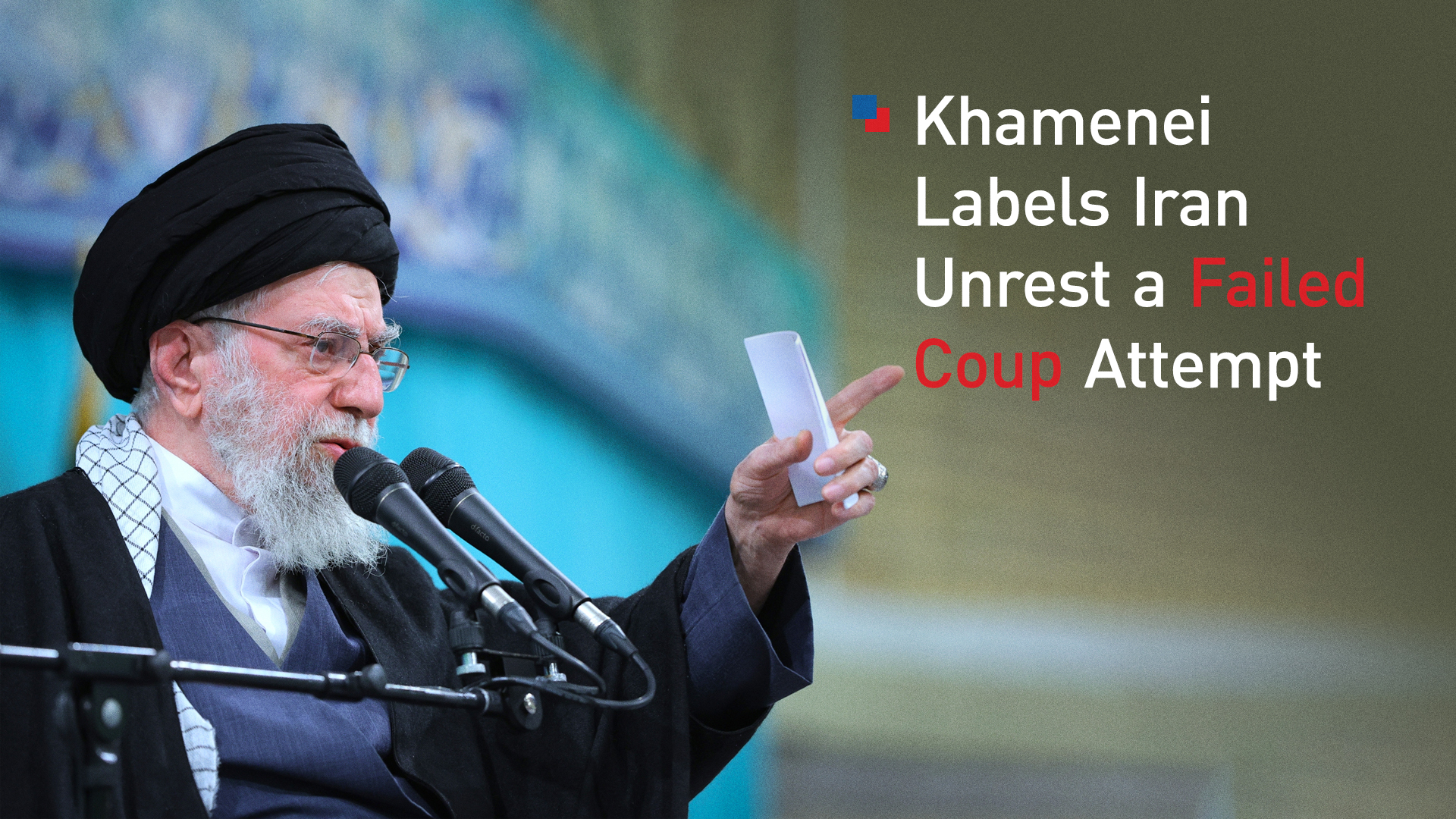
ERBIL (Kurdistan24) - Iranian Supreme Leader Ayatollah Ali Khamenei said on Sunday, Feb. 1, 2026, that Tehran will not initiate war but will respond decisively to any attack, warning that U.S. military action could escalate into a broader regional conflict, according to Tasnim news agency reports.
Speaking amid heightened tensions with the United States, Khamenei described recent American threats, including the deployment of aircraft carriers near Iran, as “just talk” and asserted that such displays have not intimidated the Iranian people. He added, “They must know that if they start a war, this time it will not remain limited to a single border; rather, it will become a regional war and will engulf the entire region.”
The Americans should know if they start a war, this time it will be a regional war.
— Khamenei.ir (@khamenei_ir) February 1, 2026
On domestic developments, Khamenei described recent unrest in Iran as a coup attempt, saying it aimed to sabotage key institutions, including police stations, government and military offices, banks, and mosques, and included the burning of the Koran. He noted that the attempts were suppressed.
"They (rioters) attacked the police, government centres, IRGC centres, banks, and mosques, and burned the Koran... It was like a coup," Khamenei said according to Tasnim news agency, adding that "the coup was suppressed".
The Iran-based Human Rights Activists News Agency (HRANA) reported that the demonstrations resulted in 6,563 deaths, including over 6,100 protesters and 124 children, though the agency and other human rights groups warn that the toll may be far higher. Iranian authorities have confirmed more than 3,000 deaths, mostly members of security forces or bystanders, attributing fatalities to “rioters.”
The remarks followed statements by U.S. President Donald Trump, who predicted that Iran would likely seek to negotiate a deal to avoid military action, according to AFP reporting on January 31, 2026. “I can say this, they do want to make a deal,” Trump told reporters in the Oval Office, noting that a U.S. naval carrier group was positioned off Iran’s coast.
“Hopefully we’ll make a deal. If we do make a deal, that’s good. If we don’t, we’ll see what happens,” he added. Trump cited what he said was Iran’s suspension of executions following the protests as a sign of willingness to negotiate.
AFP reported that Trump declined to provide a specific deadline for talks on Iran’s nuclear and missile programs. U.S. officials have indicated that any potential deal would need to include caps on Iran’s long-range missile arsenal, removal of enriched uranium, and a ban on independent enrichment, according to reporting by Axios cited by AFP.
Analysts, including Serhan Afacan of the Ankara-based Centre for Iranian Studies, described linking a nuclear deal with other issues as “likely impossible,” noting that Iran considers its ballistic missile program a red line central to its defense strategy.
Iranian authorities have reiterated that missile and defense capabilities will not be subject to negotiation. Foreign Minister Abbas Araghchi stated that Tehran is “ready to begin negotiations if they take place on an equal footing,” but emphasized that the country’s defensive and missile programs would never be on the table.
The Supreme National Security Council secretary, Ali Larijani, reportedly met with Russian President Vladimir Putin in Moscow, with Russia offering to mediate between Washington and Tehran. No details of the talks have been released.
The tensions occur against the backdrop of Iran’s recent confrontation with the European Union. On Sunday, February 1, 2026, Iran declared the armed forces of European countries to be “terrorist groups” following the EU’s decision to designate the Islamic Revolutionary Guard Corps (IRGC) as a terrorist organization, according to Kurdistan24 reporting.
Parliament Speaker Mohammad Bagher Ghalibaf, speaking in parliament and wearing an IRGC uniform, said that under Iran’s Law on Countermeasures Against the Declaration of the IRGC as a Terrorist Organization, the EU’s militaries would now be considered terrorist entities. The practical implications of this declaration remain unclear.
The EU move followed allegations that the IRGC played a central role in a deadly crackdown on protests in late December and early January. European Commission President Ursula von der Leyen described the designation as “long overdue” and criticized the Iranian authorities for “crushing its own people’s protests in blood.”
Alongside the designation, the EU imposed visa bans and asset freezes on 21 Iranian officials and state entities.
Iran’s IRGC, founded after the 1979 Islamic Revolution, wields broad political and economic influence, controlling significant sectors of the economy. While the organization and its senior commanders were already under EU sanctions, officials acknowledged that the formal terrorist designation was largely symbolic, with limited practical impact.
EU foreign policy chief Kaja Kallas emphasized that diplomatic channels with Tehran would remain open despite the designation, while French Foreign Minister Jean-Noël Barrot urged Tehran to halt executions, lift internet restrictions, and allow its citizens political freedom.
The EU decision was welcomed by Israel as a “historic” step, aligning the bloc with earlier U.S., Canadian, and Australian designations of the IRGC as a terrorist entity.
Meanwhile, in Washington, senior Gulf officials have expressed concern that any U.S. strike on Iran could destabilize the region and trigger economic and security repercussions, according to AFP.
One official said the United States is “closely guarded” about its plans and stressed that stability depends on Iran “doing the right thing.”
Iranian authorities have consistently warned that any U.S. military action would provoke immediate missile strikes against American bases, ships, and regional allies, including Israel.
Ali Shamkhani, head of Iran’s Defense Council, stated, “We are not limiting the geography of confrontation to the sea alone and have prepared ourselves for broader and more advanced scenarios,” Tasnim reported.
At a joint news conference in Istanbul, Turkish Foreign Minister Hakan Fidan said Israel was pushing the United States toward military action and urged Washington to avoid escalation.
Khamenei’s statements on Sunday underline Iran’s dual approach: rejecting war initiation while signaling readiness to respond forcefully if attacked. They come amid ongoing U.S. and European pressure, domestic unrest, and regional concerns about escalating confrontation.
This article was updated again on Sunday, Feb. 1, 2026, at 12:48pm.
This article was updated on Sunday, Feb. 1, 2026, at 12:31pm.