PM Barzani Says Talks Continue With No Agreement Yet on Iraqi Presidency
Kurdistan Region PM Masrour Barzani said no agreement has been reached on Iraq's presidency, talks continue, and he emphasized unity, and support for stability in Western Kurdistan.
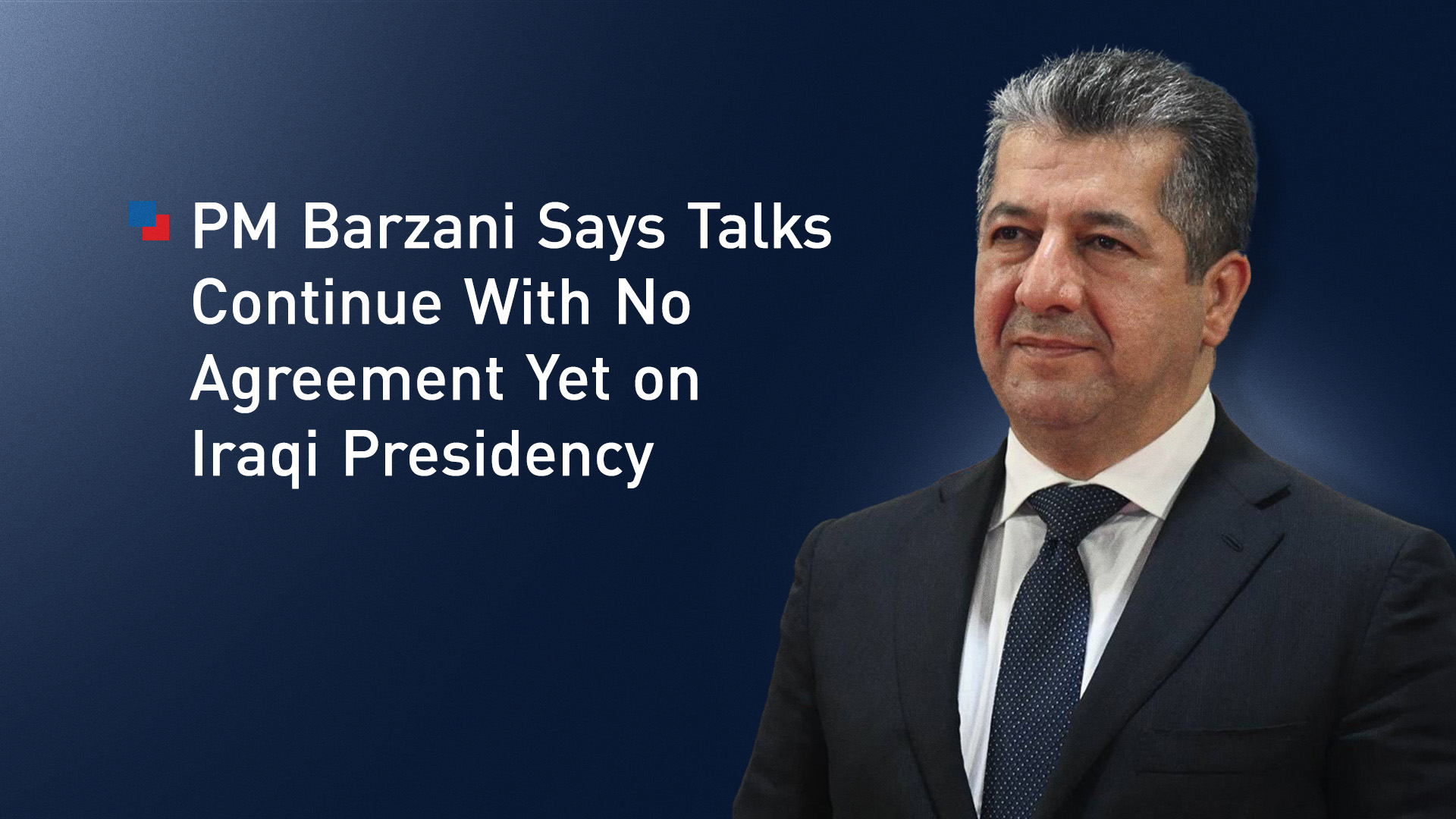
ERBIL (Kurdistan24) - Kurdistan Regional Government Prime Minister Masrour Barzani said on Sunday that no agreement has yet been reached regarding the post of president, adding that discussions are ongoing and that any decision will be made in line with what he described as the supreme interests of the people.
Prime Minister Masrour Barzani made the remarks in a press statement after attending the annual commemoration of the February 1 martyrs in Erbil. Following the ceremony, he responded to a series of questions from journalists covering issues ranging from internal Kurdish political talks to recent developments in Western Kurdistan (Rojava) and relations between Kurdish parties.
Speaking on the anniversary, PM Barzani began by addressing the significance of February 1, marking the 22nd anniversary of what he described as a terrorist act that claimed the lives of Kurdish leaders and citizens. He said the commemoration was an occasion to remember not only those killed on that day but all martyrs of what he termed Kurdistan’s liberation movement.
He expressed hope that such events would never again befall the Kurdish people and said the memory of the martyrs should reinforce the need for unity and persistence in pursuing what he described as the legitimate rights of the Kurdish people. He added that the path set by the martyrs should not be abandoned until those goals are achieved.
The press conference also focused on ongoing political discussions at both the regional and federal levels.
Asked about an expected visit by a delegation from Iraq’s Coordination Framework to Erbil concerning the election of the prime minister and the president, PM Barzani said that, regarding the presidency, no agreement has yet been reached. He said delegations are expected to arrive and hold meetings with President Masoud Barzani and the leadership of the Kurdistan Democratic Party (KDP). Decisions, he said, would be taken following those meetings and would be guided by the needs and interests of the people.
In response to the same question, PM Barzani also addressed developments in Rojava.
He said President Masoud Barzani played what he described as a primary role in bringing parties together to halt tensions and allow a ceasefire to begin and continue. He said he had heard that a preliminary agreement had now been reached between Damascus and the Syrian Democratic Forces (SDF). PM Barzani expressed hope that the agreement would be expanded and lead to the return of peace and stability to Syria, particularly in Kurdish areas.
PM Barzani was further questioned about the status of talks with the Patriotic Union of Kurdistan (PUK) concerning both the election of the president of Iraq and the formation of the tenth cabinet of the Kurdistan Regional Government.
He said that following the Kurdistan elections, which he noted took place more than a year ago, the KDP had stated that the will of the people and the election results must be respected. He said the party continues to adhere to that position, viewing the election results as the basis for forming the government cabinet.
Regarding discussions in Baghdad, PM Barzani said no agreement has yet been reached. He said talks are ongoing and indicated that it remains to be seen what outcome those discussions will produce. He did not provide further details on the nature or timeline of the negotiations.
Journalists also asked PM Barzani for his personal message following the reported agreement between the SDF and Damascus. He said he welcomed the cessation of war and expressed hope that the rights of all Syrian people, particularly the Kurds, would be established legally within the country’s constitution. He added that the prevalence of peace would serve everyone’s interests.
Another question addressed concerns that a lack of agreement between the KDP and PUK on the issue of the presidency could negatively affect the formation of the tenth KRG cabinet.
PM Barzani rejected the idea that the two matters should be linked. He said the Kurdistan election was held in the Kurdistan Region, while another election took place across Iraq, describing them as two different issues. He said he does not believe they should be mixed or that developments in one should alter the other, adding that both should be viewed as separate matters.
PM Barzani was also asked about potential risks if the agreement related to Rojava is not implemented and about the Kurdistan Region’s role in supporting its implementation. He said continued tension anywhere in the region does not serve the interests of the Kurdish people. For that reason, he said, the Kurdistan Region supports the absence of tension and the presence of peace and stability. He added that efforts would continue to bring the parties together.
Throughout his remarks, PM Barzani returned repeatedly to the themes of unity, dialogue, and stability. He framed the anniversary of February 1 as a reminder of past losses and a call to maintain a firm stance in seeking rights through unity. He also underscored the distinction between regional government formation and federal-level political processes, emphasizing that discussions on the presidency remain unresolved.
His comments on Rojava echoed earlier statements highlighting President Masoud Barzani’s involvement in efforts to reduce tensions between the SDF and the Syrian government. PM Barzani characterized those efforts as focused on ceasefire arrangements and broader stability, expressing optimism about recent developments while stopping short of describing them as final or comprehensive.
The press statement did not indicate when a decision on the presidency might be reached, nor did it specify the next steps in talks with political counterparts in Baghdad or within the Kurdistan Region. PM Barzani said only that discussions are ongoing and that outcomes will depend on future meetings and deliberations.
The appearance followed the annual commemoration ceremony in Erbil, where PM Barzani joined others in honoring those killed in the February 1 attack. He described the anniversary as a moment of reflection and recommitment, linking remembrance of the past to present political responsibilities.
In addressing multiple questions from journalists, PM Barzani sought to clarify the government’s position on several fronts while reiterating that no final decisions have yet been made regarding the presidency. He emphasized that any eventual agreement would be shaped by what he described as the higher interests of the Kurdish people and by efforts to maintain stability both within the Kurdistan Region and in neighboring areas.
Full text of the Prime Minister's responses and journalists' questions:
Journalist: What is your message on the 22nd anniversary of the February 1st martyrs?
Prime Minister Masrour Barzani: We hope that such calamities never again befall the Kurdish people. Unfortunately, this is the anniversary of the martyrdom of a group of leaders and citizens of Kurdistan who were all martyred in a terrorist act. Today’s commemoration of these martyrs, and all the martyrs of Kurdistan’s liberation movement, must convey the message that we must be united, take a firm stand, persist in seeking the legitimate rights of our people, and—God willing—not abandon the path of those martyrs until we achieve our people's ultimate goal.
Journalist: A delegation from the Coordination Framework is scheduled to come to Erbil regarding the election of the Prime Minister and the President; what have the KDP and PUK reached in this regard? Also, what was President Barzani's role in the agreement between the SDF and the Syrian government?
Prime Minister Masrour Barzani: As you know, His Excellency President Barzani played a primary role in bringing the parties together to stop the tensions and for a ceasefire to begin and continue, leading to a result. We heard that there is now a preliminary agreement between Damascus and the SDF. We hope this agreement will be expanded and that peace and stability will return to Syria, particularly the Kurdish areas. Regarding the issue of the presidency, no agreement has been reached yet. We are waiting to see the delegations that will arrive and meet with His Excellency President Barzani and the KDP leadership. At that time, we will make a decision based on the needs and the supreme interests of our people, whatever that interest may be.
Journalist: Regarding the election of the President of Iraq and the formation of the tenth cabinet of the Kurdistan Regional Government, at what level are your discussions with the PUK?
Prime Minister Masrour Barzani: Right after the Kurdistan elections, which took place more than a year ago, we said that the voice of the people of Kurdistan and the election results must be respected. We continue with that same vision; it is the KDP’s view that the election results serve as the path to forming the government cabinet. As for Baghdad, no agreement has been reached yet. Discussions are ongoing; let’s see what we achieve.
Journalist: What is your personal message following the agreement between the SDF and Damascus?
Prime Minister Masrour Barzani: We are happy to see the war stop and to see the rights of all Syrian people, especially the Kurds, established legally within the constitution, and for peace to prevail. This is in everyone’s interest.
Journalist: If the KDP and PUK do not agree on the issue of the presidency, will it not have a negative impact on the formation of the tenth cabinet? Where have the steps reached?
Prime Minister Masrour Barzani: They are two separate issues. The Kurdistan election was held here, and another election was held across Iraq; they are two different matters. I do not believe they should be mixed or that one should change the other. Therefore, we view both as two separate issues.
Journalist: What are the risks if the Rojava agreement is not implemented? What will the Kurdistan Region’s efforts be toward its implementation?
Prime Minister Masrour Barzani: Continued tension anywhere in the region is not in the interest of our people. Therefore, we support the absence of tension and the existence of peace and stability. For that reason, we will continue our efforts to bring the parties together.