Curfews, Deployments and an Explosion Mark First Day of SDF–Syrian Accord
Implementation of the SDF–Damascus pact began Monday under curfews in Hasakah and Qamishlo as state forces deployed. The agreement’s fragility was highlighted by an explosion in Hasakah, witnessed live by Kurdistan24 correspondent Zhevan Abed.
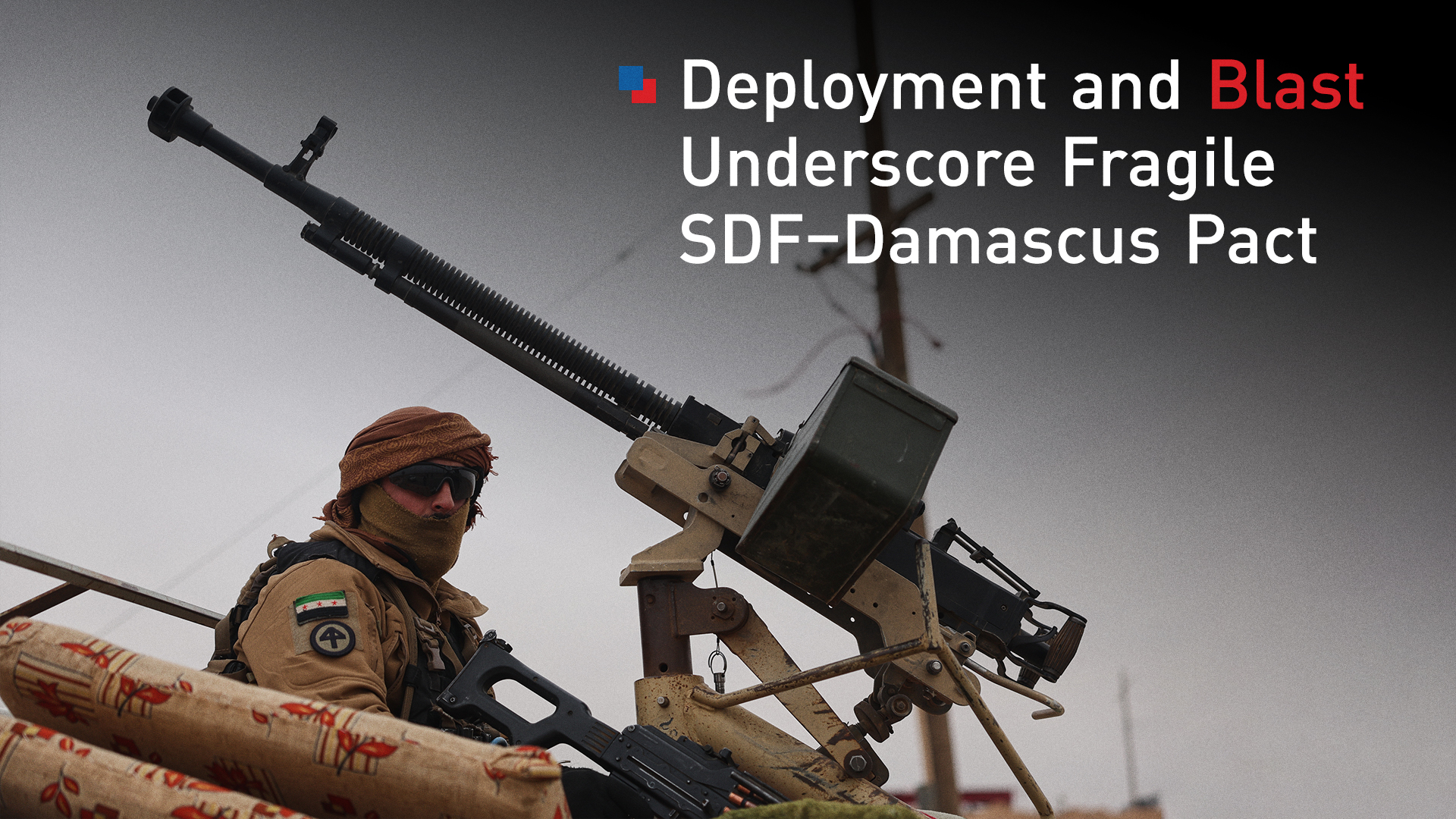
ERBIL (Kurdistan24) - The implementation of a comprehensive agreement between the Syrian Democratic Forces (SDF) and the Syrian government commenced on Monday, February 2, 2026, marking the beginning of a significant restructuring of the military and administrative landscape in northeastern Syria. Amid a strict curfew imposed across the cities of Hasakah and Qamishlo, Syrian state security forces began their deployment into key zones as International Coalition fighter jets patrolled the skies, signaling the start of a phased integration process intended to merge Kurdish-led military structures with state institutions.
The execution of the accord, which was signed on Jan. 29, 2026, began under tense conditions. While the agreement outlines a detailed roadmap for the cessation of hostilities and the unification of governance, reports from the ground indicated immediate security challenges. A curfew has been in effect in both major cities since the previous night, scheduled to last until 6:00 PM on Monday.
The Internal Security Forces of the Autonomous Administration, known as the Asayish, stated that the restriction on movement was a necessary measure to prevent security disturbances during the sensitive transition period. They warned that strict penalties would be applied to any violations.
However, the fragility of the ceasefire was underscored by an incident in Hasakah during the early hours of the implementation. Zhevan Abed, a correspondent for Kurdistan24, witnessed an explosion while reporting live from the city’s Panorama area. Describing the event as it unfolded, Abed reported that a shell had landed in the vicinity, disrupting the relative calm enforced by the curfew.
"Opposite me—honestly, if my colleagues can assist—a shell just landed... while I am with you right now," Abed said during the broadcast. He described a scene of rising smoke and confusion, noting that aircraft were continuously monitoring the situation from above.
"This smoke you see right now... this is the first situation like this occurring before our eyes. Meaning, it is anticipated that this may be a violation related to the situation that just unfolded, though we do not know from which side this shell came, or which side carried out the violation," he reported.
The correspondent’s account provided a window into the tense atmosphere on the ground. He observed that the roads were largely empty due to the curfew, with only the Internal Security Forces visible.
"Opposite us are the SDF forces, or let me say Internal Security (Asayish), because the SDF is no longer supposed to be seen inside the city," Abed explained, referencing one of the key provisions of the new agreement which mandates the withdrawal of military units from urban centers.
He described the sound of the explosion as "very powerful" and noted that it occurred in close proximity to his location, highlighting the potential for spoilers to disrupt the transfer of authority.
Despite this incident, the formal mechanisms of the agreement proceeded as scheduled.
In Qamishlo, Syrian government security forces were stationed within the city's "Security Square," a symbolic and strategic zone that has long been a point of contention between the Kurdish administration and Damascus. This deployment is part of a broader effort to reassert state authority over internal security matters.
According to the terms of the deal, forces affiliated with the Syrian Ministry of Interior are set to enter the centers of both Hasakah and Qamishlo to initiate the process of merging the Asayish with the national police apparatus.
The agreement, which is structured to be implemented in four stages over the course of one month, involves a radical reorganization of military forces in the region. In this initial phase, a new military division is being established, comprised of three brigades totaling 16,000 personnel drawn from the SDF.
This process of integrating Kurdish fighters into the state military structure is expected to take one month to complete.
Additionally, a specialized brigade for forces from Kobane will be formed and integrated into a division affiliated with the Aleppo Governorate, effectively bringing these units under the centralized chain of command.
The military protocols also dictate a significant redeployment of assets. The agreement stipulates the withdrawal of SDF military forces from the cities of Hasakah and Qamishlo to agreed-upon bases outside the urban perimeter. In exchange, the Syrian Army is required to immediately withdraw its units to the town of Shaddadi, south of Hasakah.
This reciprocal movement is designed to demilitarize the city centers, where security will ostensibly be managed by a bolstered police presence. To support this, 15 vehicles belonging to state security forces are scheduled to enter Hasakah and Qamishlo to reinforce stability.
Parallel to the security arrangements, the agreement addresses critical economic and infrastructure transfers. The first phase includes the handover of Qamishlo Airport to the Civil Aviation Authority and the transfer of border crossings to state control.
Specifically, a team from the Border Crossings Authority is being dispatched to the Semalka and Nusaybin crossings. Their mandate includes formalizing the status of civil staff, ensuring the immediate opening of these transit points, and enforcing a ban on the transport of weapons and foreign fighters.
Following the secure transfer of the airport and borders, the second phase will involve the handover of the Rumailan and Suwaydiya oil fields to the Syrian government, with their civil employees being integrated into the Ministry of Energy.
The administrative dimensions of the deal are equally comprehensive. According to the 14-point agreement detailed by the news outlet Al-Majalla, all institutions currently operating under the Autonomous Administration will be transferred to official Syrian state institutions.
This transfer includes a guarantee that civil servants currently employed by the Kurdish administration will be secured in their positions and formalized as state employees.
The agreement also addresses the contentious issue of education, with provisions to work with the Ministry of Education to accredit certificates issued by schools and universities of the Autonomous Administration and to discuss the specificities of Kurdish education within the national curriculum.
A power-sharing arrangement regarding high-level appointments has also been codified.
The agreement outlines the distribution of sensitive posts, stipulating that the Governor of Hasakah will be appointed based on a nomination by the SDF, while the Provincial Police and Security Commander will be nominated by the Syrian government.
Furthermore, the position of Deputy Minister of Defense constitutes a designated slot for an SDF nominee. This distribution aims to balance central oversight with local representation.
The political ramifications of the agreement were addressed by the Kurdish National Council in Syria (KNCS), which issued a statement endorsing the pact as a necessary step toward stability.
The KNCS emphasized that the agreement must be implemented "seriously and sustainably" to end the suffering of the population. The Council viewed the accord, alongside Presidential Decree No. 13, as an "important starting point for a serious dialogue" between the government and representatives of the Kurdish people.
In its statement, the KNCS articulated that the ultimate goal of this process must be the achievement of "legitimate national rights" and the redress of historical grievances through constitutional reform.
The Council reiterated that guaranteeing the rights of all Syrian components based on "genuine partnership, justice, and equality" is the only viable foundation for lasting security. They argued that these principles are essential for protecting the supreme national interest and ensuring a dignified life for all citizens without distinction.
Humanitarian concerns are also central to the agreement, particularly regarding the rights of displaced populations. The terms explicitly guarantee the return of all displaced persons to their cities and villages, specifically naming Afrin, Sheikh Maqsud, and Sere Kaniye (Ras al-Ain).
To facilitate this, the agreement calls for the appointment of local officials within the civil administrations of those areas, suggesting a framework for restoring local governance in territories that have seen significant demographic upheaval.
Other civil liberties addressed in the pact include the licensing of media and cultural organizations. The agreement mandates that all local and cultural organizations and media institutions be granted licenses in accordance with the applicable laws of the relevant ministries.
This provision aims to integrate the vibrant civil society that has emerged in the northeast into the national legal framework.
As the curfew remains in force until Monday evening, the situation in Hasakah and Qamishlo remains fluid. The reported shelling incident serves as a stark reminder of the potential for disruption, even as the administrative and military machinery of integration begins to turn.
With International Coalition aircraft patrolling overhead and Syrian Interior Ministry forces moving into position, the coming weeks will be a critical test of whether this ambitious roadmap can transition from paper to reality, fundamentally altering the governance of Western Kurdistan and its relationship with Damascus.