Barham Salih Says Aid Efforts to Kobani Ongoing, Praises Kurdistan Region’s Support
He praised the Kurdistan Region for its role in facilitating aid deliveries, saying, “We appreciate the role of the Kurdistan Region in delivering aid.”
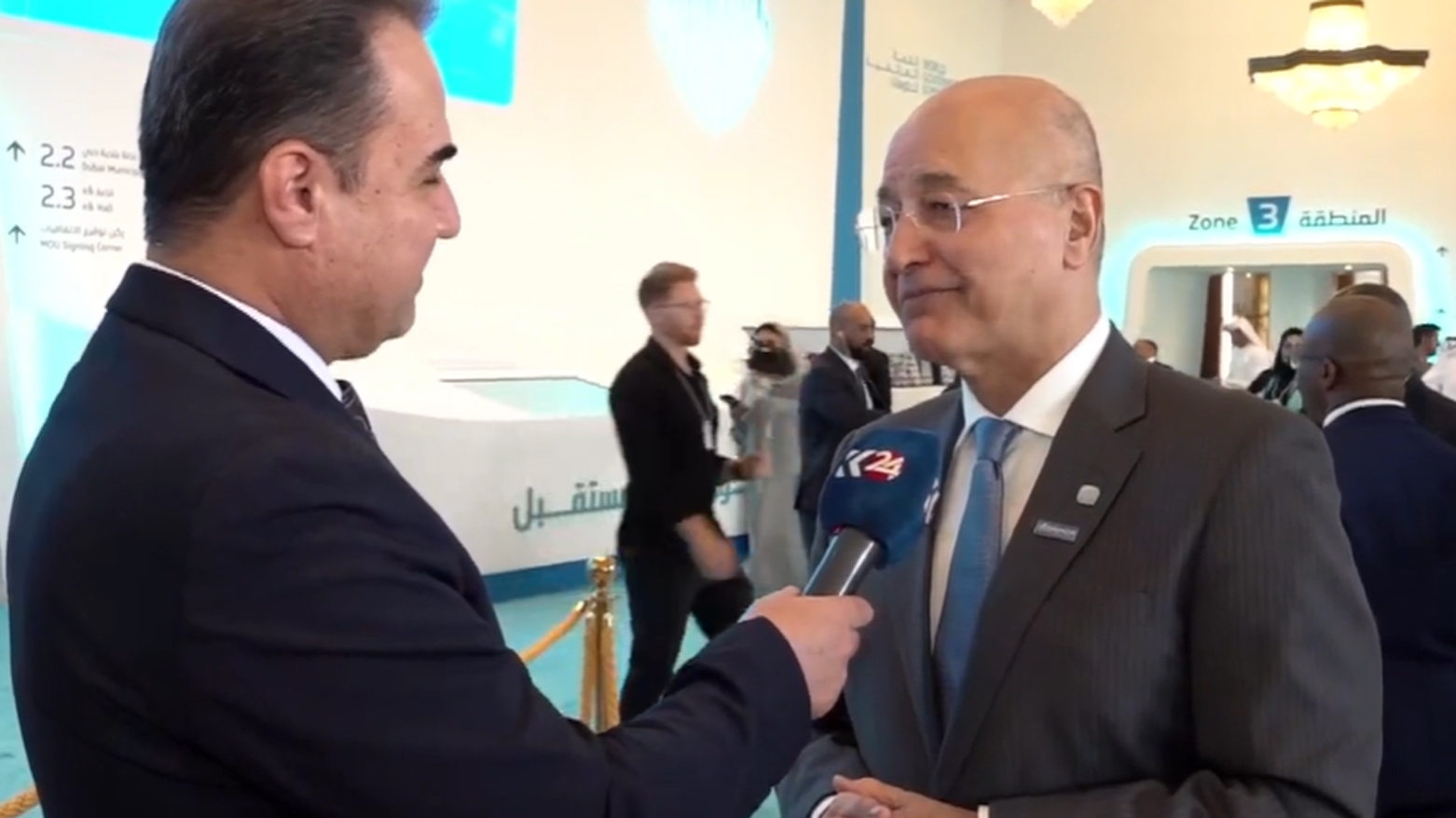
ERBIL (Kurdistan24) – On Wednesday, United Nations High Commissioner for Refugees (UNHCR) Barham Salih said United Nations efforts to deliver humanitarian assistance to Western Kurdistan, particularly the Syrian city of Kobani, are continuing despite the worsening situation on the ground.
In an exclusive interview with Ammar Najmaddin, Kurdistan24’s correspondent in Dubai, Salih expressed concern over the deteriorating humanitarian conditions in Syria and emphasized the importance of sustained international support. He praised the Kurdistan Region for its role in facilitating aid deliveries, saying, “We appreciate the role of the Kurdistan Region in delivering aid.”
Salih stressed that the implementation of a ceasefire is essential to ensure the uninterrupted flow of humanitarian assistance. “We hope that the ceasefire will be implemented as it is, to pave the way for the delivery of humanitarian aid,” he said.
He noted that UN aid operations are ongoing, with assistance already reaching several areas. “UN efforts to deliver aid to Kobani continue. Some of the aid has gone to Aleppo, while others have reached Qamishlo and Kobani,” Salih added.
The remarks come amid renewed international attention on Kobani’s humanitarian situation. Last week, the United Nations welcomed the start of aid deliveries to the city, describing them as a critical step toward easing civilian suffering in Western Kurdistan.
In an exclusive interview with Kurdistan24 on Jan. 27, Farhan Haq, Deputy Spokesperson for the UN Secretary-General, said the organization was pleased with the initiation of humanitarian assistance to Kobani. He underlined that opening humanitarian corridors and delivering food and medical supplies are “crucial and important steps,” particularly as the city has faced severe pressure due to siege conditions and ongoing military clashes.
Haq said the arrival of the first aid convoys followed diplomatic efforts and pressure from the international community, reaffirming the UN’s commitment to preventing a further deterioration of conditions and averting a potential humanitarian disaster affecting hundreds of thousands of civilians.
The renewed focus on Kobani coincides with the anniversary of the city’s historic resistance against ISIS. The Battle of Kobani began on Sept. 13, 2014, and ended with the city’s liberation on Jan. 26, 2015, after 134 days of intense fighting. The defense, led by the People’s Protection Units (YPG) and Women’s Protection Units (YPJ), was later reinforced by Kurdistan Region Peshmerga forces, whose deployment proved decisive.
The victory in Kobani marked the first major territorial defeat of ISIS after it declared its so-called “caliphate” in 2014 and laid the groundwork for further cooperation between Kurdish forces and the international coalition in subsequent battles against the extremist group.
UN officials say humanitarian support to Kobani and surrounding areas remains a priority as efforts continue to stabilize conditions and meet the urgent needs of civilians in northern Syria.