Semalka Border Crossing to Remain Operational Under New SDF–Interim Government Agreement, Says Mazloum Abdi
Abdi said that an office representing the interim government will be established at the Semalka Border Crossing to oversee coordination, signaling increased administrative cooperation without altering cross-border movement.
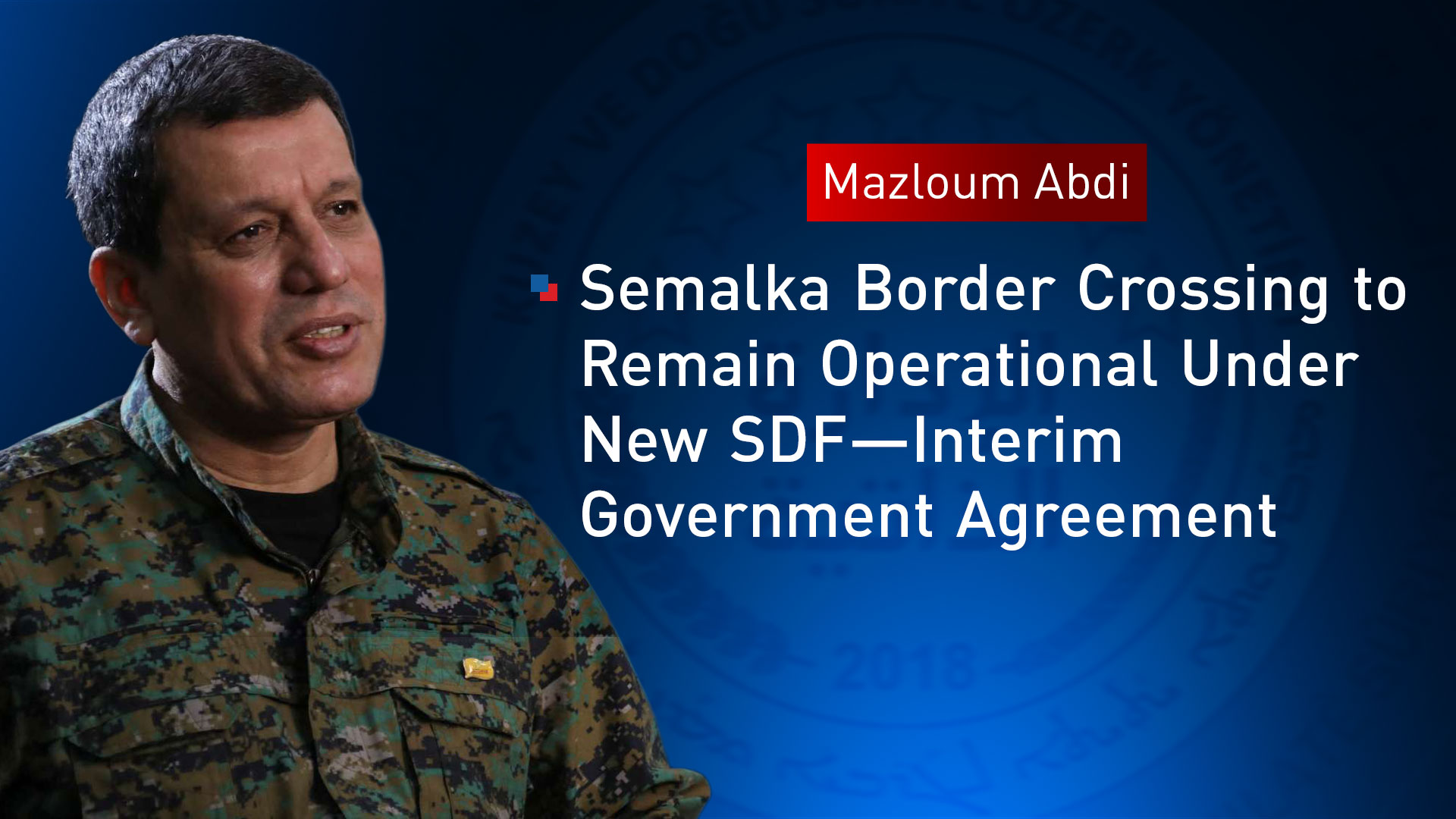
ERBIL (Kurdistan24) – The Semalka Border Crossing will continue operating under its current framework, Mazloum Abdi, commander-in-chief of the Syrian Democratic Forces (SDF), confirmed on Monday, as part of a broader agreement between the SDF and Syria’s interim government aimed at restructuring governance in Western Kurdistan (northeastern Syria).
Speaking during a meeting with residents of Hasakah and internally displaced persons (IDPs) from Afrin and Serê Kaniyê, Abdi outlined the key provisions of the December 29 agreement, describing it as a major step toward political stabilization and administrative reform.
Under the agreement, institutions affiliated with the Democratic Autonomous Administration of North and East Syria (DAANES) will be gradually integrated into state institutions, while continuing their work during the transition period. Structural changes will be implemented to safeguard the rights of IDPs, particularly those displaced from Afrin and Serê Kaniyê.
Abdi noted that existing ministries and administrative bodies will be reorganized at the directorate level to align with state structures, a move intended to improve coordination and governance without disrupting public services.
Addressing border management, Abdi emphasized that the Semalka Border Crossing will remain unchanged in its operations. However, an office representing the interim government will be established at the crossing to oversee coordination, signaling increased administrative cooperation without altering cross-border movement.
On the security front, Abdi announced that an SDF military brigade will be deployed in Hasakah as an initial measure, with additional deployments planned for other areas under a new security reorganization strategy.
The December 29 agreement is widely viewed as a turning point in the Syrian crisis, marking a shift from years of conflict toward negotiated arrangements. Despite ongoing challenges—particularly in Afrin—officials and community representatives expressed cautious optimism that the new measures will contribute to long-term stability and improved governance across the region.