President Masoud Barzani Receives Hungarian Ambassador, Discusses Bilateral Ties and Regional Security
Talks focus on expanding Kurdistan–Hungary relations, counterterrorism coordination, and developments in Syria and Iraq
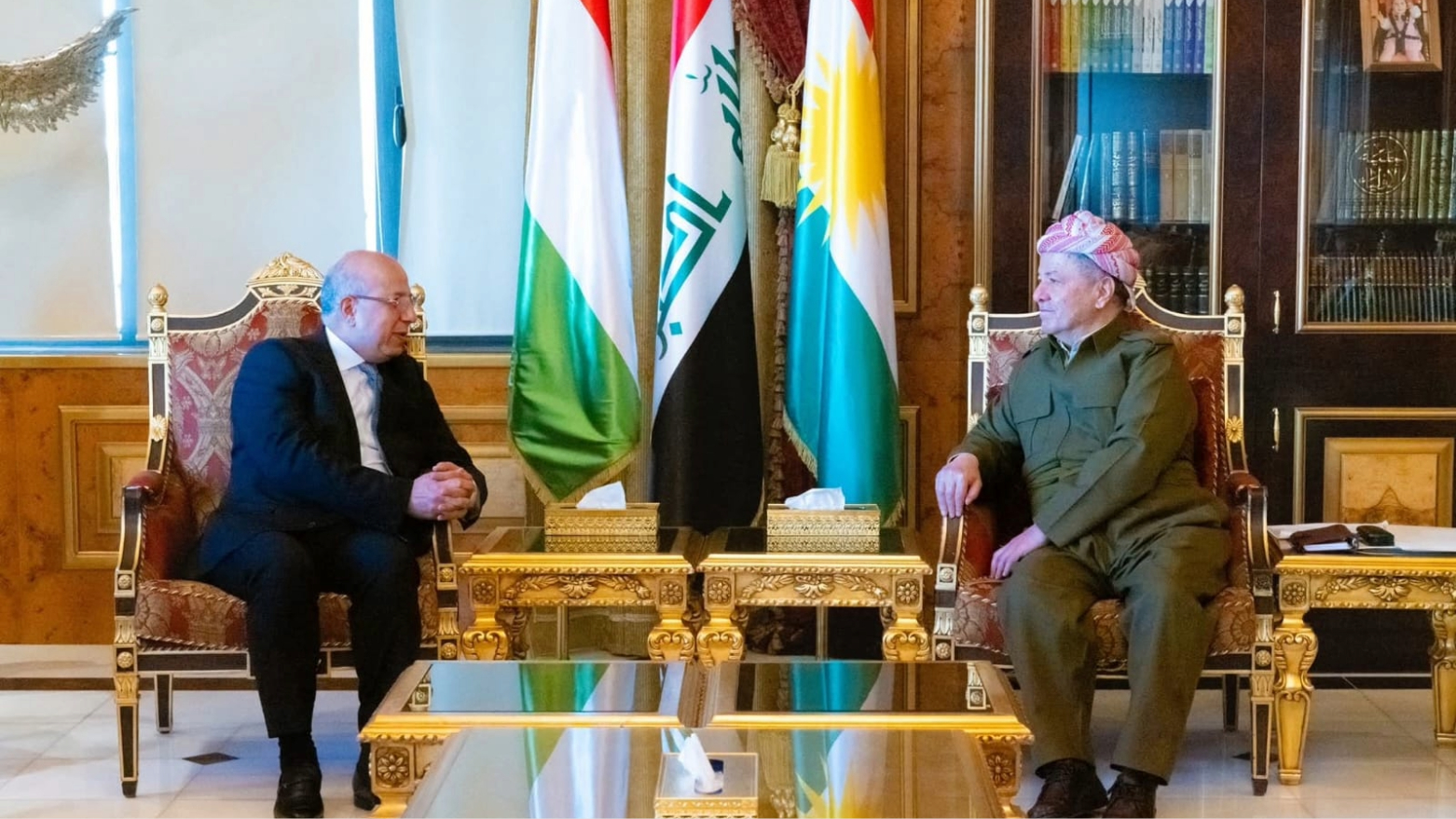
ERBIL (Kurdistan24) — President Masoud Barzani on Monday received Hungary’s Ambassador to Iraq, Osama Ibrahim Naffa, in Pirmam, where the two sides discussed strengthening bilateral relations and addressing pressing regional security challenges.
During the meeting, the Hungarian envoy conveyed the greetings of Hungary’s president and prime minister to President Barzani and reaffirmed Budapest’s interest in expanding ties with the Kurdistan Region across multiple sectors.
He emphasized Hungary’s desire to further develop cooperation in political, economic, and cultural fields.
President Barzani, for his part, welcomed the ambassador and expressed support for broadening relations between the Kurdistan Region and Hungary, underscoring the importance of sustained diplomatic engagement and mutual cooperation.
The meeting also addressed the persistent threat of terrorism and the risks associated with a potential resurgence of ISIS. Both sides stressed the necessity of continued international coordination to prevent the re-emergence of extremist groups and to safeguard stability in the region.
Developments in Syria and the latest dynamics in Iraq’s political process were also key topics of discussion, reflecting shared concerns over regional security and governance challenges.
Relations between the Kurdistan Region and Hungary have steadily developed over the past decade, particularly in the context of counterterrorism cooperation, humanitarian assistance, and support for minority communities affected by conflict.
Hungary has been among the European countries that provided political backing and limited military assistance to Iraqi and Kurdish forces during the fight against ISIS following 2014.
Budapest has also engaged the Kurdistan Regional Government (KRG) through educational and cultural initiatives, including scholarship programs and diplomatic exchanges aimed at strengthening institutional ties.
Hungary’s broader Middle East policy, which places emphasis on stability, migration management, and the protection of Christian and other minority communities, has intersected with the Kurdistan Region’s role as a relatively secure and pluralistic entity within Iraq.
President Masoud Barzani has in recent years emerged as a pivotal interlocutor in regional and international security discussions. As a veteran Kurdish leader with longstanding ties to Western capitals and regional actors, Barzani has frequently hosted senior officials, diplomats, and security delegations seeking dialogue on conflict mitigation and political stabilization efforts.
Amid shifting geopolitical alignments, recurring tensions in Syria, Iraq, and beyond, and the ongoing threat posed by extremist networks, Barzani’s consultations have become part of a broader diplomatic traffic to the Kurdistan Region.
Regional leaders and international representatives increasingly view Erbil and Pirmam as venues for strategic dialogue, leveraging Barzani’s political influence and historical experience in navigating complex multi-front conflicts.
In a Middle East long characterized by overlapping crises — from terrorism and state fragility to proxy confrontations — the Kurdistan Region has positioned itself as a comparatively stable actor. Within this context, Barzani’s role has extended beyond domestic politics to encompass advisory and mediatory functions in wider regional security and political dynamics.