PM Barzani Marks Mother Language Day, Emphasizes Linguistic Diversity in Kurdistan
On International Mother Language Day, Prime Minister Masrour Barzani reaffirmed the Kurdistan Regional Government’s commitment to supporting Kurdish and other languages in the region.
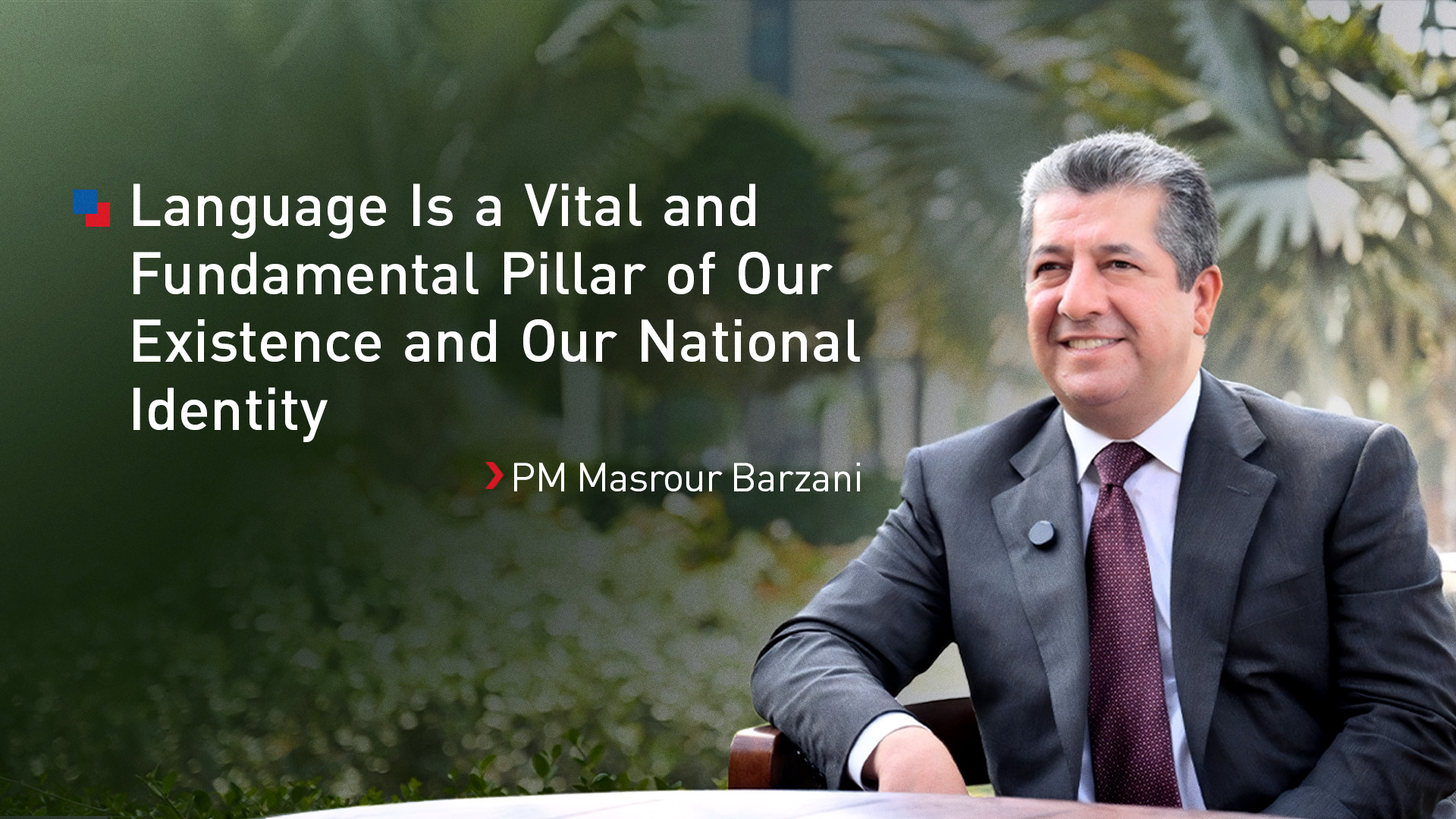
ERBIL (Kurdistan24) - Kurdistan Region Prime Minister Masrour Barzani on Feb. 21, 2026, issued a message marking International Mother Language Day, stating that the Kurdistan Region is enriched by its diverse languages and cultures and reaffirming the Kurdistan Regional Government’s commitment to supporting the Kurdish language and the languages of all components of the people of Kurdistan.
“Happy International Mother Language Day to the people of Kurdistan,” Barzani wrote in a message posted on X. “The Kurdistan Region is enriched by its diverse languages and cultures. It is a source of pride that all components of Kurdistan can freely speak and study in their mother tongues.”
He described language as “a vital and fundamental pillar of our existence and our national identity,” adding that “the Kurdistan Regional Government reaffirms its commitment to supporting the Kurdish language and the languages of all components of the people of Kurdistan.”
On the eve of the international observance, Kurdish institutions based in Switzerland, Brussels, and Stockholm issued a coordinated declaration emphasizing that education in a native language is an essential prerequisite for the preservation of national dignity.
The joint statement, released on Friday, highlighted the risk of extinction facing nearly half of the world’s estimated 7,000 languages and underscored the historical depth of the Kurdish language. According to the declaration, approximately 2,500 to 3,000 languages are currently considered at risk globally.
The Kurdish language is recognized as one of the oldest and most deeply rooted in the world, comprising four primary dialects: Kurmanji, Sorani, Zazaki, and Hawrami. Each of these dialects is described by specialists as an independent linguistic entity, supported by centuries of literary, historical, and philosophical manuscripts produced by Kurdish scholars and thinkers.
These institutions noted that despite this rich heritage, the language has faced significant periods of marginalization following the regional divisions of the twentieth century.
The international community established Feb. 21 as International Mother Language Day following a 1999 proclamation by UNESCO. The date serves as a tribute to the 1952 Bengali language movement in what was then East Pakistan.
During that period, mass protests erupted after the central government declared Urdu as the sole official language, leading to a confrontation on Feb. 21, 1952, when police opened fire on demonstrators in Dhaka. The deaths of those protesters became a defining catalyst for a broader cultural movement, eventually leading to the independence of Bangladesh in 1971.
For the Kurdish people, the observance of this day carries significant historical weight due to decades of assimilation policies implemented across the region.
Throughout the first half of the twentieth century, regional policies aimed at creating monolithic linguistic states resulted in systematic campaigns of Arabization, Persianization, and Turkification. These efforts were designed to promote a "one state and one language" model, often at the expense of Kurdish cultural dissolution.
Specifically, reports from Kurdish organizations in Europe have noted that the Kurdish language has faced a decline in use and structural disruption in various areas, particularly within Türkiye.
The institutions warned that persistent policies of denial and marginalization have placed certain dialects at risk of assimilation, making the push for native-language education a matter of national existence. "A nation that is educated in its mother tongue preserves its language, values, and dignity," the joint statement concluded.
Scholars have historically worked to counter these pressures by introducing Kurdish to global academic circles.
Amir Hassanpour, a prominent academic, conducted extensive research in international sociolinguistic journals to clarify the value of the Kurdish language and the specific risks threatening it. His efforts were directed at ensuring that future generations would not be deprived of the right to learn and speak their mother tongue despite the prevailing geopolitical pressures of the era.
The transmission of linguistic heritage has also been shaped by the social and political instability of the region.
Conflicts and systemic violence—including the Anfal campaign, chemical bombardments, and the more recent war against ISIS—have left lasting psychological impacts on Kurdish families.
Research indicates that these tragedies often forced linguistic shifts or silences within families, as women and mothers navigated a language burdened by the collective memory of conflict and pain.
Modern preservation efforts have shifted focus from the domestic sphere toward institutional education. While the family remains the initial foundation for language acquisition, linguists and education specialists emphasize that the systematic teaching of Kurdish in nurseries and kindergartens is necessary to produce a generation fluent in academically grounded language.
The role of women within these educational centers is now viewed as a systematic and contemporary extension of the historical responsibility traditionally held by mothers at home.
The Prime Minister’s reaffirmation of linguistic freedom aligns with broader international efforts to protect multilingualism and cultural diversity.
In 2008, the United Nations General Assembly formally supported the observance of International Mother Language Day, declaring it the International Year of Languages to raise awareness of the shared heritage of humanity.
The Kurdistan Regional Government has positioned the protection of mother tongues as a central element of its administrative policy.
By ensuring that all components can freely use their languages in both speech and formal study, the government aims to safeguard the region’s identity against the historical threats of cultural dissolution. As the world marks the annual observance, the focus in Erbil remains on the institutional support necessary to maintain the vessel of the region's collective memory and history.
This article was update on Saturday, Feb. 21, 2026, at 11:23am.