Ukraine Nears Opening of Consulate in Erbil as Bilateral Ties Strengthen, Ambassador Says
Ukraine's ambassador detailed consulate plans in Erbil and war reflections in a Kurdistan24 interview.
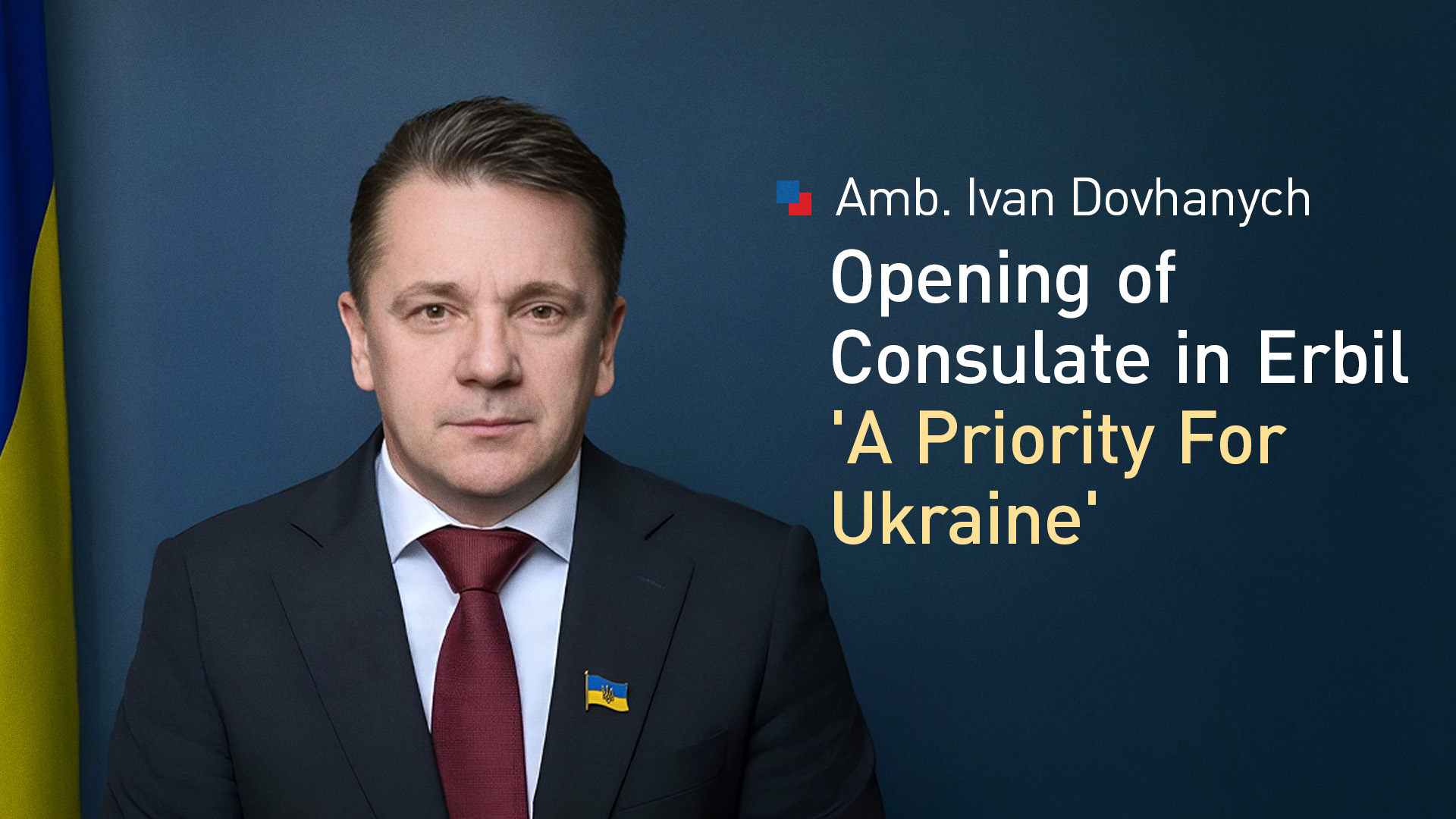
ERBIL (Kurdistan24) – Ukraine is advancing plans to open a consulate in Erbil, with a government decision already in place and formal approvals underway with Baghdad, the Ukrainian Ambassador to Iraq, Ivan Dovhanych, said in an interview with Kurdistan24 marking the fourth anniversary of the war with Russia.
Dovhanych described the consulate opening as "a priority for Ukraine," noting that the process involves procedural and bureaucratic steps that have caused delays. He expressed hope that the formation of a new Iraqi government would speed up the approval, adding that he anticipates attending the opening ceremony soon and believes the process is approaching its final stage.
In the interview, the ambassador highlighted Ukraine's relations with the Kurdistan Region as characterized by warmth and respect, grounded in shared experiences of struggling for survival, identity, and self-determination. He told Kurdistan24 that Erbil has emerged as a "key trade hub for Ukraine," where Ukrainian products are familiar and appreciated in the local market.
Dovhanych affirmed Ukraine's dedication to expanding this partnership while respecting the territorial integrity of a unified Iraq.
Turning to economic aspects, Dovhanych provided details on trade volumes between Ukraine and Iraq, including the Kurdistan Region. He said bilateral trade peaked at nearly $700 million in 2021 but declined to $293 million in 2022 after Russia's full-scale invasion.
By 2025, the figure rose to $392.8 million, reflecting a nearly 30% increase from 2024 despite wartime challenges.
The ambassador noted to Kurdistan24 that this recovery demonstrates Ukraine's economic adaptability, with the Kurdistan Region playing a vital role as a dependable partner and entry point for Ukrainian exports such as sunflower oil, food products, confectionery, and metals. He expressed confidence in future growth.
Dovhanych also discussed the Ukrainian community in Iraq. He estimated that up to 1,000 Ukrainian citizens reside in the country overall, with 219 adults specifically in the Kurdistan Region.
In the interview with Kurdistan24, he explained that the embassy keeps regular contact with these individuals and is ready to offer necessary consular services, emphasizing heightened attention during the ongoing war.
Shifting to the broader context of the conflict, which entered its fourth year on the date of the interview, Dovhanych outlined Ukraine's aspirations for resolution.
He told Kurdistan24 that Ukraine seeks a just peace founded on the rule of law rather than force, rejecting a ceasefire or frozen conflict in favor of a durable solution where the aggressor faces accountability and the victim receives protection.
The ambassador stated that four years of war have reinforced Ukraine's determination, asserting that a people defending their land and dignity will ultimately succeed.
On readiness for peace, Dovhanych said Ukraine has been prepared since the war's outset, attributing the conflict's start to Russia's choice. He identified Moscow's persistent aim to eradicate Ukraine as a sovereign entity as the chief barrier.
In speaking to Kurdistan24, he noted that Russia treats negotiations as a temporary halt for military regrouping, making authentic peace unattainable until realities are acknowledged: Ukraine's existence, its refusal to capitulate, and the inviolability of borders against armed coercion.
Addressing the possibility of territorial concessions for peace, the ambassador described such inquiries as anguishing for Ukrainians enduring devastation, lost lives, and occupied homes. He reaffirmed Ukraine's stance against legitimizing any occupation.
However, Dovhanych mentioned in the interview that President Volodymyr Zelensky has kept diplomacy viable, contingent on any accord featuring verifiable security guarantees to avert recurrence. Without these, he warned, an agreement would merely defer future hostilities.
Dovhanych detailed the war's profound impacts in his discussion with Kurdistan24. He said losses include tens of thousands killed, millions displaced, cities razed, infrastructure obliterated, and a generation stripped of normalcy, with no metrics fully encapsulating the toll.
Conversely, he highlighted gains: the forging of a highly experienced military, unprecedented national solidarity, expansion of the domestic defense sector, and global admiration for Ukraine's unyielding stance.
Among key lessons from the conflict, the ambassador listed to Kurdistan24 the imperative of independent security, as dependence on external assurances breeds vulnerability. He added that democracies must safeguard themselves via weaponry, intelligence, and resolve.
Dovhanych equated the information battlefield to kinetic warfare in lethality, and underscored that fighters motivated by existential stakes are invincible, as Ukrainians battle for their right to be.
The ambassador's remarks on the consulate plans underscore Ukraine's intent to bolster diplomatic presence in the region amid ongoing global challenges. He framed the initiative within the context of strengthening ties, noting procedural hurdles but optimism for resolution.
In elaborating on bilateral relations, Dovhanych emphasized mutual understanding derived from historical parallels, telling Kurdistan24 that this foundation supports practical cooperation. He avoided broader geopolitical commentary, focusing on trade and community support.
Trade statistics shared by the ambassador illustrate wartime disruptions followed by rebound, with specific figures highlighting resilience. He pointed to the Kurdistan Region's contribution without attributing causes beyond the invasion's effects.
Community details provided context for embassy operations, with Dovhanych stressing consular readiness in the interview.
On peace hopes, the ambassador's statements reflect Ukraine's principled position, reiterated in his responses to Kurdistan24. He contrasted Ukraine's openness with Russia's objectives, grounding obstacles in strategic realities.
Regarding concessions, Dovhanych's response to Kurdistan24 highlighted emotional and practical dimensions, linking diplomacy to Zelensky's conditions for security.
The account of losses and gains balanced devastation with progress, as conveyed in the discussion.
Lessons enumerated by the ambassador extend to self-reliance and multifaceted defense, shared directly with Kurdistan24.
Dovhanych's overall narrative in the interview ties regional engagement to national perseverance, without forward speculation.
The consulate development aligns with Ukraine's broader diplomatic efforts in Iraq.