Erbil Marks 35th Anniversary of 1991 Uprising Against Ba'ath Regime
Peshmerga and civilians united to liberate the city, with female martyr Khaja Bawa remembered as a symbol of Kurdish women’s resistance
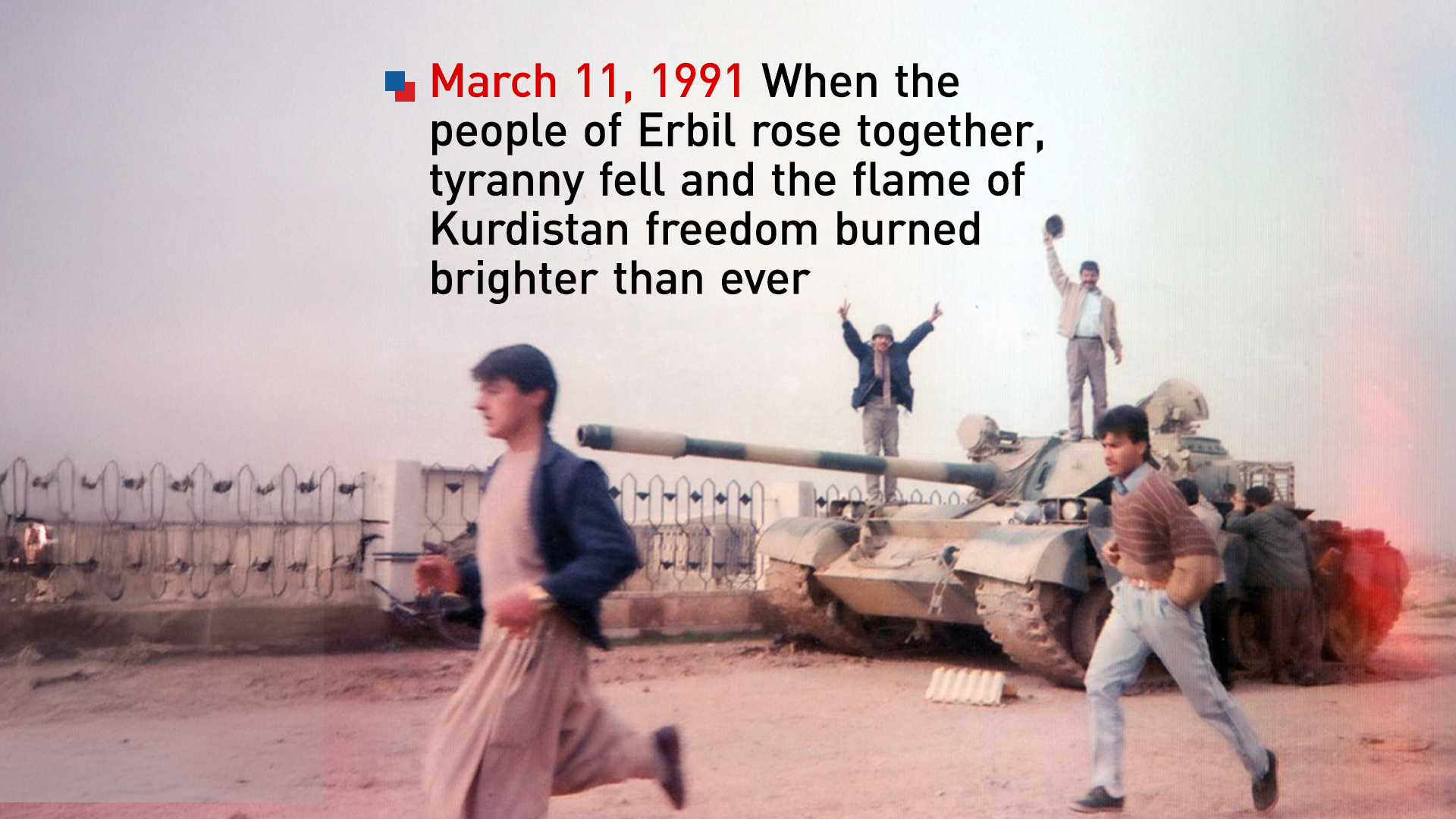
ERBIL (Kurdistan24) — Residents of Erbil are marking the anniversary of the 1991 uprising that saw civilians and Peshmerga forces overthrow the rule of the former Ba'athist regime in the city after decades of repression.
Thirty-five years ago, on March 11, 1991, the people of Erbil rose up against the authoritarian rule of the Ba'ath regime led by the dictator Saddam Hussein. Within a short period, residents—working alongside units of the Peshmerga—managed to seize control of the city and dismantle the regime’s security apparatus.
The uprising in Erbil formed part of the broader 1991 Kurdish Uprising, during which communities across northern Iraq revolted against Baghdad’s rule in the aftermath of the Gulf War.
Among those remembered from the uprising is Khaja Bawa, a Kurdish female activist from Erbil who is widely regarded as a symbol of the bravery and sacrifice of Kurdish women. She was killed during the uprising and is honored as a martyr of the Kurdish struggle.
The liberation of Erbil was made possible through years of resistance and the close coordination between civilian protesters and Peshmerga forces affiliated with the Kurdistan Front. Their cooperation intensified the uprising, allowing Kurdish fighters and residents to free the city in a matter of hours.
At the time, Erbil was one of the largest and most strategically important cities in the region, hosting numerous military, intelligence, and security facilities belonging to the Iraqi regime. Despite the heavy security presence, the uprising succeeded in dismantling these institutions.
The fall of Ba'athist authority in Erbil also had a powerful psychological impact across the Kurdistan Region, encouraging other communities in the other cities and towns to continue the uprising.
Following Sulaimani, Erbil became the second major city in the Kurdistan Region to break free from Ba'athist control during the uprising.
The rebellion came after years of suffering under brutal campaigns carried out by the regime, including the Anfal Campaign, chemical attacks against Kurdish areas, the destruction of more than 4,000 villages, forced displacement, and widespread repression.
For many Kurds, the events of March 1991 represented a turning point, as residents reclaimed their city and redefined it as a symbol of Kurdish national identity and resistance.
Today, Erbil stands as one of the most important political and economic centers in the Middle East, a transformation rooted in the historic uprising that reshaped the future of the Kurdistan Region.