Trump Says U.S. May Escalate Strikes if Iran Deal Fails
“If for any reason a deal is not shortly reached […] and if the Hormuz Strait is not immediately ‘Open for Business,’ we will conclude our lovely ‘stay’ in Iran by blowing up and completely obliterating all of their Electric Generating Plants, Oil Wells and Kharg Island,” Trump said.
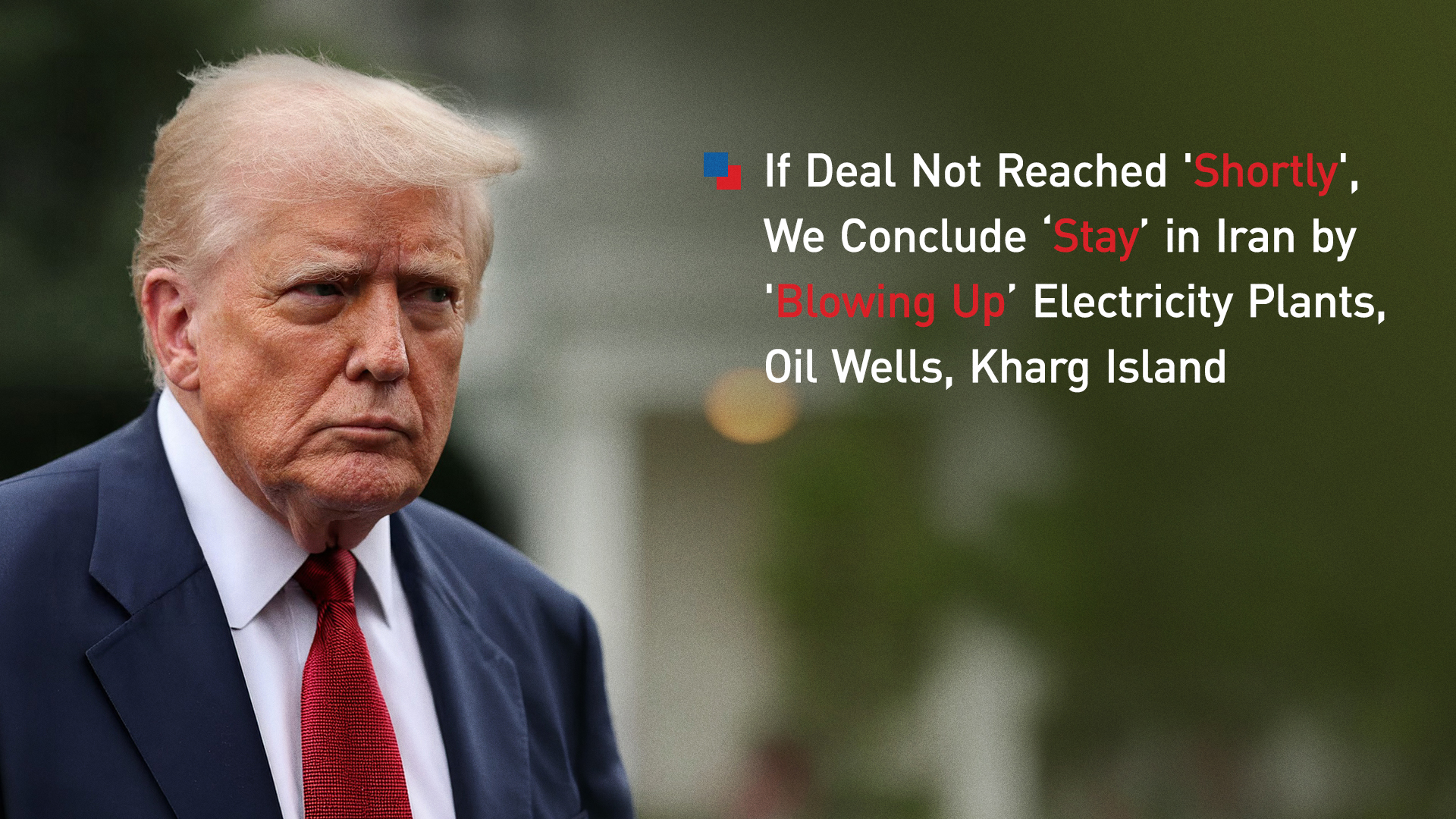
ERBIL (Kurdistan24) - U.S. President Donald Trump threatened Monday to destroy Iran's oil export hub of Kharg Island, along with its oil wells and power plants, if it does not soon agree to a deal to end the war, according to a post on his Truth Social network.
The warning came a day after Trump had sounded a more conciliatory tone, suggesting a deal could be reached this week and describing the current Iranian leadership as much more reasonable following what he called regime change achieved through U.S. military actions.
"Great progress has been made but, if for any reason a deal is not shortly reached, which it probably will be, and if the Hormuz Strait is not immediately 'Open for Business,' we will conclude our lovely 'stay' in Iran by blowing up and completely obliterating all of their Electric Generating Plants, Oil Wells and Kharg Island (and possibly all desalinization plants!), which we have purposefully not yet 'touched,'" Trump said in the post.
The president added that the United States is in serious discussions with a more reasonable regime in Tehran.
The remarks, issued on Monday, follow the U.S.-Israel-Iran war that was launched a month ago with Israel and have focused international attention on the trajectory of negotiations and military pressure.
Trump told reporters aboard Air Force One on Sunday that what he described as regime change had effectively occurred in Iran following recent U.S. military actions. The president stated that U.S. forces had carried out extensive strikes against Iranian military capabilities, asserting that multiple regimes within Iran had been decimated or replaced. “It truly is regime change,” Trump said, according to accounts of the press gaggle.
He added that the current group of Iranian representatives seem to be much more reasonable.
The president indicated that negotiations were advancing, describing them as very good and progressing very nicely. Trump noted that the United States was communicating with Iran both directly and through intermediaries. According to the president, Tehran had agreed to elements of a U.S.-proposed framework, which he described as a 15-point plan, and had already conceded most of the points.
The president detailed recent Iranian oil shipments as gestures linked to the negotiations. He said Iran had sent an initial group of 10 oil tankers and subsequently committed to sending an additional 20 vessels through the Strait of Hormuz.
“They gave us, I think out of a sign of respect, 20 boats of oil,” Trump said, adding that the shipments were scheduled to begin the following morning and continue over several days.
At the same time, the president outlined the scale of recent U.S. military operations. Trump stated that American forces had destroyed many, many targets and significantly degraded Iran’s naval and air capabilities. He said U.S. forces had knocked out their entire Navy and their entire Air Force, as well as most of their missile systems.
He added that while some missile attacks continued, Iranian capabilities were down to sputtering. The president did not provide independent verification of these claims but emphasized that the operations had advanced faster than anticipated.
“We’re weeks ahead of schedule,” he said, comparing the pace of military developments to progress in domestic construction projects he also discussed during the briefing.
Trump said that while he believed a deal with Iran was likely, it was not guaranteed.
“I do see a deal in Iran… could be soon,” he told reporters, while noting that negotiations with Tehran have historically been unpredictable. He reiterated his position that Iran must not acquire nuclear weapons, stating that U.S. actions had prevented such an outcome in the past and would continue to do so.
Addressing questions about Iranian leadership, Trump said that one figure believed to be associated with the country’s leadership may still be alive but was very seriously in trouble and seriously wounded. He did not provide further details or identify the individual beyond referencing earlier reports.
The president also addressed the strategic importance of the Strait of Hormuz, a critical global shipping route. When asked about reports that Iran might impose tolls or assert control over the passage, Trump said he would need to verify the information but emphasized U.S. capabilities in the region.
“We could close that up in two minutes,” he said, referring to the waterway.
Trump further stated that regional countries including Saudi Arabia, Qatar, the United Arab Emirates, Kuwait, and Bahrain were actively responding to Iranian actions. “They’re all fighting back,” he said, adding that the United States maintained strong communication with these governments and that they were 100 percent on our side.
In separate remarks during the same exchange, Trump addressed developments involving Cuba, describing the country as a failing country and predicting that it would be next in terms of requiring U.S. involvement. “Cuba’s going to be next within a short period of time,” he said, adding that the United States would be prepared to assist.
The president also commented on reports that a Russian oil tanker might be permitted to deliver fuel to Cuba. He said he had no objection to such shipments, regardless of origin. “If a country wants to send some oil into Cuba right now, I have no problem with it,” he said, arguing that such deliveries would have limited geopolitical impact and would primarily address humanitarian needs. “The people need heat and cooling,” he added.
Trump dismissed concerns that allowing Russian oil shipments to Cuba would benefit Russia, stating that the loss of a single shipment would not significantly affect Moscow. “He loses one boatload of oil. That’s all it is,” Trump said, referring to Russian President Vladimir Putin.
The remarks on Cuba and Russia were delivered alongside broader commentary on U.S. domestic and foreign policy issues, though Trump repeatedly returned to the situation in Iran as the central focus of his administration’s current priorities. “I’m more focused on Iran,” he said when asked about unrelated matters.
Throughout the exchange, the president maintained that recent military operations and diplomatic efforts were interconnected, describing a dual-track approach combining force and negotiation. He suggested that Iranian concessions, including the reported oil shipments and engagement with U.S. proposals, were the result of sustained pressure.
“They’re going to give up nuclear weapons,” Trump said, adding that Iran would comply with U.S. demands or face further consequences. “If they don’t do that, they’re not going to have a country,” he said.
Trump also characterized the current Iranian leadership structure as fundamentally altered compared to previous periods. He said the initial leadership group had been destroyed, followed by a second group that was also largely eliminated, leaving what he described as a third group now engaged in talks with the United States.
While the president framed these developments as evidence of success, he acknowledged the uncertainty inherent in negotiations with Iran. “You never know with Iran,” he said, noting that previous agreements had not always held.
The briefing included additional commentary unrelated to foreign policy, including discussion of a proposed ballroom project at the White House and domestic legislative issues. However, the president’s remarks consistently returned to the military and diplomatic situation involving Iran.
Officials have not released separate detailed statements corroborating the operational specifics cited by the president, including the scale of destruction of Iranian military assets or the exact terms of the reported negotiations and oil shipments.
The press gaggle concluded without further elaboration on timelines for a potential agreement or additional military actions, though Trump reiterated that discussions were ongoing and that further developments could occur soon.
The president’s remarks underscored the simultaneous pursuit of military operations and negotiations with Iran, alongside statements on regional security, oil shipments through the Strait of Hormuz, and U.S. positions on Cuba and Russia.
In closing, Trump reiterated that negotiations with Iran were advancing while military pressure continued, describing the situation as involving both active conflict and ongoing diplomatic engagement.