U.S. B-52 Bomber Flights Signal Air Dominance as War in Iran Enters Sixth Week
Fox News reports U.S. B-52 bombers are now operating over Iran, signaling growing American air dominance. The Stratofortresses, capable of heavy, sustained strikes, support broader operations amid Tehran explosions, missile attacks in the Gulf, and reports of a downed U.S. pilot.
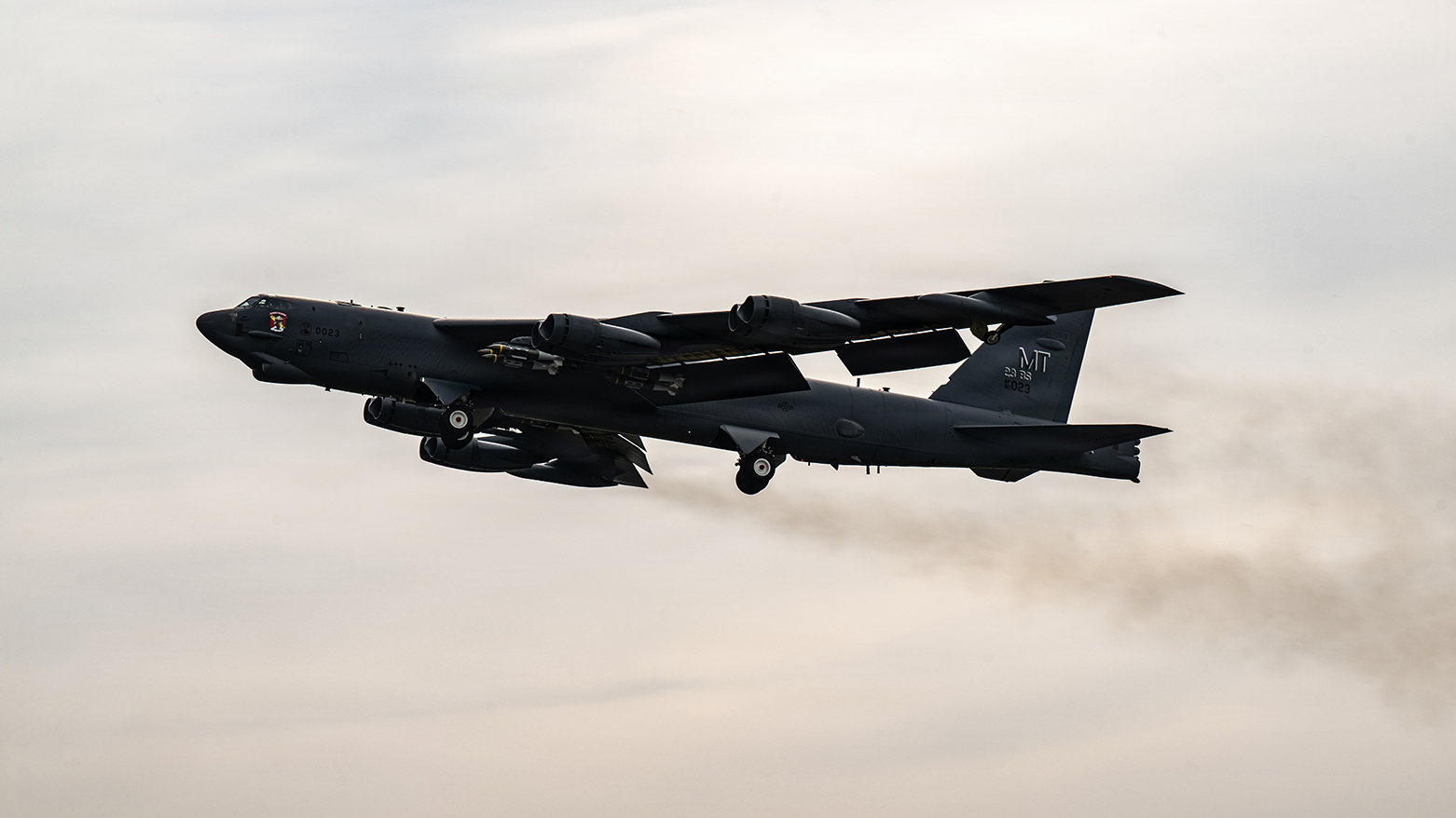
ERBIL (Kurdistan24) - Fox News reported Friday that U.S. B-52 bombers are now flying over Iran, describing the missions as an operational shift that reflects greater American control of the skies after weeks of strikes that have degraded Tehran’s air defenses.
In the report, Fox News said Chairman of the Joint Chiefs of Staff Gen. Dan Caine told a briefing Tuesday that the missions began “given the increase in air superiority,” while President Donald Trump said Thursday night that Iran’s air defenses had been “annihilated” and that U.S. forces were “unstoppable.”
The report, published under the headline “What B-52 bombers bring to Iran fight — and what it means for the war now,” said the change gives U.S. forces a broader and more flexible strike option than earlier stand-off attacks.
Fox News said the B-52 Stratofortress, first used during the Cold War and flown for about 70 years, allows the military to remain over the battlefield and strike multiple targets in a single mission, including mobile systems and hardened sites, according to Mark Gunzinger, a retired Air Force colonel and former B-52 command pilot quoted by the outlet.
Gunzinger told Fox News Digital that the bomber’s ability to stay on station marks a major difference from earlier phases of the campaign, when long-range cruise missiles were launched from outside Iranian airspace.
He said the aircraft can sustain strikes against targets as they emerge, rather than relying only on pre-planned attacks, giving commanders greater flexibility as operations continue. “The fact that these B-52s are now flying over Iran is clear evidence that we have air superiority — and even air dominance over parts of Iran,” Gunzinger said, according to Fox News.
Fox News said the bomber can carry up to 70,000 pounds of ordnance and is capable of delivering a wide range of weapons in the U.S. inventory, including gravity bombs, cluster bombs, precision-guided missiles and joint direct attack munitions.
The report described the aircraft as a platform built to deliver heavy payloads over long distances, a role that has become more relevant as U.S. operations have shifted from initial defensive suppression to broader strike missions.
Fox News noted that the aircraft’s size and range make it useful for sustained bombing campaigns, especially when multiple target sets may need to be hit in one sortie.
At the same time, Fox News pointed out that the B-52 is slower than modern aircraft and lacks stealth, which makes it more vulnerable to radar and air defenses under ordinary conditions.
That vulnerability has long kept the aircraft out of heavily contested airspace, the report said, but the current deployment over Iran indicates those defenses have already been weakened significantly. Fox News said the bomber’s use in this environment reflects how much Iran’s air defenses have been degraded by the ongoing campaign.
The outlet quoted military analyst Rebecca Grant as saying that B-52s flying in Iranian airspace show “America’s complete air dominance,” adding that the aircraft are supported by F-22 and F-35 fighters at high altitude.
Grant told Fox News Digital that the bombers bring large payloads for attacks on drone and missile factories, as well as underground targets. Her comments, like those of Gunzinger, framed the bomber deployment as part of a broader shift toward sustained, higher-volume strikes inside Iran.
Fox News also said the current use of the aircraft is part of a larger force posture that includes the transfer of B-52s to the region to support sustained operations if needed.
The report said that during the June 2025 strikes on Iran’s nuclear facilities, stealth B-2 bombers led the assault, dropping bunker-buster bombs on hardened sites such as Fordow and Natanz.
By contrast, the B-52s have been positioned to support the wider buildup and to keep pressure on Iran if the campaign intensifies further.
According to Fox News, the more recent deployment from RAF Fairford in Britain has seen B-52s carrying precision-guided bombs rather than only cruise missiles launched from standoff range.
The report said that change suggests U.S. control of the skies has improved enough to permit closer-range attacks. Fox News described this as a move beyond the initial phase of degrading Iran’s air defenses and into a phase in which U.S. aircraft can operate more freely over the country.
Gunzinger said the shift matters because bombers can sustain a bombing campaign in a way that fighters or launch platforms farther from the target cannot. He told Fox News Digital that if the objective is to damage Iran’s ability to launch missiles and drones, bombers are the type of aircraft the United States would want to use.
The retired colonel also said the U.S. is drawing heavily on its bomber fleet for the campaign, noting that the force totals 140 aircraft including B-2s, B-52s and B-1Bs, but that fewer than 50 are likely combat ready at any given time.
“That is a dramatic change since the end of the Cold War era, where we had over 400 bombers,” he said. “So we’re using a good percentage — I’d say a majority — of our combat capable bombers for this fight, to sustain this fight,” Fox News reported.
Fox News said Trump told the public Thursday night that the conflict had already lasted 32 days and that Iran’s military capability had been sharply reduced. “We are in this military operation … for 32 days,” he said, according to the report. “And the country has been eviscerated and essentially is really no longer a threat.”
The president also said strikes would continue as the campaign moved toward what he described as a final phase, with U.S. officials signaling that attacks could intensify in the coming weeks, according to Fox News.
The Pentagon could not immediately be reached for comment, Fox News said.
The report did not say whether all of the aircraft referenced were operating directly over Iranian territory at the same time or from supporting positions in the region, but it framed the deployment as evidence that the United States had moved beyond the early phase of the campaign and into a more permissive air environment.
Additional reporting from The Associated Press placed the bomber missions within a wider and still-expanding war. AP reported Friday that Iranian media claimed a U.S. fighter pilot had ejected over southwestern Iran and urged people in the area to help locate the crew.
The report said Iranian television called on residents to hand over any “enemy pilot” to police and offered a reward for anyone who did. AP said the U.S. Central Command, the Pentagon and the White House did not immediately respond to requests for comment.
AP also reported that Iranian state media published images and videos said to show parts of the downed plane and one of the ejection seats, which the footage suggested may have belonged to an F-15 fighter jet.
Iranian authorities also expanded the search area for the pilot, the report said, while local sources described helicopter searches in rural provinces. AP noted that the claims were not independently verified in the report.
At roughly the same time, AP said a major explosion from an airstrike struck Tehran, though it was not clear what had been hit.
The report also said Iran’s missiles had recently set alight a refinery and damaged a desalination plant in Kuwait, while the war continued to disrupt energy infrastructure across the Gulf and tighten pressure on shipping through the Strait of Hormuz.
AP said the conflict, now in its sixth week, is destabilizing economies and prompting warnings from several regional governments.
AP further reported that the United Arab Emirates said its air forces intercepted 18 ballistic missiles, four cruise missiles and 47 drones, and that at least 12 people were injured in Abu Dhabi after missile shrapnel fell in the Ajban area.
Elsewhere in the region, Israel said missiles had been launched from Iran toward its territory, and Bahrain said it intercepted drones, AP reported.
Humanitarian concerns have also been raised as the fighting has intensified. AP said Amnesty International warned that Iran has recruited children as young as 12 into the Basij force and said the practice puts them at grave risk as strikes continue to hit security sites and other facilities.
Taken together, the Fox News report and the AP coverage portray a campaign in which U.S. bombers are now operating more boldly over Iran while the broader conflict continues to spread across airspace, energy infrastructure and maritime routes in the region.